
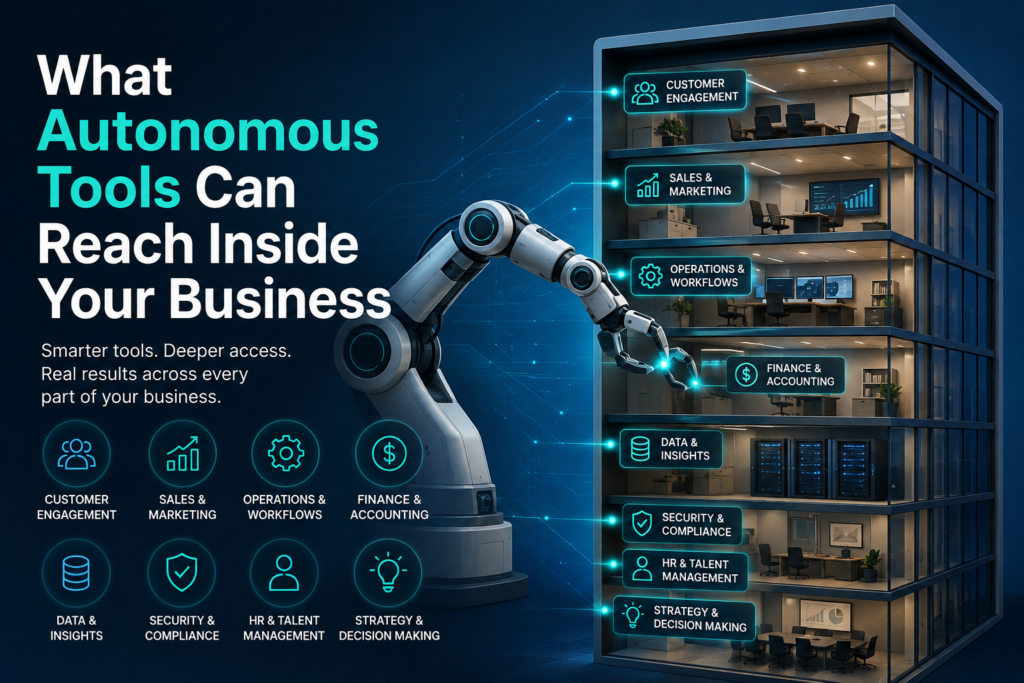
Every “connect your account” button is a door. Most businesses have opened far more of them than anyone remembers.
CRMs talk to ad platforms. Ad platforms talk to analytics. Analytics talks to a chatbot that talks to a spreadsheet nobody has opened in months. Each connection made sense on its own, at the time, to whoever set it up. Together, they form a map that almost nobody in the business could actually draw.
That’s not a knock on how these businesses are run. It’s just what happens when convenience wins, one login at a time, for years.
How Many Doors Are Actually Open
Small businesses run somewhere between 25 and 70 apps on a regular basis. Larger companies run into the hundreds. Each one usually has some level of access to customer data, financial records, or both, and that access rarely gets revisited once granted.
The riskier part isn’t the apps themselves. It’s the connections between them.
Every OAuth login and API token is a bridge one tool builds into another, and most of those bridges are invisible day to day. Nobody checks them the way they’d check a financial statement, because there’s rarely a single place that shows them all at once.
Researchers tracking this found that roughly 31 percent of breaches now trace back to exactly that kind of overlooked, app-to-app connection rather than a direct attack on the business itself.
Nobody sets out to build an unmanaged web of access. It happens one integration at a time, each one reasonable, none of them reviewed again after setup.
Agentic AI Identity Security Enters the Picture
The newer wrinkle is that some of these tools don’t just move data anymore. They act on it.
An AI agent that used to summarize a report can now file it, forward it, or trigger the next step in a workflow without anyone approving the individual action. That’s a meaningful shift from a business risk standpoint, and most companies haven’t caught up to it yet.
Sixty-eight percent of organizations say they lack basic identity security controls for the AI systems already operating inside their business. That’s not a future problem. Those agents are typically live now, connected to real accounts, with real permissions.
Ory, a company that builds identity infrastructure, treats every one of those agents as its own identity, not an extension of whoever set it up. That distinction matters. An agent with its own verifiable identity can be scoped, monitored, and cut off the moment it does something it shouldn’t. An agent quietly borrowing a staff member’s login can’t be, because nobody can tell the two apart in the logs.
What Actually Needs Reviewing

Most businesses could answer, off the top of their head, how many employees have keys to the office. Very few could answer how many tools have standing access to their customer list.
That gap is worth closing before it becomes a problem rather than after. A useful starting point is a simple audit: which tools are connected, what data each one can see, and whether that access still matches what the tool is actually used for today.
Old integrations are the easiest place to find waste. A marketing tool a business stopped using eighteen months ago often still has an active token quietly sitting in an admin panel, untouched and unreviewed. Removing it takes minutes. Finding it in the first place is the actual work.
Newer AI-driven tools deserve a second look specifically. If a tool can take action on its own, rather than just displaying information, it deserves the same scrutiny a new employee would get on day one. What can it touch. What can it change. Who gets notified if it does something unusual. Those three questions catch most of the real risk, and none of them require a security team to answer.
Closing the Doors You Forgot Were Open
None of this means turning off integrations or refusing to adopt AI-driven tools. Both are genuinely useful, and pulling back entirely isn’t realistic for a business trying to stay competitive.
It does mean treating access the way most businesses already treat cash: something with a clear owner, a visible record, and a reason it still exists. A tool that made sense to connect a year ago deserves the same second look a subscription renewal gets.
The businesses that get ahead of this aren’t the ones with the fewest tools. They’re the ones who can actually say, with confidence, what every single one of them is allowed to reach.