

HubSpot published its internal performance data on topic clusters after restructuring roughly 12,000 blog posts into a pillar-and-spoke content model. The results were striking: Domain Authority climbed from 49 to 60, and clicks on target keywords increased by more than 500%. Those numbers have been cited in dozens of SEO guides since. What rarely gets discussed is the structural logic behind the shift, why it worked at that scale, and whether the same approach translates to an Australian SME publishing two pages a month instead of two hundred.
This is a dissection of that case and what it actually means for smaller sites trying to build site structure topical authority without a 50-person content team.
Twelve Thousand Posts and a Ranking Ceiling
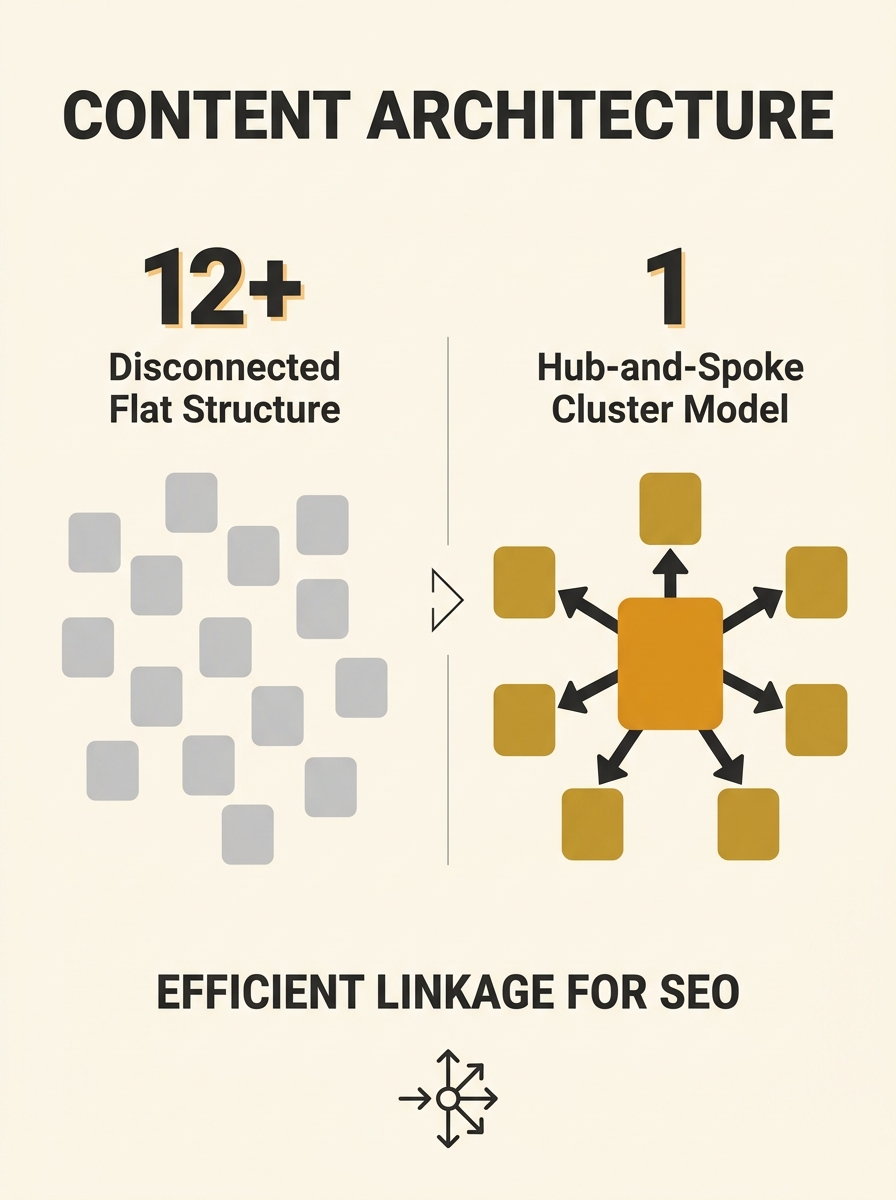
Before the restructure, HubSpot’s blog operated the way most content-heavy sites still do: each post targeted a keyword, lived in a flat archive, and competed with every other post on the domain for internal authority. The blog had massive volume but suffered from what SEO practitioners call keyword cannibalisation — multiple posts competing for the same queries, diluting each other’s ranking potential.
The problem was architectural. Google’s crawler couldn’t easily determine which page on HubSpot’s domain was the definitive resource for, say, “email marketing” versus the fifteen other posts touching the same subject from different angles. Internal links existed, but they were ad hoc. There was no hierarchy telling the crawler (or the reader) where to start and where to go deeper.
This is a familiar pattern for Australian SMEs, even at much smaller scale. A business with 40 blog posts can run into the same structural issue if those posts overlap in topic without clear parent-child relationships. If you’ve published content that should rank but doesn’t, and your on-page SEO looks fine, the cause is often how your site architecture distributes authority across pages.
The Pillar-and-Spoke Rebuild
HubSpot’s restructure followed a hub and spoke content model. The team identified core topics central to their business — things like “email marketing,” “SEO,” “social media marketing” — and created a single pillar page for each. These pillar pages were long, detailed overviews (typically 2,500–4,000+ words) that covered the broad topic and linked out to more specific cluster pages.
Each cluster page focused on a subtopic — “email subject line best practices” or “email deliverability troubleshooting” — and linked back to its parent pillar. The pillar linked down to each cluster page. Cluster pages linked laterally to each other where relevant.
As Animalz explains in their breakdown of hubs versus pillars, the distinction matters. A pillar page is a single, usually very long piece of content covering a topic in depth. A hub page is lighter — it acts as a navigation point linking out to spoke pages where the real depth lives. HubSpot used a hybrid: their pillar pages had substance on their own but also served as navigation hubs.
The internal linking wasn’t random. Every link used descriptive anchor text that told Google what the target page was about. If you’re working on this for your own site, the principles behind choosing anchor text for internal links apply directly here. Generic phrases like “click here” or “read more” waste the signal.
Three structural rules governed the rebuild:
- Every cluster page linked back to its pillar using consistent anchor text
- The pillar page linked to every cluster page in its topic group
- Cluster pages linked to sibling pages within the same cluster where the content naturally connected
This created a clear topical map that Google could crawl and understand. The crawler didn’t have to guess which page was authoritative on a topic — the link structure made it explicit.
Google’s crawler couldn’t determine which page was the definitive resource when fifteen posts covered the same subject from different angles. The fix wasn’t better content. It was better architecture.
Five Hundred Percent More Clicks, and What Held the Gains
The performance shift after the restructure was significant. Domain Authority moved from 49 to 60. Target keyword clicks increased by over 500%. But the more telling metric was durability: clustered content maintained rankings 2.5 times longer than standalone posts had previously.
Why did rankings hold? Because content clustering SEO creates a reinforcing loop. When Google identifies a site as authoritative on a topic — what the industry calls topical authority — new pages published within that cluster inherit some of that authority. They rank faster and hold position longer because the domain has already proven expertise in the area.
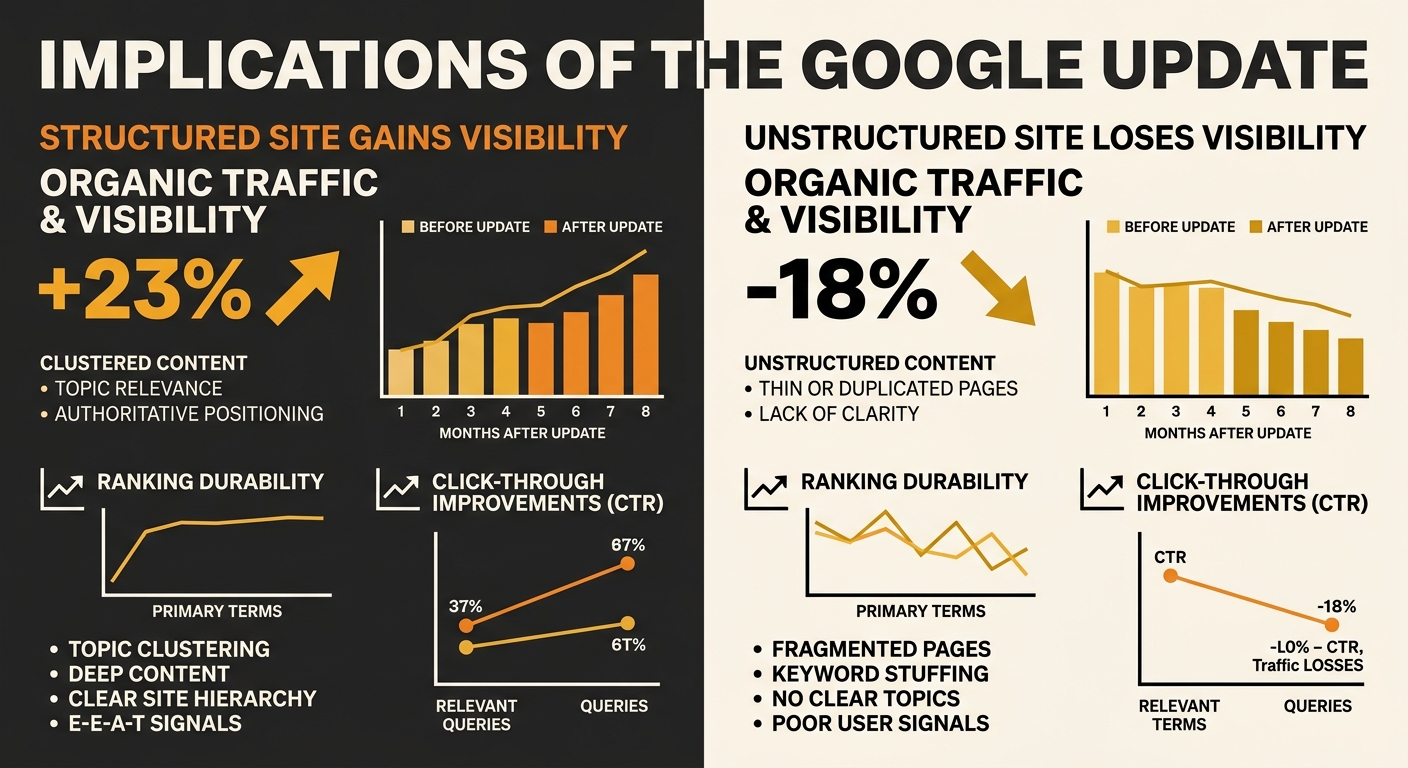
Google’s December 2025 Helpful Content Update reinforced this pattern across the industry. Sites with well-structured topic clusters gained an average of 23% in organic visibility, while sites covering unrelated topics without clear structure lost approximately 18%. The update explicitly rewarded depth and coherence over breadth and randomness.
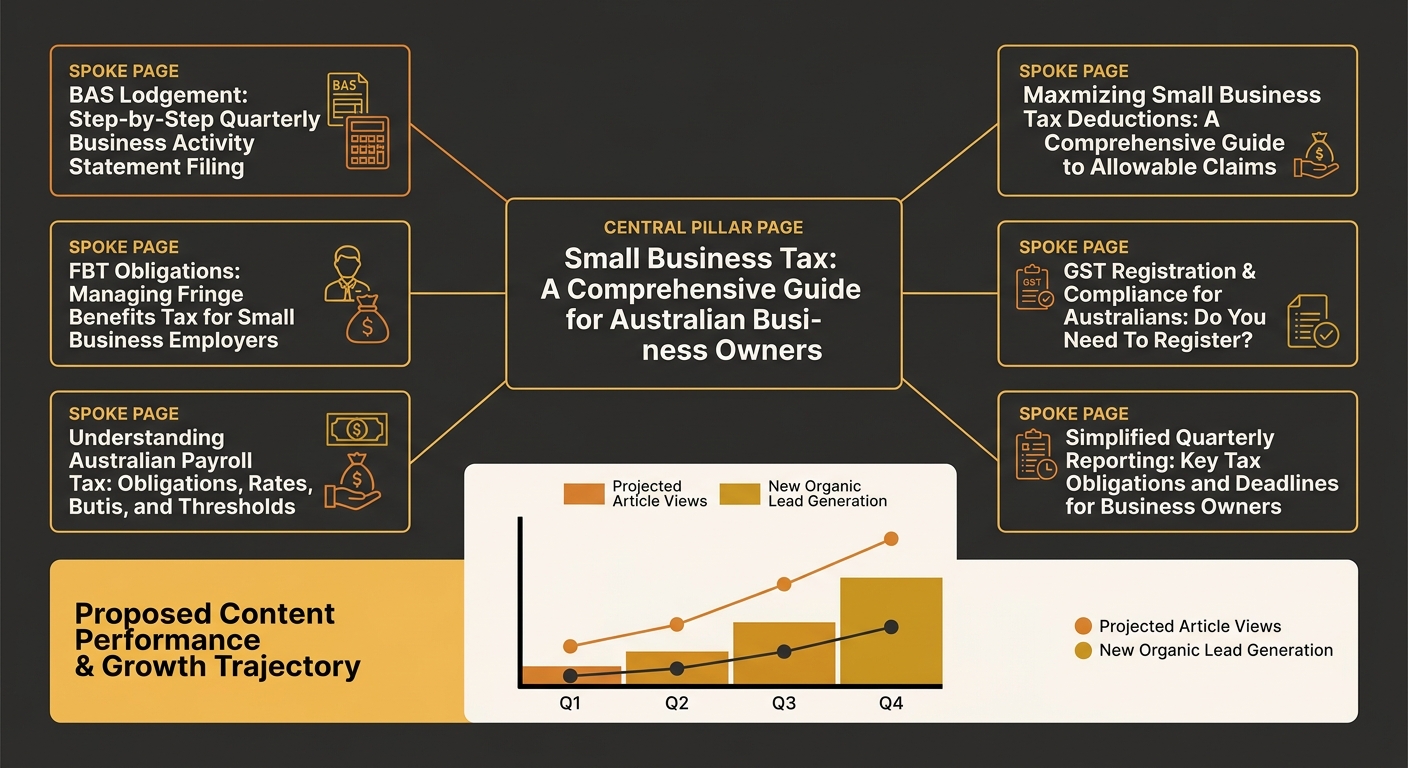
For Australian SMEs, this shifts the competitive advantage away from raw publishing volume toward structural intelligence. A local accounting firm with 30 well-clustered pages about small business tax obligations can outrank a generalist content mill with 300 loosely related articles. If your content demonstrates genuine expertise and your site architecture makes that expertise legible to crawlers, you’re building a pillar page strategy Australia’s competitive landscape rewards.
The AI search angle reinforces the case. Google AI Overviews now appear in 30% of search results and 74% of problem-solving queries. Surfer SEO data shows pages ranking for “fan-out” sub-queries — the 12–15 sub-questions AI systems generate when processing a query — are 161% more likely to be cited in AI Overviews. Topic clusters naturally align with this: the pillar answers the main query while cluster pages address sub-questions. If you’re thinking about how AI-generated summaries affect your SEO priorities, clustering is one of the most practical structural responses available.
Where the Model Fractures at Smaller Scale
HubSpot had a content team of dozens, an existing library of 12,000 posts to reorganise, and the resources to produce pillar pages exceeding 3,000 words. An Australian SME with a marketing manager who also handles social media and event coordination doesn’t have that luxury. The adaptation challenge shows up in three places.
Pillar page depth. According to Orbit Media’s 2025 Blogger Survey, 39% of marketers publishing content over 2,000 words report strong results, compared to 21% for shorter content. But writing a 3,000-word pillar page requires research, structure, and editing time that smaller teams often can’t justify for a single piece. The practical answer: your pillar page should be as long as the topic demands, not as long as HubSpot’s. A 1,500-word pillar that genuinely covers the core topic and links thoughtfully to cluster pages will outperform a padded 4,000-word piece full of filler.
Cluster page volume. A topic cluster needs enough supporting pages to demonstrate depth. Three is a minimum; five to eight is more effective. For a small team, this means committing to a single cluster topic for months before moving to the next one. Publishing without a coherent content architecture leads to the same scattered coverage that clustering is supposed to fix.
Credibility signals. Clustering handles structure, but Google’s E-E-A-T requirements mean each page also needs to demonstrate real expertise. SE Ranking and Profound research found that pages with 19 or more data points average 5.4 AI citations, versus 2.8 for pages with minimal statistics. For SMEs, this means citing industry data, including original analysis, and showing genuine practitioner knowledge. Running a trust signals audit can reveal where your site’s credibility gaps undermine the authority your content structure is trying to build.
If you’re running an online store, the same clustering logic applies to product categories and buying guides. Structuring your ecommerce SEO around product clusters — a pillar guide to a product category linking to individual product pages and comparison content — creates the same architectural advantage HubSpot built with their blog.
Tip: Start with your highest-revenue topic, not your broadest one. An Australian SME gets more value from deeply clustering “commercial lease accounting” (if that’s what pays the bills) than from trying to cover all of “small business finance” at once.
The Compounding Arithmetic of Two Pages Per Month
Siteimprove’s analysis of content clustering outcomes notes that the strategy starts with planning — picking the right topic, building strong content around it, and connecting everything with purpose. For Australian SMEs, “planning” means accepting a slower timeline than enterprise teams while understanding that the maths still works.
Google interprets consistent publishing as a signal of editorial investment. Sites publishing one to two quality cluster pages per week build authority significantly faster than those doing burst publishing. But even two quality pages per month compound meaningfully over 12 to 18 months. That’s 24 to 36 pages — enough for three to four complete topic clusters, each with a pillar and five to eight supporting pieces.
The HubSpot case demonstrates the ceiling of what content clustering SEO can achieve at scale. The lesson for smaller sites is to replicate the structure, not the volume. Pick one topic your business knows deeply. Build the pillar page. Publish one supporting piece at a time. Link them together with intention. Then pick the next topic and repeat.
The sites that struggled after the December 2025 update weren’t necessarily small. They were scattered — covering dozens of tangentially related topics without depth in any of them. The sites that gained ground had narrower focus and clearer internal architecture, regardless of their size. An Australian SME with a tight content cluster on a topic it genuinely understands will build more durable search visibility than a larger competitor publishing generalist content across every keyword it can find. That’s the structural advantage worth building toward, and it doesn’t require a twelve-thousand-post library to start.