

A free tool released June 23 captures the traditional web searches ChatGPT and Gemini execute in the background when generating responses, according to Search Engine Journal. QueryFan generates persona-specific prompts, runs them through both models, and records the exact queries each AI triggers—revealing which search rankings actually determine AI citation visibility.
TL;DR: QueryFan shows the hidden Google and Bing searches AI models perform when users ask questions, exposing the real ranking targets for businesses seeking AI-generated citations.
The mechanism Search Engine Journal describes is Retrieval Augmented Generation. When a user asks ChatGPT or Gemini a question, the model performs traditional searches on Google or Bing, retrieves the top-ranking pages, and synthesizes an answer from that content. Sites ranking for those background queries get cited; sites that don’t rank remain invisible.
Reddit Citation Collapse Proved the Dependency
Reddit’s citation rate in ChatGPT responses collapsed from 15% to below 2% on September 10, 2026, when Google removed the num=100 parameter from its search API. The parameter allowed bulk retrieval of 100 search results simultaneously.
Search Engine Journal reported that Reddit’s visibility in ChatGPT tracked Google’s bulk-search capabilities rather than any content update or model alignment change. ChatGPT was bulk-pulling Google search results; Reddit dominated those results; when bulk retrieval disappeared, Reddit’s citations vanished.
The episode revealed that AI search visibility depends on traditional search rankings. The AI synthesis layer is real—conversational coherence, personalization, multi-turn context—but the information retrieval step queries existing search indexes.
How the Tool Captures Background Queries
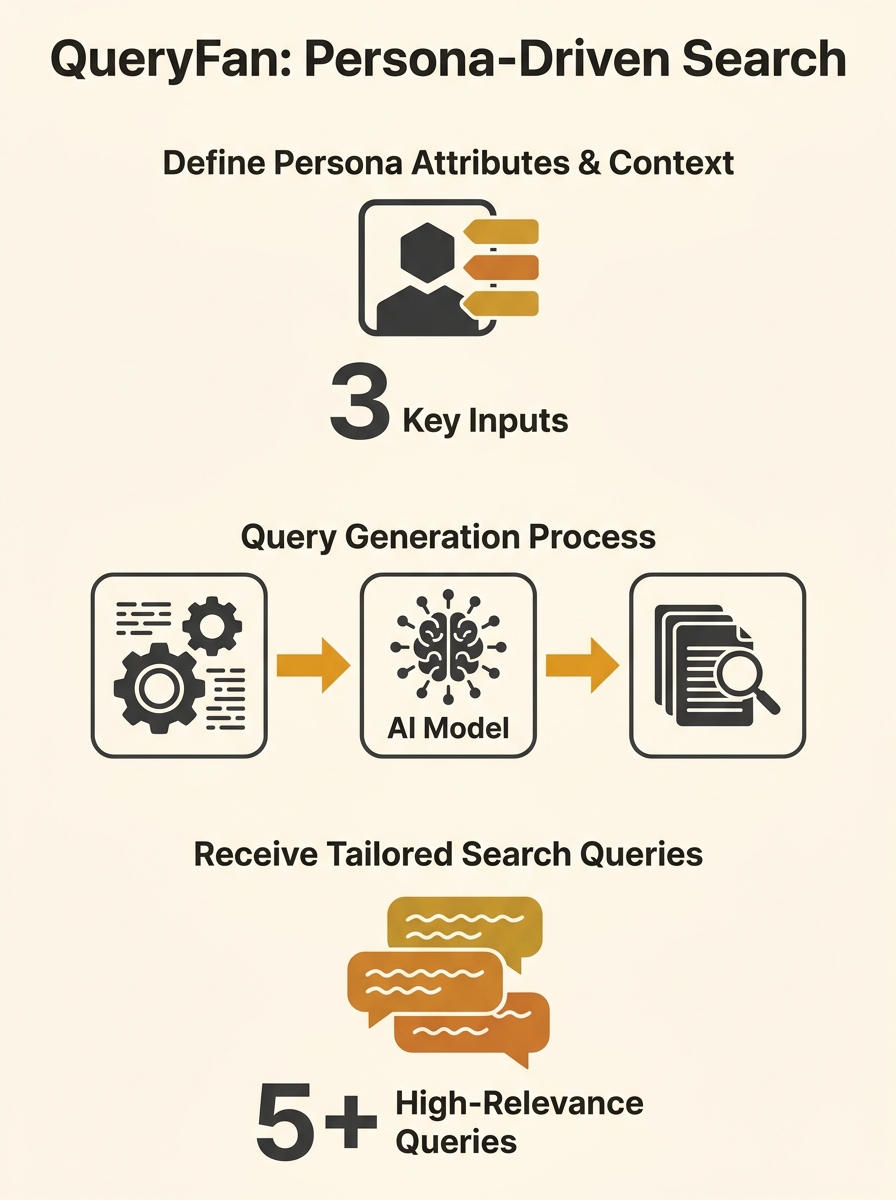
QueryFan operates in three steps. Users enter a topic keyword and define user personas—demographic or behavioral profiles such as “middle-aged vegan man who just started running.” The tool sends that persona-topic combination to the target LLM to generate conversational questions that persona would ask, not single-shot keywords.
For the running-shoes example, QueryFan produces prompts like “Which vegan running shoes are good for middle-aged men just starting to run?” and “Where can I buy vegan running shoes online in the UK?” It then runs those prompts through ChatGPT and Gemini while capturing the actual web searches each model executes in the background.
The output is a list of traditional search queries the AI models used to build their responses. Those queries become the ranking targets for businesses seeking citation visibility.
The Optimization Gap Between User Prompts and Model Queries
Search Engine Journal noted three structural differences between user prompts and the searches AI models execute. LLM prompts tend to be longer, multi-faceted, and conversational; traditional searches are narrower. LLM conversations carry context from previous exchanges; traditional searches are independent. AI models personalize their background searches based on prior user context—if a user previously stated they are vegan and asks about running shoes, the model searches for vegan running shoes.
Australian SMEs optimizing for AI-generated answers face a shifted target. The optimization goal is no longer matching what users type into a chat interface. It is ranking for what the AI agent quietly searches on the user’s behalf.
QueryFan’s persona-generation layer addresses this gap. By simulating how different user types would phrase questions, the tool maps the token space AI models traverse when interpreting broad topics. A “running shoes” keyword becomes dozens of persona-contextualized searches the AI would actually execute.
The Takeaway
QueryFan makes visible a retrieval mechanism most users don’t know exists. ChatGPT and Gemini are not searching their training data when they generate answers—they are searching Google and Bing in real time, then citing the pages that rank. Reddit’s citation collapse on September 10 when Google disabled bulk-result pulls confirmed the dependency.
Australian businesses optimizing for AI visibility cannot rely on traditional keyword lists alone. The conversational, context-rich prompts users send to AI models decompose into narrower, persona-specific searches in the background. Those background queries—not the user’s original question—determine which sites get cited. QueryFan captures that list for free, shifting the optimization target from guessing what users ask to knowing what the AI actually searches.
The tool’s release comes as Google extends Preferred Sources into AI Overviews, creating earned-visibility channels outside traditional ranking. Businesses that rank for the hidden queries QueryFan exposes gain citation access; those that don’t remain invisible regardless of prompt optimization.