
Content Architecture for SEO: How to Structure Your Site for Better Rankings and User Experience
Sites with shallow, well-organised architectures rank 47% higher on average for their target keywords than those with deep, disorganised structures, even when domain authority and backlink profiles are comparable. That figure, drawn from an analysis of 50,000 websites, makes the case plainly: how you organise your content matters as much as the content itself.
The reason is mechanical. Search engines crawl websites by following links from page to page. When important pages sit buried four, five, six clicks from the homepage, they receive less crawl attention, less link equity, and less indexing priority. Users face the same friction. If someone can’t find what they came for within a few seconds of navigating your site, they’ll leave and try the next result. Content architecture SEO addresses both problems simultaneously by giving your site a logical skeleton that search engines can parse and humans can follow.
The Three-Click Rule and Why It Still Holds
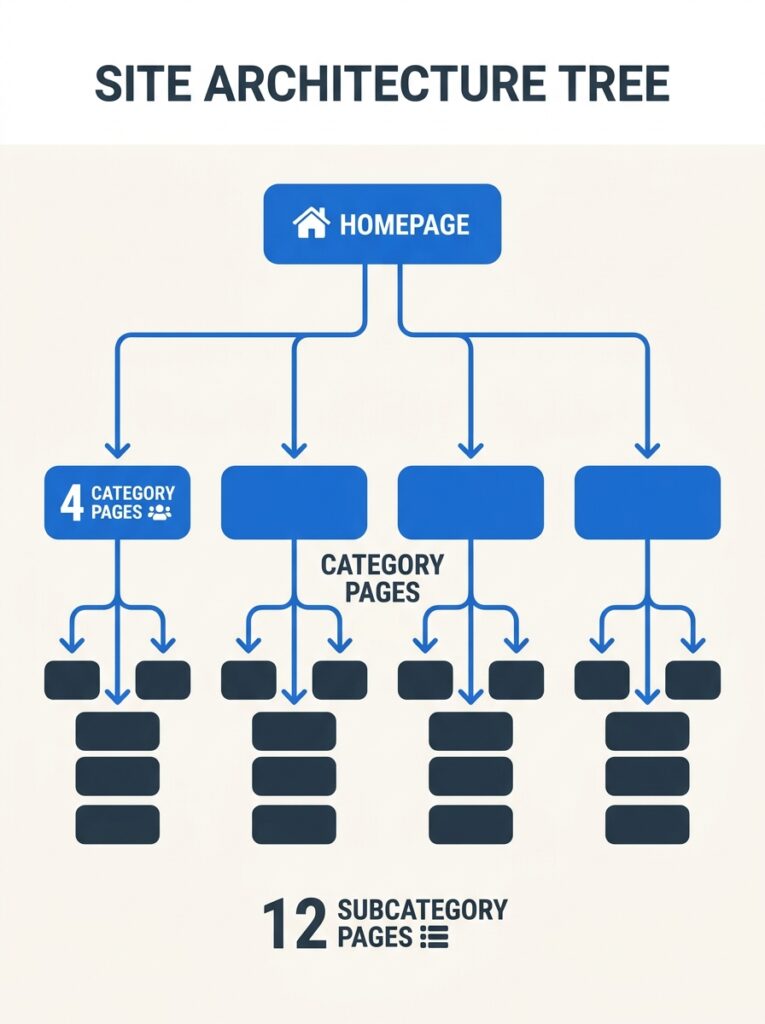
The principle is straightforward: no important page on your site should be more than three clicks from the homepage. This keeps your architecture flat rather than deep, which has two practical effects. First, Googlebot and other crawlers discover pages faster. Second, link equity flows more efficiently from high-authority pages (typically your homepage) down to the pages you actually want to rank.
A flat architecture doesn’t mean dumping everything into one level. It means grouping content into logical categories that branch outward without stacking too many layers. Think of it as a tree with a wide canopy rather than a tall, narrow trunk.
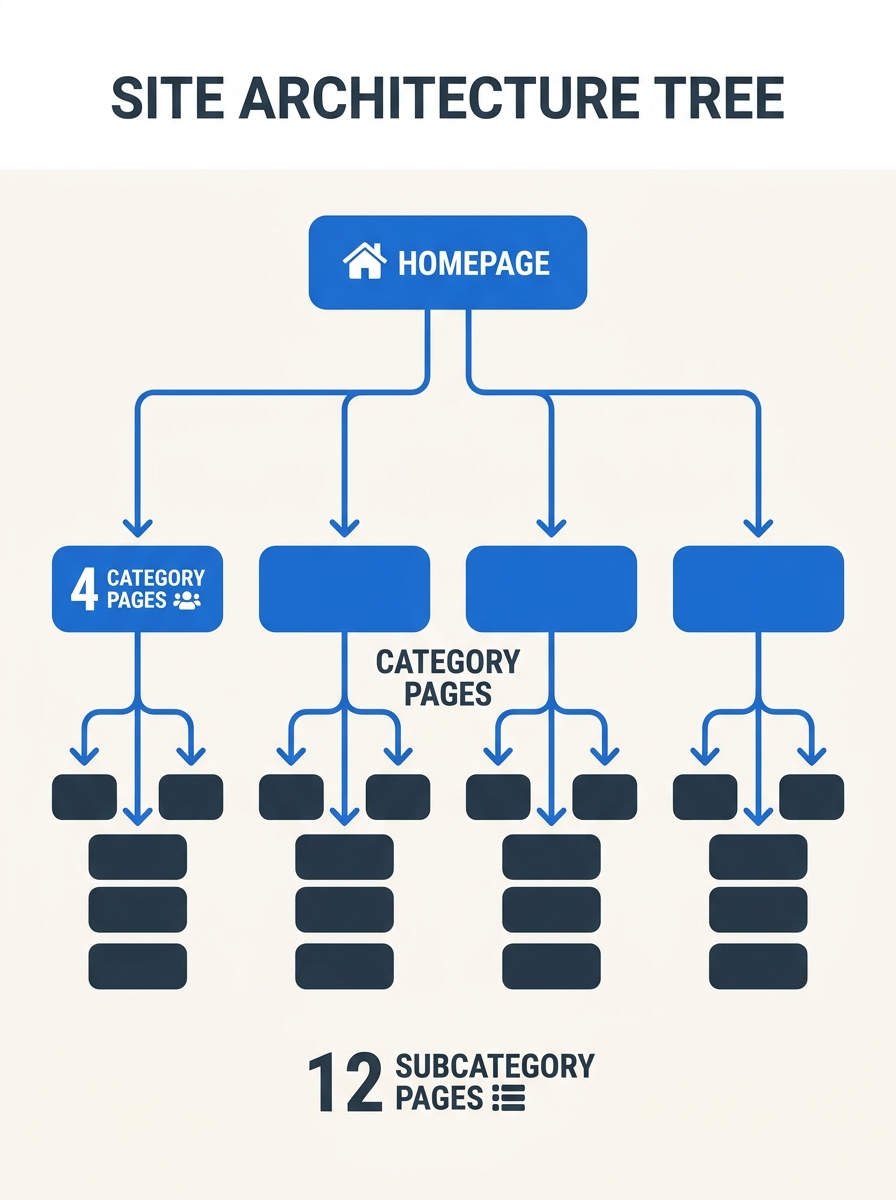
When you’re planning a site migration, preserving this shallow structure is one of the highest-priority items. Migrations that accidentally deepen the click path to key pages routinely cause ranking drops that take months to recover from.
Topic Clusters and Content Silos
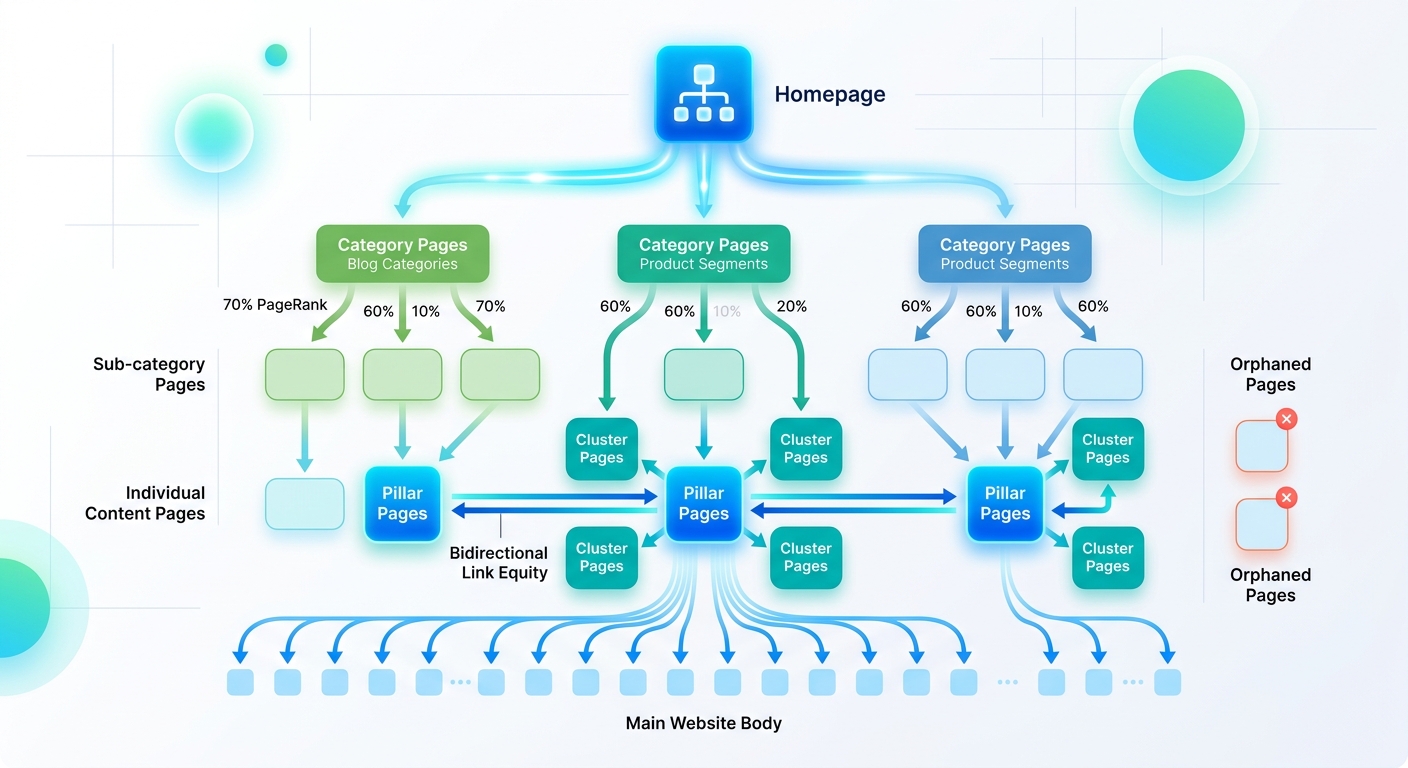
The dominant model for content organisation in 2026 revolves around topic clusters. A pillar page covers a broad subject in depth and links to a set of related cluster pages that explore individual subtopics. Those cluster pages link back to the pillar. Internal links flow both ways, reinforcing the topical relationship.
For example, an e-commerce site selling outdoor gear might have a pillar page on “Hiking Boots” that links to cluster pages on waterproofing, ankle support, trail types, boot care, and sizing guides. Each cluster page links back to the pillar. Google sees this web of related content and recognises the site as a genuine authority on hiking boots, which helps every page in the cluster rank higher for related terms.
Content silos take a similar approach but add stricter boundaries. Within a silo, pages link primarily to other pages in the same thematic group, with controlled cross-linking between silos to avoid diluting topical focus. The distinction between clusters and silos is largely academic for smaller sites; what matters is that related content is grouped together and interconnected through purposeful links.
Tip: Audit your existing content before building clusters. You likely already have pages that belong together but aren’t linked. Connecting them is often faster and more effective than creating new content from scratch.
Internal Linking Strategy That Actually Moves Rankings
Internal links do two jobs: they help users navigate and they distribute link equity across your site. According to Moz’s best practices on internal linking, pages with a high number of incoming internal links are treated as authoritative by search engines and can pass that equity onward.
The most common mistake is treating internal linking as an afterthought. Pages get published with no inbound links from anywhere else on the site, creating what’s known as orphaned pages. An analysis by Americaneagle.com identifies orphan detection as a critical step in any internal link audit. If search engines can’t find a page through links, they may never index it at all.
Practical guidelines for an effective internal linking strategy:
- Every page should have at least one internal link pointing to it.
- Use descriptive anchor text that tells both users and search engines what the target page covers. Choosing the right anchor text for your internal links is worth getting right, since generic phrases like “click here” or “read more” waste an opportunity to signal relevance.
- Link from high-authority pages (those with strong external backlinks or high traffic) to pages you want to boost.
- Update older content to include links to newer pages. This is the step most teams skip, and it’s arguably the most valuable.
If search engines can’t find a page through links, they may never index it at all.
Metadata, Taxonomy, and Search Optimisation
Taxonomy is the system of categories, subcategories, and tags you use to classify your content. Good taxonomy does two things: it gives users intuitive pathways to find what they need, and it gives search engines a clear signal about what each section of your site covers.
According to Figma’s guide on information architecture, effective taxonomy classifies content into clear, standardised categories, subcategories, and tags. A thoughtful taxonomy helps users find what they need without guessing.
Metadata taxonomy search optimisation works best when your categories map to real search intent. If people search for “running shoes for flat feet,” your taxonomy should have a category or tag structure that groups content around that concept, rather than burying it under a generic “Footwear” label with no further subdivision.
A few principles for getting taxonomy right:
- Be specific but not granular to the point of absurdity. A tag that applies to only one page isn’t a useful tag. A category that contains 500 pages isn’t a useful category.
- Use consistent naming. If one category is “SEO Tips” and another is “Search Engine Optimisation Advice,” you’re splitting what should be one bucket into two.
- Revisit taxonomy quarterly. As your content library grows, the categories that made sense with 30 pages may not work with 300. Machintel’s research on content taxonomy emphasises continuous assessment and refinement as business goals evolve.
Metadata at the page level, including title tags, meta descriptions, and structured heading hierarchies (H1, H2, H3), reinforces taxonomy by telling search engines how individual pages fit into your broader content organisation for rankings. Clean, readable URLs that reflect your hierarchy (such as /category/subcategory/page-name) perform better than parameter-heavy alternatives.
Breadcrumbs, Schema, and the Technical Layer
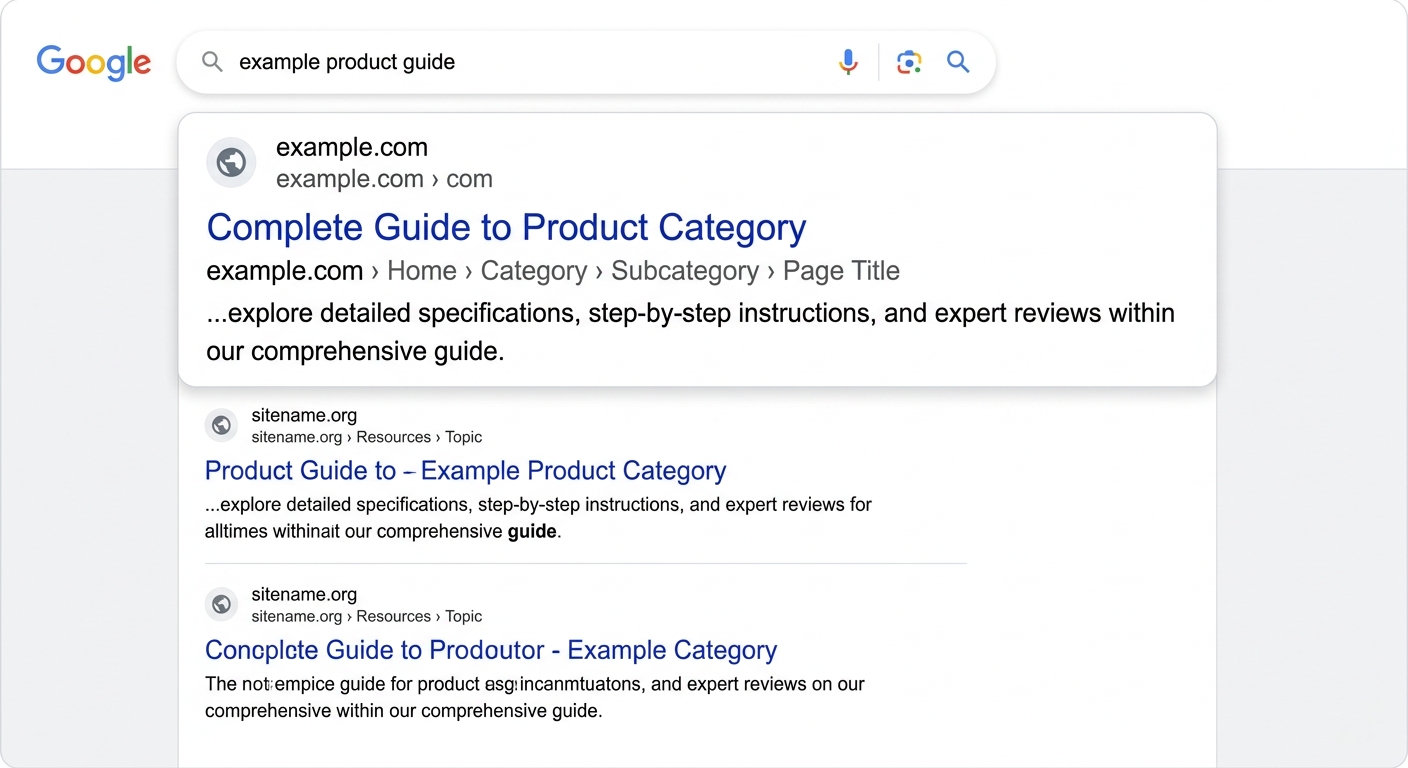
Breadcrumb navigation shows users where they sit within your site’s hierarchy. It’s a small UX detail with outsized SEO value. Breadcrumbs appear as rich snippets in search results, which improves click-through rates. They also create additional internal links that reinforce your site structure for search engines.
Pairing breadcrumbs with structured data markup through Schema.org’s BreadcrumbList type ensures Google displays them correctly in SERPs. This is one of those website structure ranking factors that takes 20 minutes to implement and pays dividends for years.
For larger sites with tens of thousands of pages, crawl budget becomes a genuine constraint. Faceted navigation on e-commerce sites can generate millions of URL variations that waste Googlebot’s time on low-value pages. Managing this through robots.txt directives, canonical tags, and careful parameter handling keeps the crawler focused on the pages that matter. If you’re running a Shopify store, our guide on e-commerce SEO fundamentals covers these technical considerations in detail.
Structuring Content for AI-Driven Search
Google’s AI Overviews and tools like ChatGPT Search pull information from pages that are well-structured and clearly organised. Content that uses clear heading hierarchies, answers specific questions directly, and includes structured data is more likely to be cited in AI-generated summaries.
This means content architecture now serves a third audience beyond users and traditional crawlers: AI extraction systems. Pages formatted with FAQs, comparison tables, and logically ordered sections give these systems clean data to work with. Writing in natural, conversational language while maintaining structural clarity is the balance to aim for.
The Open Threads
Several questions remain genuinely unsettled in how content architecture SEO will evolve. As zero-click results continue to grow, the relationship between site structure and organic traffic may shift in ways that are difficult to predict. Sites that optimise heavily for featured snippets and AI overviews sometimes find that Google answers the user’s question without sending a click at all.
The role of taxonomy in voice search and multimodal search is another area without clear best practices yet. When someone asks their phone a question, the underlying content architecture determines whether your page gets surfaced, but the signals that matter most for voice results versus traditional results versus AI citations aren’t fully documented.
What is clear, and has been for some time, is that the underlying structure of your site determines the ceiling for everything else you do in SEO. Quality content published into a disorganised architecture is like stocking a shop with excellent products but removing all the signage and shuffling the aisles at random. The products are still good, but nobody can find them. Getting the architecture right is the prerequisite that makes every other SEO effort more effective.