
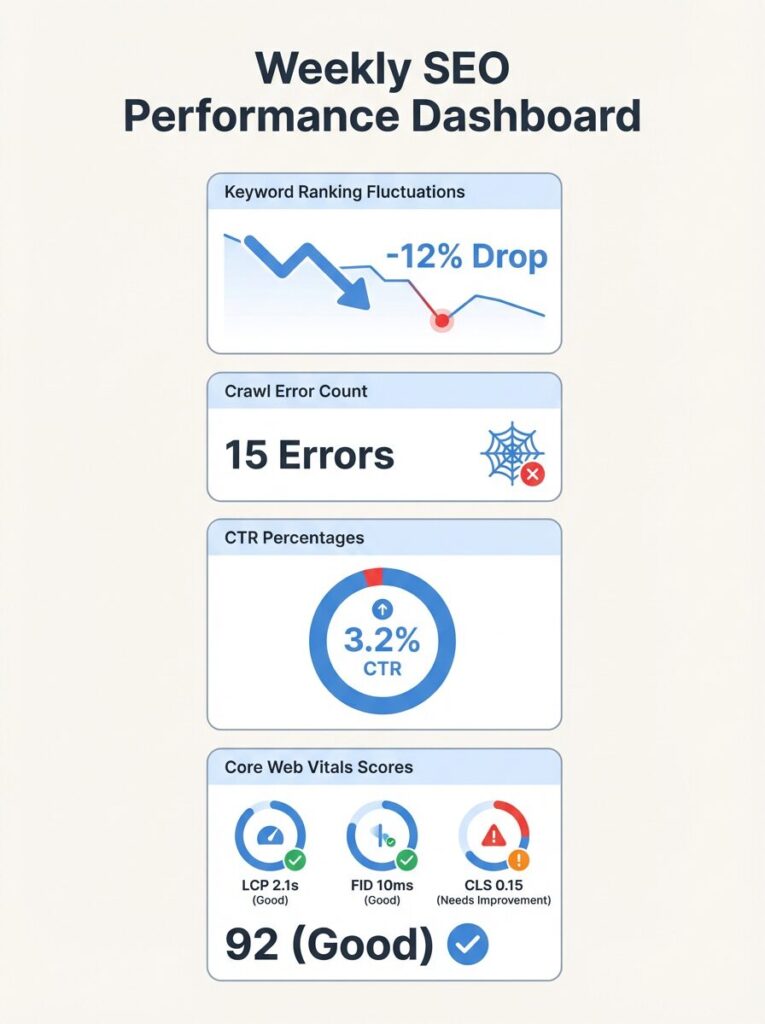
Structured weekly SEO monitoring detects ranking problems and technical faults roughly 42% faster than monthly-only reporting, according to agency research from Search Engine Land. For Australian small businesses operating with thin margins and tighter teams, that speed gap can mean the difference between catching a traffic drop on day three and discovering it on day twenty-eight, after a full month of lost enquiries.
The reason this matters so much is that SEO data behaves differently depending on how often you look at it. Some metrics shift meaningfully within days. Others need a full 30-day window before the signal separates from the noise. Choosing the wrong SEO performance monitoring schedule leads to one of two problems: you either react to normal fluctuations that would have corrected themselves, or you sit idle whilst a genuine issue compounds. Both cost money.
This article lays out a practical framework for deciding what to check weekly, what to review monthly, and how to build a small business SEO tracking dashboard that fits an Australian SME’s resources.
What Belongs in a Weekly Check
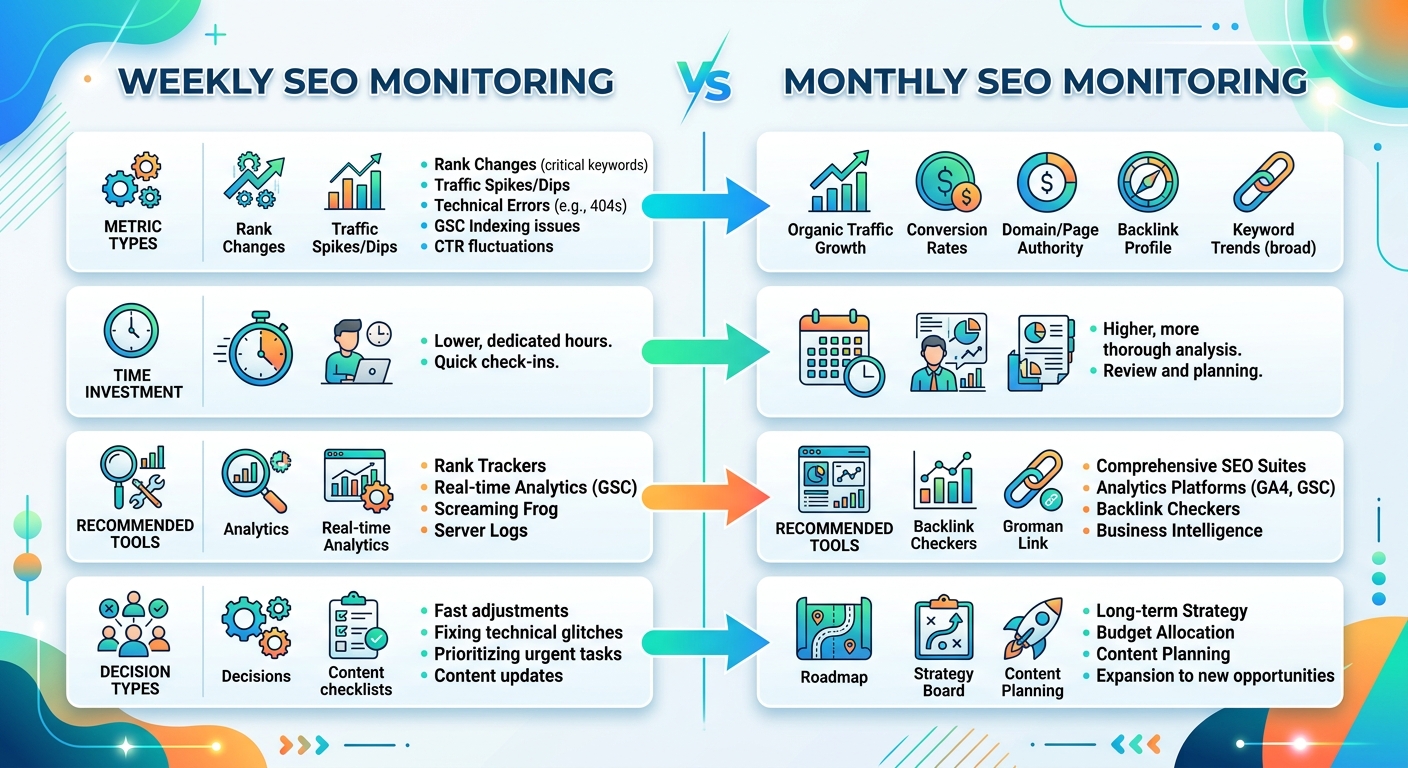
Weekly monitoring should take 30 to 45 minutes. That’s it. You’re scanning for anomalies and early signals, not writing a strategy document. The goal is triage: spot anything that needs immediate attention, note trends worth watching, and move on.
According to the SEO benchmarking guide from Factors.ai, weekly checks should focus on critical changes only — major ranking shifts, technical errors, and traffic anomalies. Everything else can wait.
Here’s what to include in your weekly review:
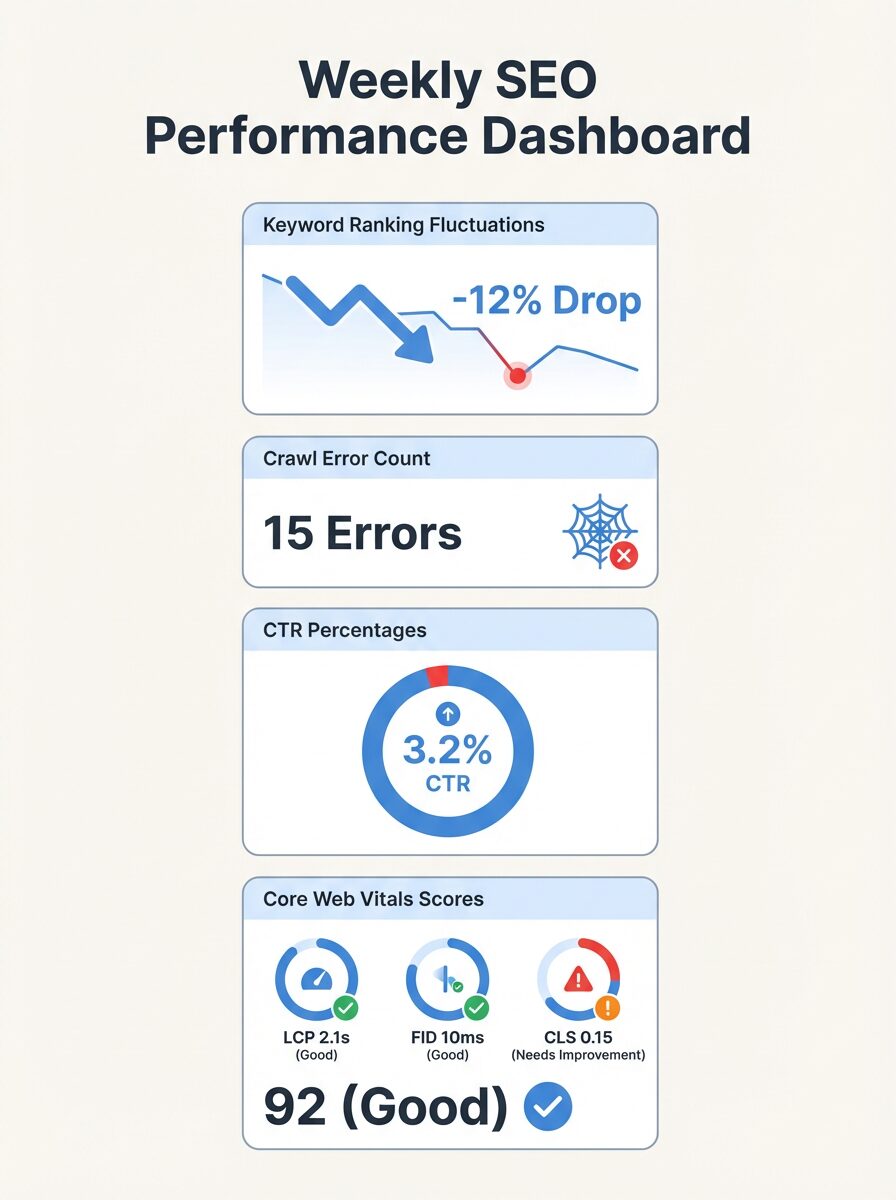
- Keyword ranking movement on your top 10 to 20 priority terms. You’re looking for sudden drops of five or more positions, not small fluctuations.
- Crawl errors and indexing issues from Google Search Console. New 404s, server errors, or pages suddenly excluded from the index need attention before they snowball.
- Click-through rate changes on your highest-traffic pages. A CTR drop on a page that hasn’t changed often signals a competitor’s new SERP feature or a title tag that’s lost relevance.
- Core Web Vitals alerts, particularly if you’ve recently pushed site changes.
Notice what’s absent from the weekly list: backlink counts, domain authority scores, and conversion rates. These metrics don’t move meaningfully in seven days. Including them weekly creates noise that obscures real signals.
If you’re managing local SEO services for a bricks-and-mortar business, add one more weekly item: check your Google Business Profile for new reviews, Q&A submissions, and any edits Google has suggested. Unreviewed profile edits can quietly change your business hours or categories.
What Belongs in a Monthly Review
The monthly review is where you assess performance against targets and make strategic decisions. A 30-day window gives search engines enough time to index content updates, process technical fixes, and reflect genuine ranking movements.
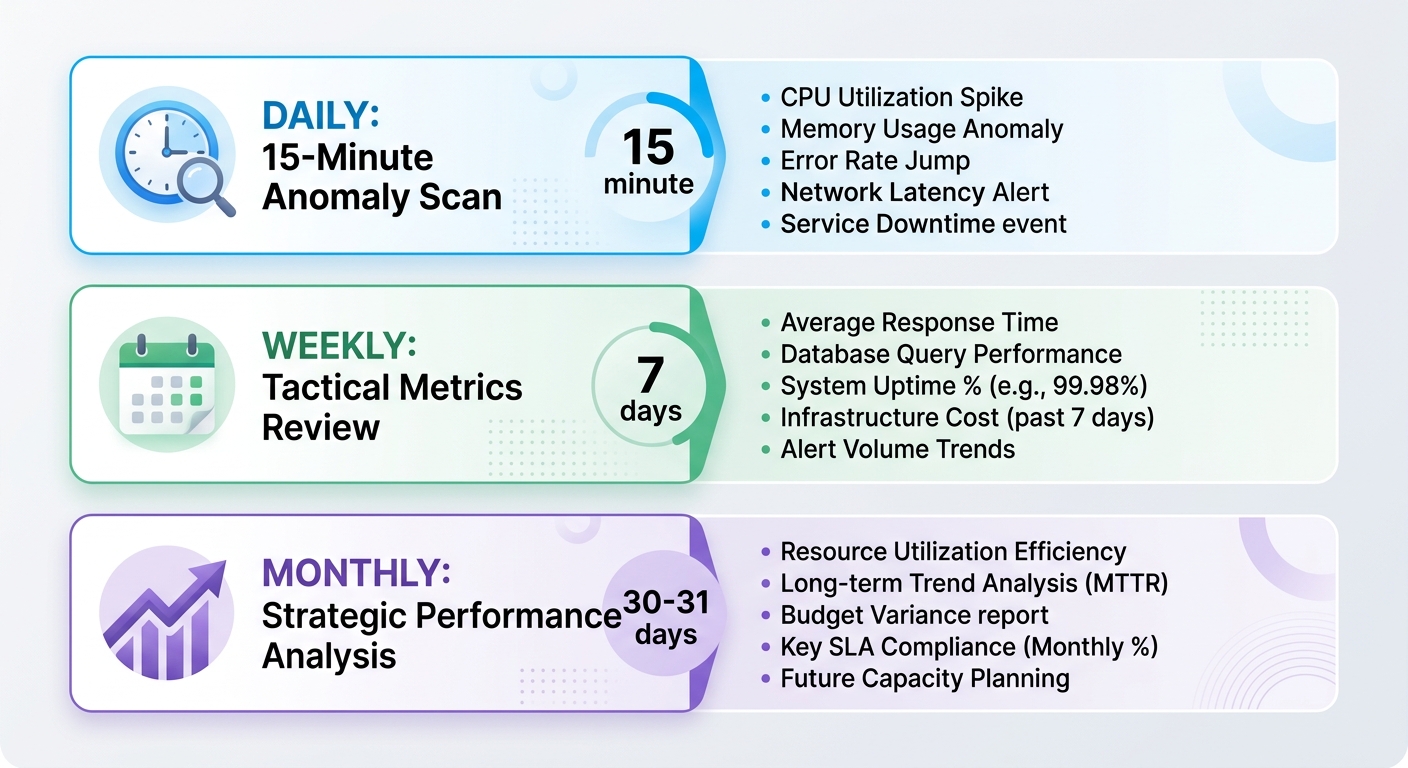
Industry benchmarking research recommends a tiered cadence: weekly rank checks, monthly traffic and conversion reviews, and quarterly benchmark comparisons against your industry. The monthly layer is where business impact becomes visible.
Your monthly review should cover:
- Organic traffic trends in Google Analytics 4, segmented by device and geography. For Australian businesses, segment by state if you serve multiple markets.
- Search visibility and total impressions from Google Search Console, compared to the previous 30-day period.
- Conversion rate from organic search. As Traffic Think Tank’s KPI guide notes, conversion rates are among the first KPIs most businesses track regardless of growth stage, and they’re essential for monthly performance comparison.
- Backlink profile changes — new links gained, links lost, and any toxic domains that have appeared.
- Content performance on pages published or updated during the period.
- Revenue or lead attribution from organic channels.
This is also when you should annotate your data with any algorithm updates Google rolled out during the month. If you’ve ever needed to recover from a Google algorithm update, you’ll know how valuable those annotations become when you’re trying to explain a traffic dip six months after the fact.
The monthly review is where you shift from “what happened” to “what should we do about it.” Weekly data informs tactics; monthly data shapes strategy.
Building a Dashboard That Works for SMEs
The biggest trap with dashboards is overbuilding them. Enterprise-grade tools offer dozens of widgets, and the temptation is to display everything. For a small business, a cluttered dashboard becomes a dashboard nobody opens.
A practical small business SEO tracking dashboard should fit on a single screen (or a single scroll on mobile) and answer three questions:
- Are we getting more or less organic traffic than the previous period?
- Are our priority keywords moving in the right direction?
- Is anything broken that needs fixing this week?
Tools Worth Considering
Google Search Console and Google Analytics 4 are free and cover roughly 70% of what an Australian SME needs. For the remaining 30%, you’ll want a rank tracking tool. SE Ranking, Semrush, and Ahrefs all offer dashboard views that pull in data from multiple sources.
If you’re building a dashboard for a team or reporting to a business partner, tools like Looker Studio (free) let you combine Search Console and GA4 data into a single visual report. Automated reporting through platforms like Swydo or DashThis can reduce the time spent on monthly reports from hours to under 30 minutes per client.
Setting Your Benchmarking Cadence
The right benchmarking cadence for SMEs depends on two factors: how competitive your market is and how actively you’re making changes to your site.
If you’re publishing new content twice a week and running an active link-building campaign, weekly monitoring is essential because you need fast feedback on what’s working. If your site is relatively stable and you’re making one or two updates a month, a fortnightly check of weekly SEO metrics Australia businesses typically track may be sufficient, with a deeper monthly dive.
Tip: Set calendar reminders for your weekly and monthly checks. Consistency matters more than sophistication. A simple spreadsheet reviewed every Friday beats an elaborate dashboard that gets ignored.
Quarterly, step back further. Compare your metrics against industry benchmarks, audit your site’s technical health from scratch, and review whether your keyword targets still reflect how your customers actually search. An SEO strategy review at this interval helps ensure your monitoring is pointed at the right goals, not outdated ones.
Where AI Visibility Fits Into Monitoring
Google’s AI Overviews and third-party AI search tools like Perplexity have added a new layer to SEO tracking. Traditional rank tracking doesn’t capture whether your content appears in AI-generated summaries, which increasingly sit above standard organic results.
We’ve covered what AI Overviews mean for search visibility in detail elsewhere. For monitoring purposes, the practical step is to add a small set of priority queries (50 to 100) and check weekly whether your brand or content appears in AI-generated answers. Tools for tracking AI citation authority and brand mentions are maturing quickly, and several now integrate with existing SEO dashboards.
This is still an emerging metric, and the tools aren’t as reliable as traditional rank trackers. But ignoring AI visibility entirely means you’ll miss a growing share of how Australians discover businesses through search.
Avoiding Common Monitoring Mistakes
Three patterns consistently trip up small businesses:
Reacting to weekly data with monthly-scale decisions. A keyword drops three positions on Tuesday, so you rewrite the page on Wednesday. By Friday, the keyword has recovered on its own. You’ve wasted time and potentially disrupted a page that was performing well. Weekly data should inform a watchlist, not trigger immediate rewrites.
Ignoring mobile performance. Australian mobile search traffic regularly exceeds desktop for local and service-based queries. If your dashboard doesn’t segment by device, you could be missing problems that affect the majority of your visitors. Understanding how mobile-first design connects to technical SEO helps you interpret those numbers in context.
Tracking vanity metrics instead of business metrics. Domain authority, total indexed pages, and social shares are interesting but rarely correlate directly with revenue. Prioritise metrics that connect to enquiries, phone calls, and sales. Measuring content marketing ROI properly means tying your organic traffic data back to actual business outcomes, not just traffic volume.
The Open Threads
Several questions don’t have clean answers yet. How much weight should AI visibility carry relative to traditional rankings in your dashboard? The data is too young to benchmark confidently. Should Australian SMEs invest in real-time monitoring tools, or is a weekly cadence fast enough for businesses without dedicated SEO staff? The answer likely depends on the pace of your market — a competitive e-commerce niche needs faster feedback loops than a suburban accounting firm.
What is clear: the businesses that build a consistent monitoring habit, even a basic one, outperform those that check their analytics sporadically and react emotionally to whatever number surprises them. Pick a schedule, build a dashboard that fits your team’s capacity, and stick with it. The discipline matters more than the tooling. If you’re unsure where to start, a short engagement with professional SEO services can establish the right baseline metrics and reporting structure before you take over ongoing monitoring yourself.