
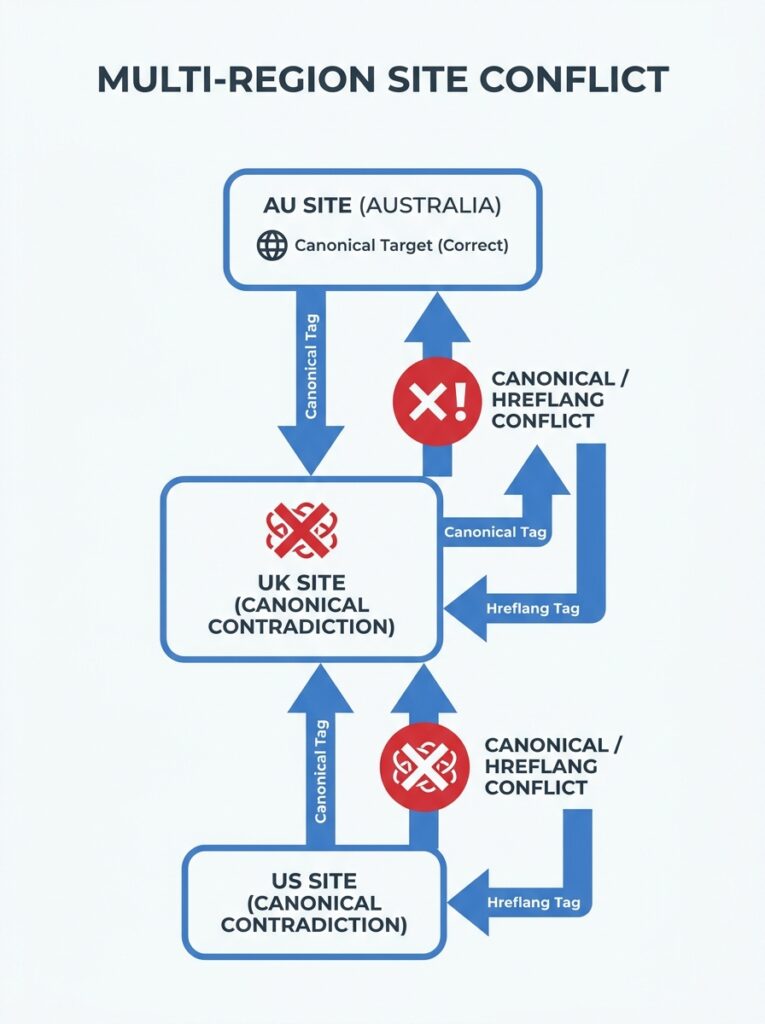
Google’s documentation on consolidating duplicate URLs states it plainly: “Don’t specify different URLs as canonical for the same page using different canonicalization techniques.” That single instruction breaks more multi-region Australian sites than any algorithm update ever has. When your AU, NZ, UK and US storefronts send conflicting signals about which page is the “real” one, Google resolves the ambiguity on its own terms. The Australian version tends to lose.
What follows is a chronological walkthrough of how this problem develops, how it escalates, and what the international SEO cannibalization fix actually looks like when you trace it from first mistake to resolution.
How the Conflict Starts
The typical multi-region site structure for an Australian business begins sensibly enough. You’ve got a primary domain — say, example.com.au — and you expand into the UK and US markets. You set up subdirectories: /au/, /uk/, /us/. The product pages carry the same descriptions, adjusted for currency and a handful of spelling differences. “Colour” becomes “color.” Prices shift from AUD to GBP to USD. Maybe the shipping information changes.
At this stage, someone on the development team adds canonical tags. They point every regional variant back to the /au/ version because it’s the “original” content. The logic feels sound: avoid duplicate content penalties by telling Google which version matters.
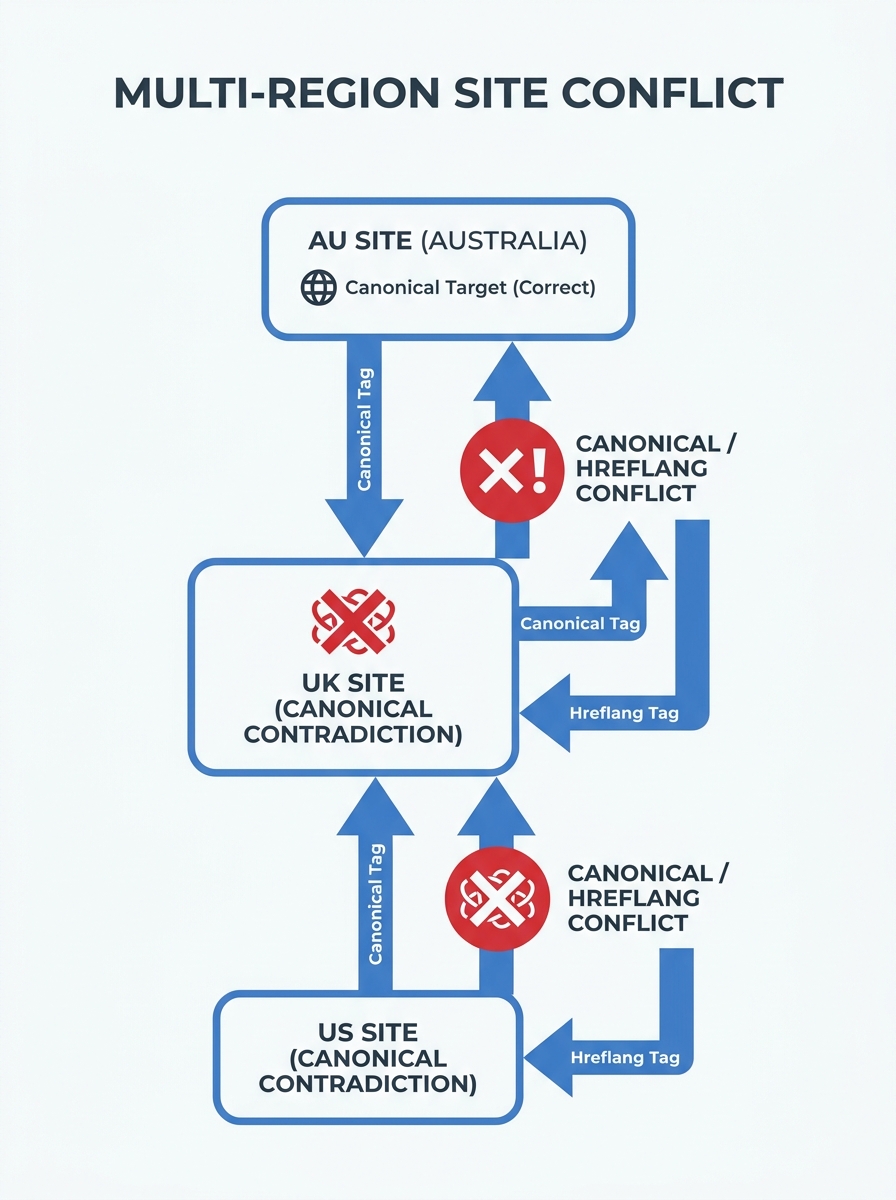
Then someone else — perhaps an SEO consultant brought in later — adds hreflang tags to indicate that /uk/ is for en-GB users and /us/ is for en-US users. Now the site is telling Google two contradictory things simultaneously. The canonical says: “The AU page is the master copy, everything else is a duplicate.” The hreflang says: “These are distinct regional pages serving different audiences.”
Google receives both signals and treats neither as reliable.
When Google Picks the Wrong Country
The first sign of trouble usually appears in Google Search Console. You’ll notice the AU version of a product page ranking in google.co.uk, or the UK version showing up for Australian searchers. Your impressions might look healthy in aggregate, but click-through rates drop because users see the wrong currency, the wrong spelling, or shipping terms that don’t apply to them.
This is textbook international SEO cannibalization. Both the AU and UK pages target substantially similar keywords — because they describe the same product — and Google, confused by the conflicting canonical and hreflang signals, picks one version and suppresses the others. The suppressed pages don’t disappear from the index entirely, but they stop appearing in the SERPs where they should.
If you’re running an online store, this directly undercuts your e-commerce SEO services investment. You’ve spent resources building regional landing pages, localising pricing and shipping, and the search engine treats all of it as duplicate content anyway.
The damage compounds over time. Regional pages that don’t rank don’t accumulate local backlinks or engagement signals. The gap between the “winning” version and the suppressed ones widens with each passing month.
Getting Self-Referencing Tags Right
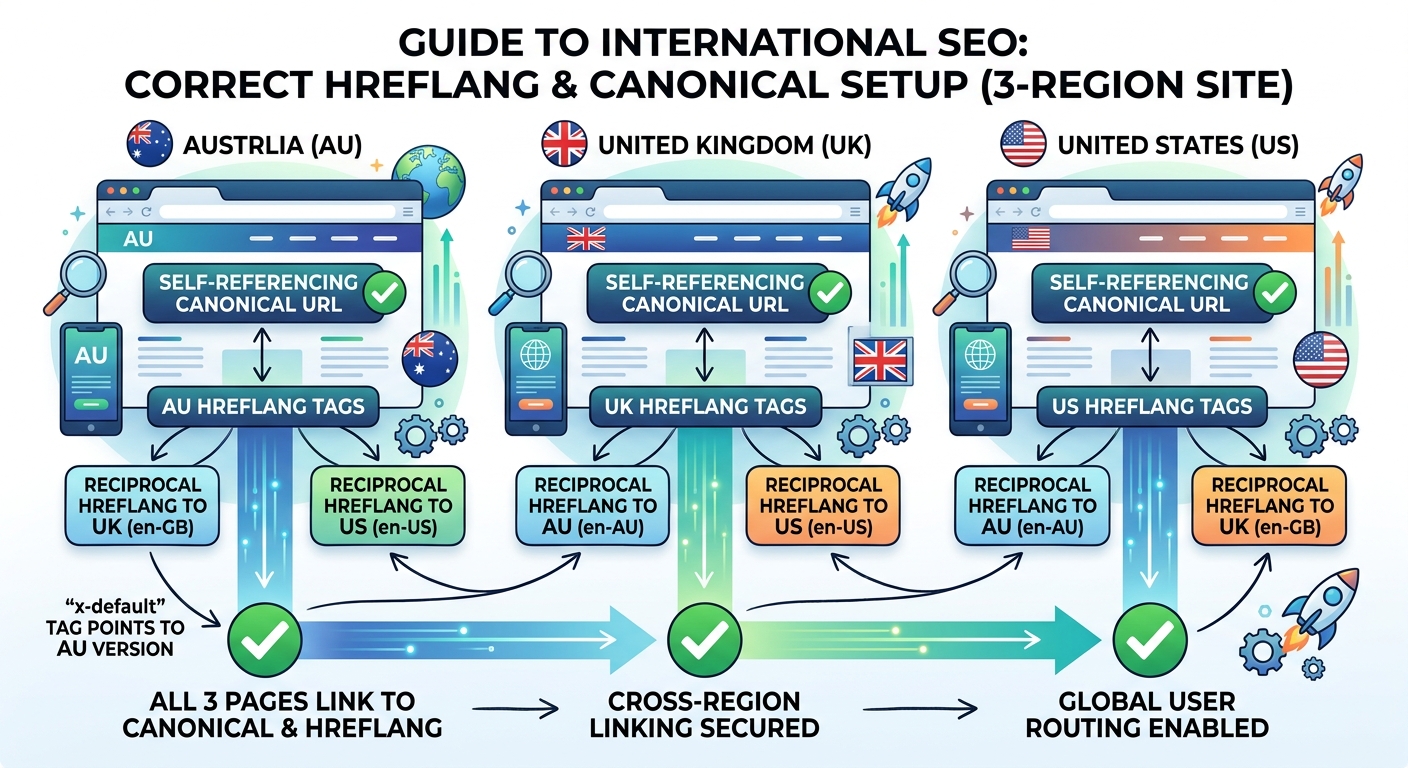
The fix begins with a principle that sounds redundant until you understand why it matters: every regional page must reference itself in both its canonical tag and its hreflang annotations.
Your /au/shirts page needs a canonical tag pointing to /au/shirts — itself. It also needs an hreflang tag for en-AU pointing to /au/shirts. The /uk/shirts page needs a canonical pointing to /uk/shirts, plus an hreflang tag for en-GB pointing to /uk/shirts. Each page is its own canonical, and each page declares its own regional identity. Google’s documentation on localised page versions confirms this setup and recommends adding an x-default annotation for users whose language or region doesn’t match any of your defined variants.
The critical part: every page in the hreflang cluster must include hreflang references to every other page in the cluster, and those references must be reciprocal. If /au/shirts references /uk/shirts as the en-GB alternate, then /uk/shirts must reference /au/shirts as the en-AU alternate. A missing return link causes Google to ignore the annotation entirely.
Warning: A common mistake during hreflang implementation in Australia is using “en-UK” as a language-region code. The correct code is “en-GB” — the ISO standard uses GB for the United Kingdom, not UK. This single error can invalidate your entire hreflang setup for that region.
This canonical tag strategy for regional sites eliminates the contradictory signals that caused the problem. Google now sees each regional page as the authoritative version for its market, with hreflang annotations that consistently reinforce which audience each page serves. As Moz’s canonical tag guide explains, hreflang annotations and self-referencing canonicals work together to manage canonicalisation for diverse audiences.
Differentiation That Justifies Separate Indexing
Here’s where many sites stall after fixing their tags. Even with perfectly aligned hreflang and canonical markup, Google may still consolidate rankings to a single regional version if the content across regions is too similar. Correct tags tell Google what you intend. Meaningfully different content gives Google a reason to respect that intention.
Swapping “colour” for “color” and AUD for GBP isn’t enough differentiation. Google’s algorithms can see through surface-level changes to the underlying content structure. If 95% of your page is identical across regions, Google may decide the pages are functionally duplicates regardless of your technical markup.
Genuine regional differentiation means adapting content to reflect how each market actually thinks about and uses your product. Australian product descriptions might reference local compliance standards, Australian shipping timeframes, or seasonal relevance (remember, your summer sale runs in December). UK pages should mention VAT, Royal Mail delivery estimates, and UK-specific sizing conventions. US pages need their own equivalents.
Correct hreflang and canonical tags tell Google what you intend. Meaningfully different content gives Google a reason to respect that intention.
This applies to your site’s content architecture as a whole. Regional blog posts, locally relevant case studies, and market-specific FAQs all contribute to making each subdirectory a genuinely distinct resource rather than a carbon copy with different currency symbols. If you’re working with an e-commerce SEO guide for your store, the same principle holds: product pages need regional substance, not regional window dressing.
Monitoring for Recurrence
Fixing hreflang and canonical conflicts is a point-in-time correction. On any active multi-region site, new pages get published, old pages get updated, and CMS templates get modified. Any of these changes can reintroduce conflicting signals.
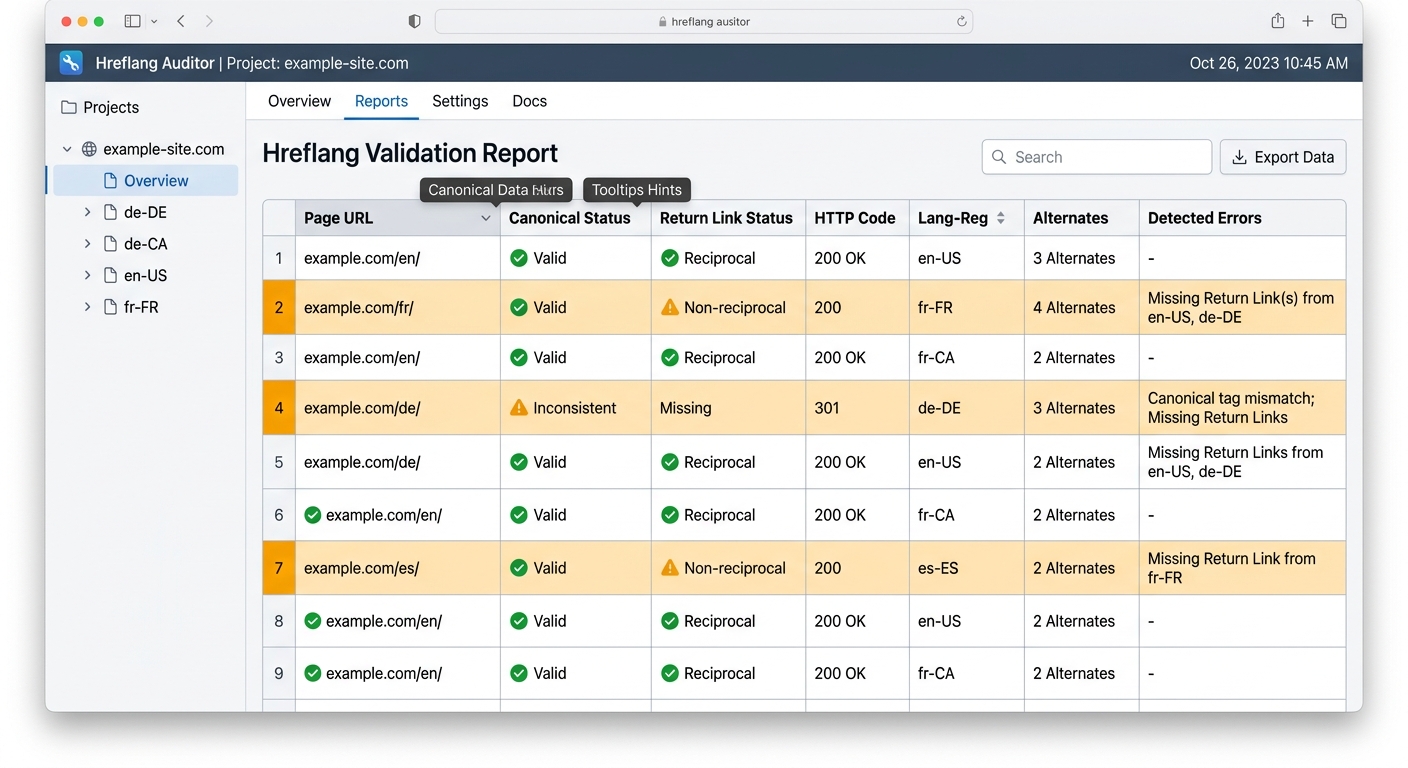
Tools like Lumar and Screaming Frog can run scheduled crawls that flag hreflang errors: missing return links, non-200 status codes on alternate URLs, and canonical-hreflang mismatches. Running these checks fortnightly catches problems before they compound into ranking losses.
The specific things to monitor:
- Self-referencing canonical integrity — every regional page’s canonical points to itself, not to another region’s equivalent
- Reciprocal hreflang completeness — every page in a cluster references every other page, and every reference is returned
- HTTP status of alternate URLs — hreflang annotations pointing to 301 redirects or 404 pages get ignored by Google
- Sitemap consistency — your XML sitemaps should list only canonical URLs, and the hreflang annotations within sitemaps should match those in your page-level markup
If your sitemaps declare one canonical whilst your HTML declares another, you’ve recreated the original conflict. Google’s documentation is explicit about this: don’t specify different URLs as canonical using different techniques.
The State of Play
The hreflang implementation Australia-based businesses need in 2026 hasn’t changed in its fundamentals since Google first introduced the attribute. Self-referencing canonicals, reciprocal hreflang annotations, x-default for unmatched users, and genuine content differentiation across regions — these remain the foundation.
What has changed is the scale of the problem. More Australian businesses are expanding into international markets through subdirectories and subdomains. Platforms like Shopify and Webflow have added localisation features that automate parts of the markup, which is helpful right up until the automation generates incorrect tag combinations that nobody audits.
The businesses that avoid cannibalization across their multi-region site structure are the ones that treat hreflang and canonical tags as a system rather than as independent technical checkboxes. When both signals agree, Google follows your lead. When they conflict, Google follows its own judgment, and that judgment rarely favours your most commercially important regional page. Getting the system right, and keeping it right through ongoing monitoring, is the difference between a multi-region site that performs and one where three-quarters of your regional pages sit idle in the index.