

Google’s March 2024 core update wiped out entire categories of thin affiliate sites. The ones that disappeared fastest shared a single structural flaw: zero deliberate content architecture. Australian SMEs running affiliate content lost rankings held for years because their site structure strategy amounted to “publish another review and hope.”
The Flat-File Era: When Every Page Was an Island
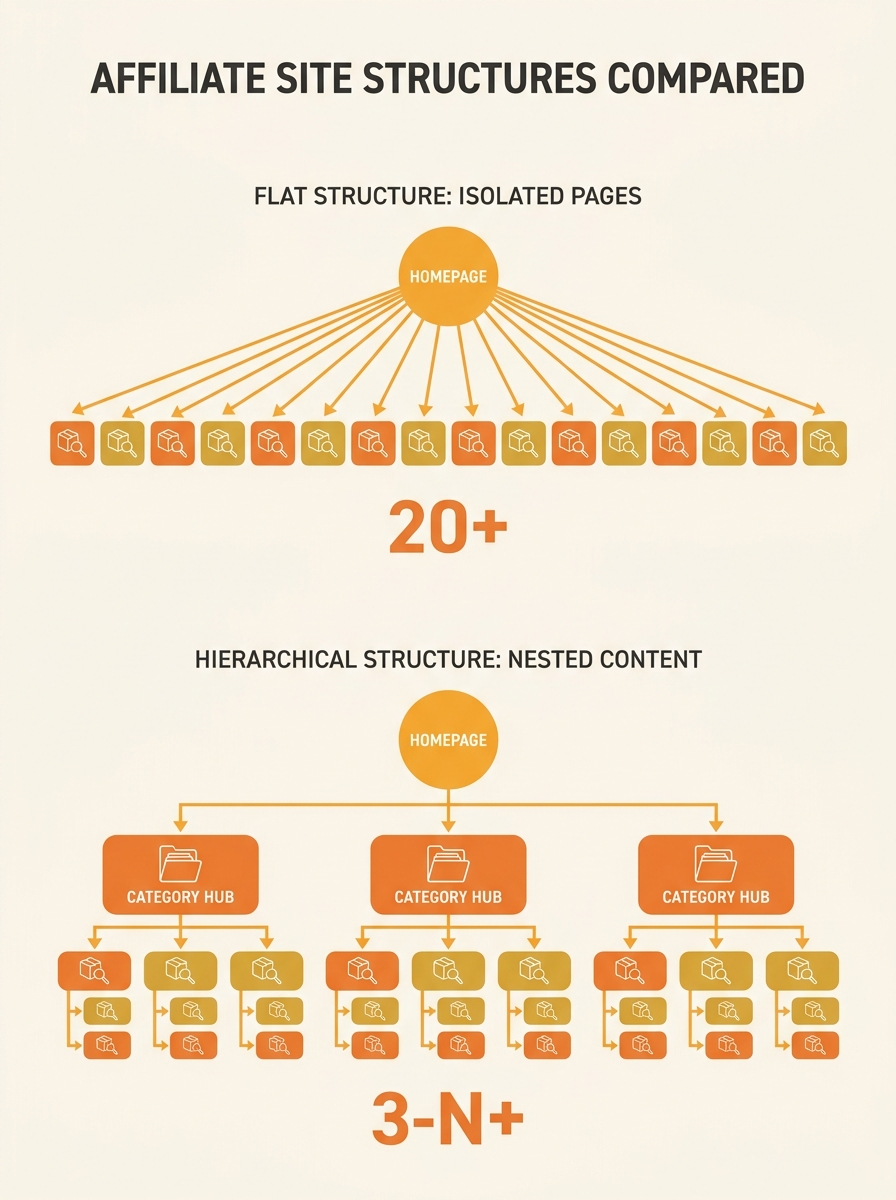
Through the early to mid-2010s, the dominant affiliate site model in Australia mirrored the global default. A homepage, a blog roll, and dozens of individual product review pages sitting at the same URL depth. No parent-child relationships between pages. No topic clustering. No deliberate information hierarchy ranking signals telling Google which pages were authoritative and which were supporting.
This architecture (or lack of it) worked for a time. Google’s algorithm was less sophisticated about evaluating site-wide structure, and affiliate sites could rank individual pages on keyword targeting and backlinks alone. A typical Australian SME running camping gear reviews had 80 pages at domain.com/product-name, each competing independently, with no architectural logic connecting a tent review to a sleeping bag comparison.
The content blueprint technical SEO required was, at that point, minimal. You picked a keyword, wrote a review, published it, moved to the next commission opportunity. Semrush’s documentation on website architecture describes the ideal site as pages organised into logical hierarchies connected by internal links. The average affiliate site of 2014 had none of that structure.
Google Starts Penalising Structural Neglect
Google’s Panda update had been rolling since 2011, but its compounding effects took years to fully register with small affiliate operators. By 2016 and 2017, Australian SMEs noticed that sites with hundreds of thin review pages were stalling. New content wasn’t indexing quickly. Older pages dropped out of the top 20 for queries they’d owned.
The issue was architectural. Search Engine Land’s guide to site architecture explains that “URLs should reflect how your content is organised” and that hierarchical URLs “reinforce hub-and-spoke models” that give crawlers topical context. Affiliate sites dumping every page at root level gave Google no signals about which pages mattered, which topics the site covered with genuine depth, or how a review of hiking boots connected to a broader outdoor gear category.
Some Australian operators responded by reorganising into category structures (domain.com/camping/tents/product-name). Others ignored the signal entirely, treating architecture as a design preference rather than a ranking input. That split in response created a performance gap that widened with every subsequent algorithm update.
The Topic Cluster Model Takes Hold
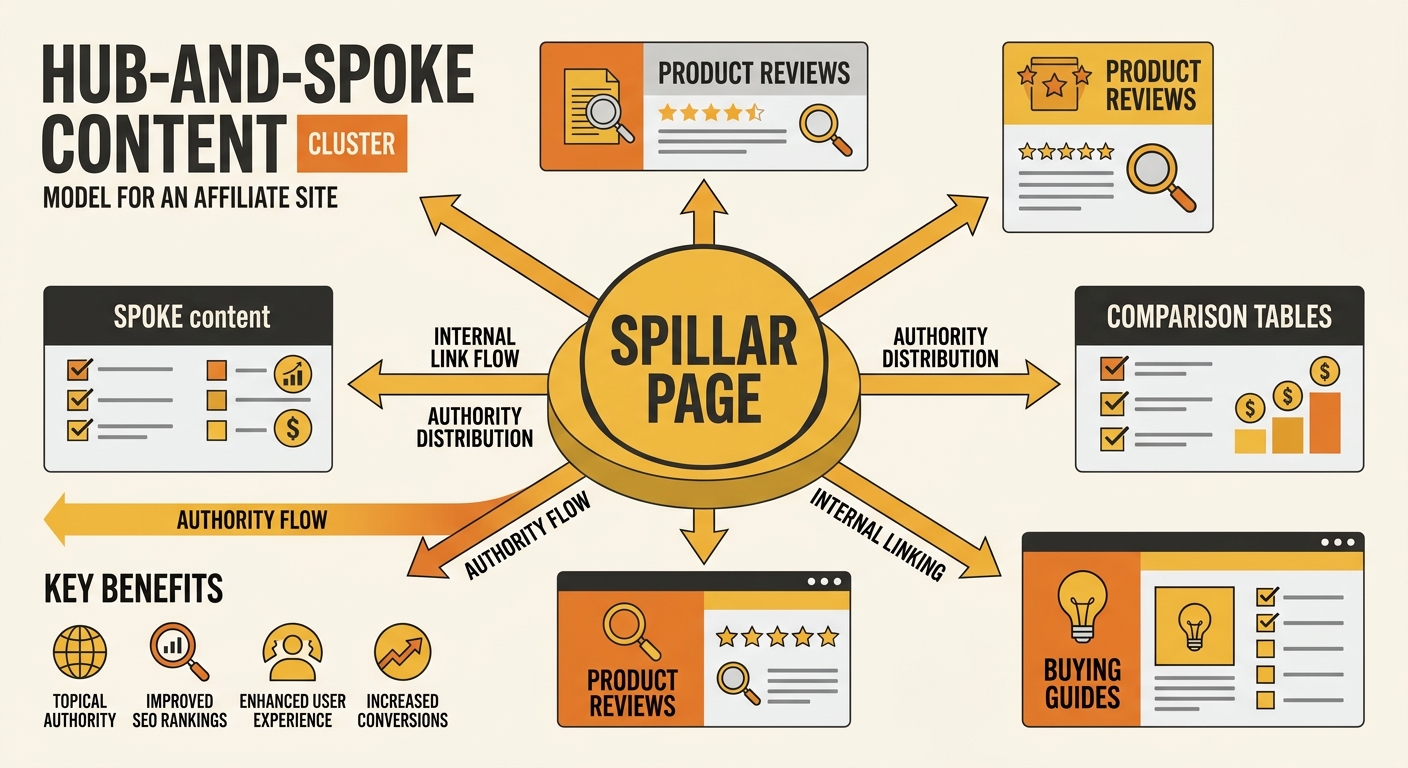
By 2019 and 2020, the SEO industry had broadly adopted the pillar page and topic cluster model. For affiliate sites, this meant building a substantial guide page on a broad topic (“Best Hiking Boots for Australian Trails”) and linking it systematically to individual product reviews, buying guides, and comparison tables.
Passion Digital’s analysis of information architecture found that “pages higher in the structure typically receive more internal links and authority, improving their ranking potential.” The pillar page became the structural hub. Individual affiliate reviews became spokes. Internal linking between them passed authority in both directions.
Australian SMEs that adopted this model saw measurable improvements. Their pillar pages started ranking for high-volume informational queries, and the affiliate review pages connected to those pillars ranked better for transactional terms. The content architecture SEO benefits were clear in both search console data and affiliate commission reports.
But here’s where the “afterthought marketing” problem shows up most plainly. The businesses that built cluster structures typically did so because a marketing consultant told them to write pillar content. The architecture was a byproduct of content planning, not a technical SEO decision made at the site infrastructure level. The URL structure, the crawl depth, the internal link distribution, the breadcrumb navigation: all left to whatever the WordPress theme defaulted to.
We’ve written about how content clustering works as a structural advantage for SMEs, and the pattern holds for affiliate and non-affiliate sites alike. Businesses that treat clustering as a content marketing activity without adjusting the underlying technical structure capture roughly 40% of the potential ranking benefit.
The Helpful Content Update Culls the Herd
Google’s Helpful Content Update, first rolled out in August 2022 and refined through multiple iterations into 2024, targeted sites where content existed primarily to generate affiliate revenue without providing genuine user value. The update evaluated content quality at the site level, meaning a handful of thin affiliate pages could drag down an entire domain’s rankings.
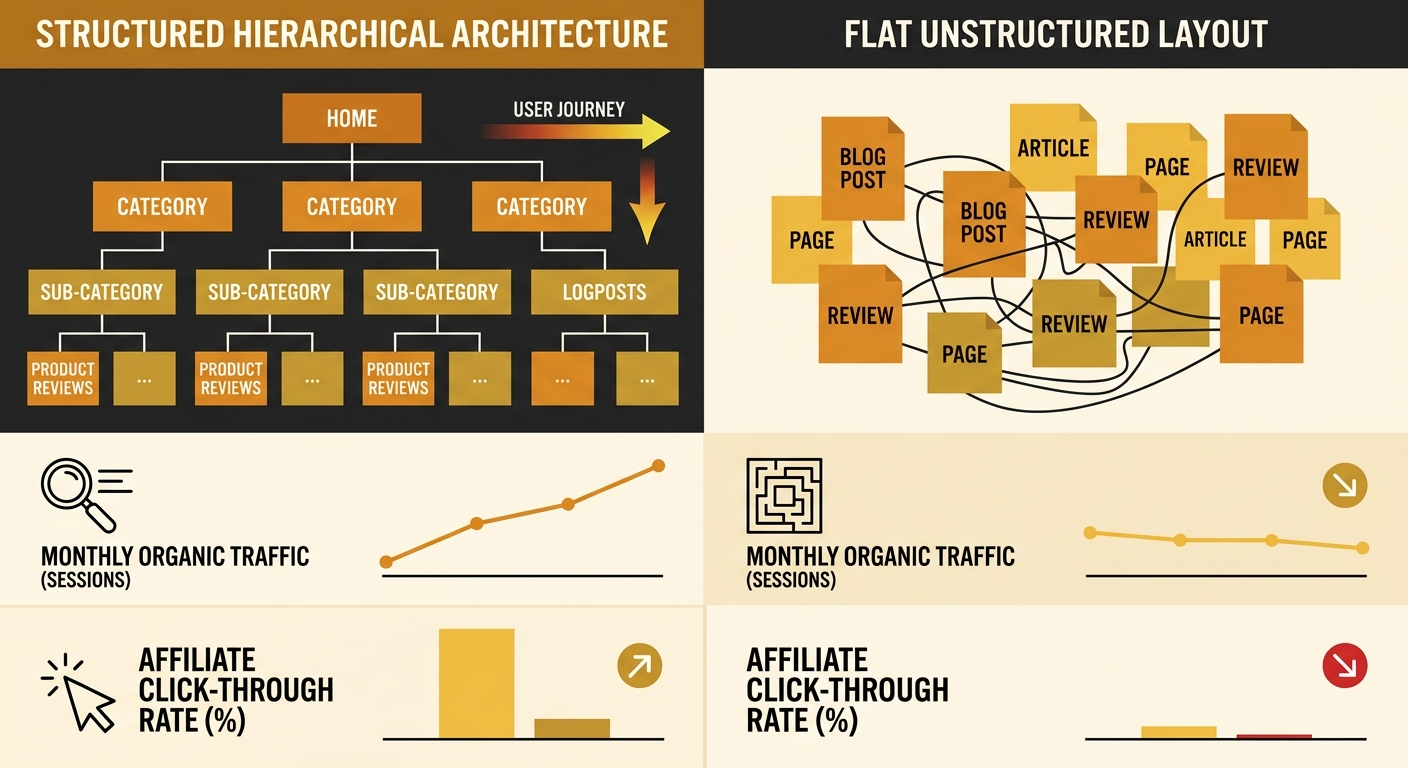
For Australian SMEs, this was the moment content architecture stopped being optional. Sites with clear topical authority signals, built through deliberate information hierarchy ranking structures, weathered the update. Sites where 200 product reviews sat in an unstructured pile got hammered. NAV43’s guide to SEO information architecture describes how organising content with “keyword research, target keywords, and user intent” creates a coherent user path that search engines reward with improved rankings and better conversion outcomes.
If your affiliate site took a hit during this period, the SEO debugging pyramid offers a systematic way to diagnose whether the damage was structural, content-related, or both. In many of the cases we’ve observed, the answer is both, with architecture being the harder fix because it requires developer involvement, not just new blog posts.
Businesses that treat clustering as a content marketing activity without adjusting the underlying technical structure capture roughly 40% of the potential ranking benefit.
AI Search Rewrites the Architecture Requirements
Elena Ghiban, an SEO specialist writing in Medium in April 2026, put it directly: “Technical SEO means ensuring the algorithm doesn’t just see the content, but understands it exactly as you intended.” This principle has become urgent as AI-powered search features now dominate query responses. Google’s AI Overviews appear on the majority of searches, and they pull structured data from sites that demonstrate topical coherence through architecture.
AI search systems extract entities, relationships, and structured data to construct answers. An affiliate site with proper content architecture, where a pillar page on “home office ergonomics” links to specific product reviews using descriptive anchor text and schema markup, gives AI models a clear topical map. A flat site with disconnected reviews gives them nothing to work with.
For Australian businesses concerned about visibility in AI-powered search results, the architecture question is now existential. AI Overviews draw from sites that demonstrate topical depth through deliberate structure. If your affiliate content sits in a flat directory with no parent-child relationships, no breadcrumbs, and no schema connecting related pages, generative search models will cite a competitor who invested in that structure.
The site structure strategy Australian businesses need for affiliate content in 2026 looks different from what worked two years ago. Schema markup (particularly Article, Product, and Review types) needs consistent application across the content hierarchy. Internal links need descriptive, keyword-relevant anchor text rather than generic “read more” phrases. And the URL structure needs to reflect topical taxonomy, not publishing dates. A proper internal link audit is the starting point for any affiliate site that hasn’t mapped its own architecture recently.
The State of Play
The pattern across a decade of algorithm updates runs in one direction: each generation of Google’s ranking system places more weight on site-level architecture signals, and each generation penalises flat, unstructured affiliate sites more severely. Australian SMEs that built content architecture into their technical SEO foundation early hold compounding advantages that grow with every update. Those still treating structure as a content marketing decision, something the blog writer handles rather than the developer, face diminishing returns on every piece of content they publish.
Australian SMEs running affiliate content alongside e-commerce product pages face a double cost when architecture is neglected, because both the affiliate content and the product pages suffer from the same flat hierarchies, poor internal linking, and missing schema. Fixing the architecture addresses both revenue streams at once.
The businesses that figured this out five years ago are the ones still earning affiliate revenue from organic search. The ones that didn’t are still publishing reviews into a structure that Google increasingly can’t, or won’t, reward.