

Four discrete AI agent types handle the workflow stages that Australian SME content teams have traditionally managed through email chains and shared spreadsheets. Optimizely’s Opal AI Benchmark Report measured the result: 71% more campaigns produced, 36% shorter cycle times, with human editors focused on judgment calls rather than formatting and scheduling.
TL;DR: AI agents improve content output when assigned to specific workflow stages (research, drafting, enrichment, quality checks) rather than used as general-purpose writing tools. Australian SMEs that structure agent-assisted publishing around staged handoffs, native tool integrations, and fixed review cadences can compress multi-week cycles into days. But without editorial oversight, the same speed creates scaled-content penalties that Google now actively enforces.
Six rules govern whether agent-assisted publishing works for small and medium businesses, or whether it creates a different bottleneck made of mediocre content that search engines progressively ignore.
Identify where your workflow actually stalls
The bottleneck in content production is almost never the writing. For Australian SMEs running lean teams, the dead zones are approval loops, brief creation, platform formatting, and distribution scheduling. A status-based workflow that tracks stages like “In Review” or “Published” makes these stalls visible, according to Activepieces’ content publishing workflow guide. Without that visibility, you can’t know what to automate.
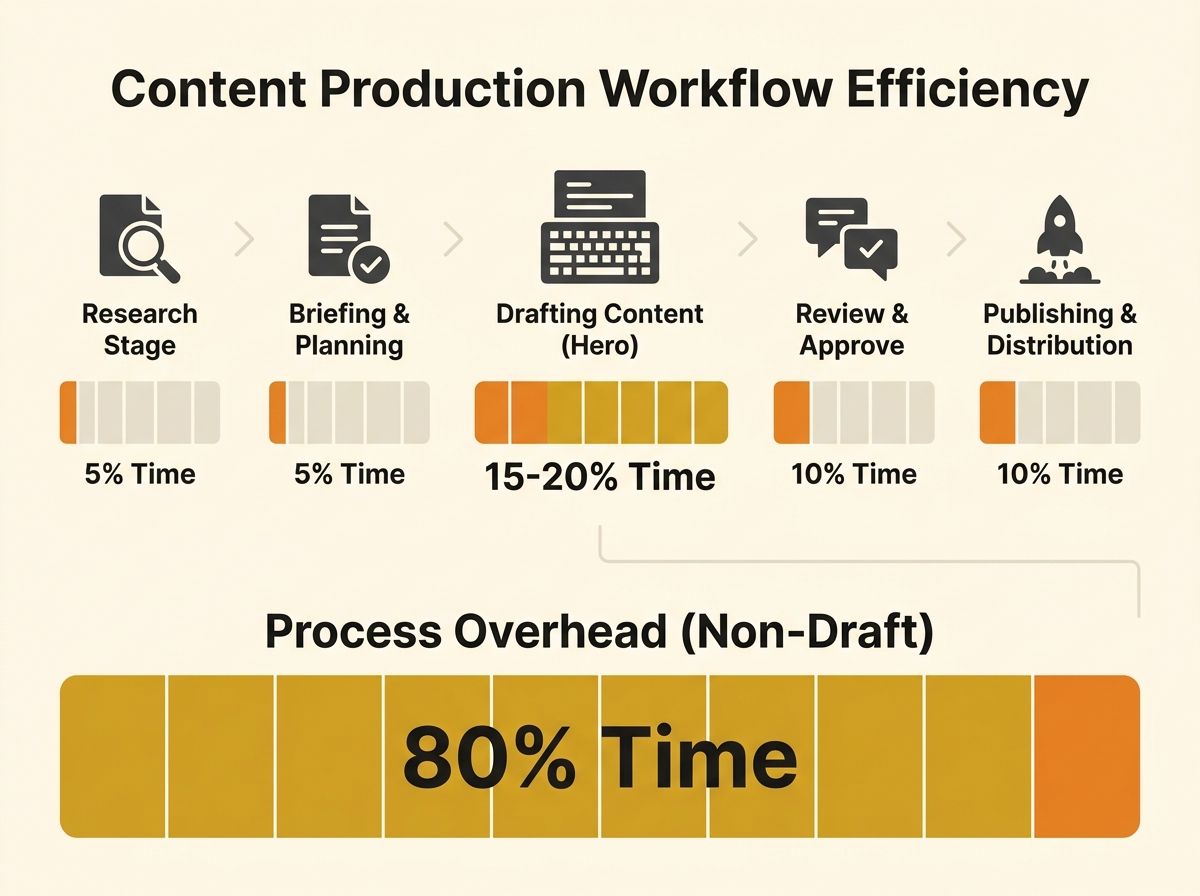
Run a two-week time audit before you introduce any AI agent. Log how many hours each content piece spends in each stage: research, brief, draft, internal review, revision, formatting, scheduling, distribution. You’ll typically find that the draft stage accounts for 15-20% of total cycle time. The remaining 80-85% is process overhead.
If your publishing cadence has already broken down, your crawler schedule may have suffered too. We’ve written about how irregular publishing affects crawl frequency in detail. The short version is that Googlebot adjusts its visit rate to match your output consistency, so a backlogged pipeline creates compounding SEO damage.
Assign agents to specific stages, not to “content” broadly
The word “agent” gets thrown around loosely. In the context of content production workflow automation, an AI agent handles a discrete, repeatable task within a defined stage. FlowWorks’ guide to AI agents for Australian businesses breaks these into four functional categories: research agents that synthesise inputs into structured briefs, drafting agents that produce first versions, enrichment agents that create modular reusable blocks, and quality agents that run compliance and accessibility checks.
The critical distinction is scope. A research agent pulls competitor content analysis, keyword data, and source material into a brief template. A drafting agent takes that brief and produces copy. A quality agent checks readability scores, metadata, and brand guideline compliance. Each agent has a single job, a defined input, and a defined output. I’d frame this as the stage-agent mapping model: every workflow stage gets its own agent with clear boundaries, rather than one tool doing everything poorly.
When you hand an AI tool “content” as an undifferentiated task, you get what Dan Taylor has described as the “Mt. AI” effect: an initial traffic spike from new content volume, followed by a sharp decline as Google’s quality systems devalue low-originality material once the freshness boost expires. The spike-and-crash pattern is well-documented across sites that scaled output without staging their workflows.
Batch your bulk content planning around topic clusters
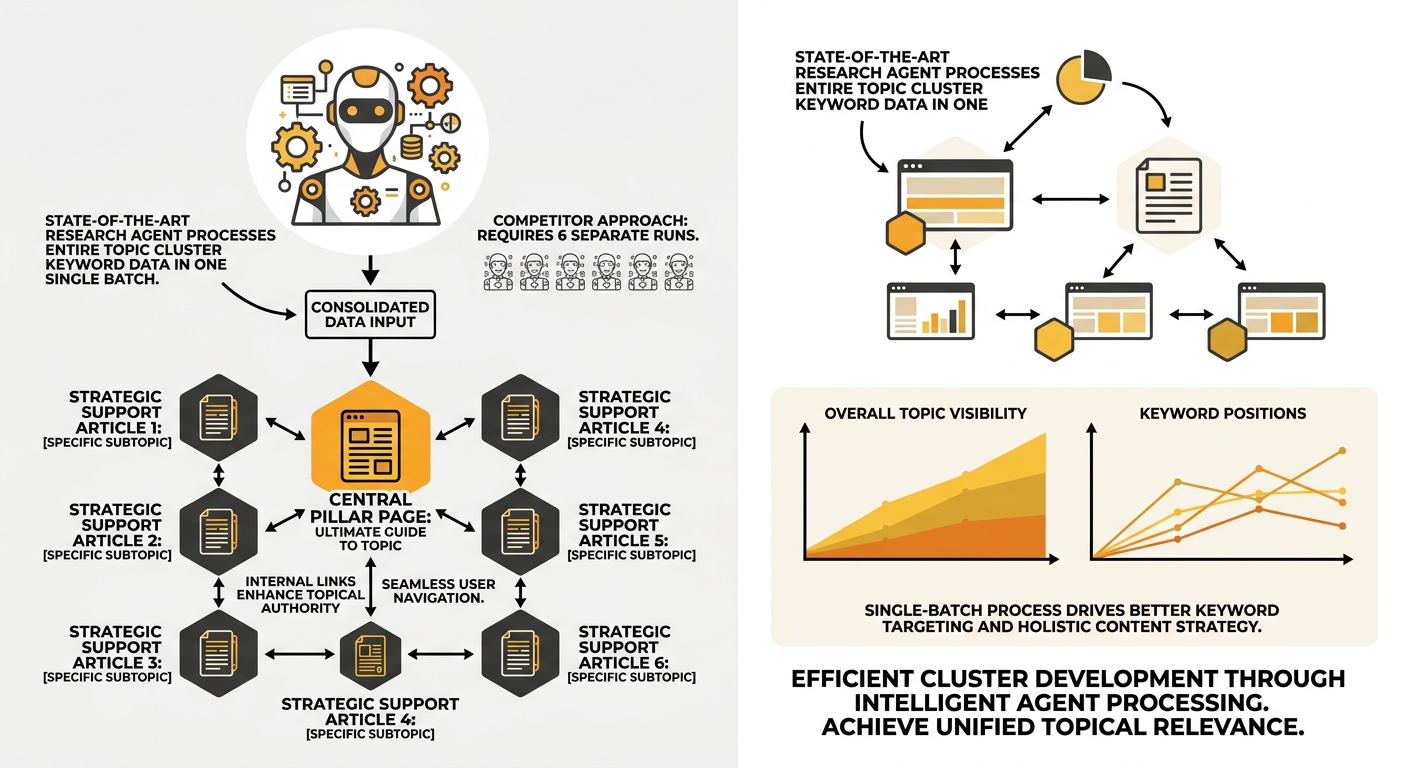
Bulk content planning works when pieces reinforce each other. It fails when you produce 20 unrelated articles that compete for different keywords with no internal linking logic. Clustering your output around topical groups means every batch strengthens a single pillar page, builds internal link equity, and gives search engines a clearer picture of your site’s authority on a subject.
If you haven’t structured your site around content clusters connecting supporting pages to pillar content, agent-driven scale will amplify a structural problem. You’ll publish faster into a disorganised architecture, which is worse than publishing slowly into a coherent one.
A practical batching cadence for SMEs producing 8-12 pieces per month: plan one cluster per month, assign 6-8 pieces to that cluster, and use 2-4 slots for time-sensitive or opportunistic content. Your research agent handles the keyword and competitor analysis for the entire cluster in a single pass, which is dramatically more efficient than piece-by-piece research. Cross-training team members on multiple stages eliminates single points of failure when someone is on leave or pulled onto a client project.
Demand native integrations between your marketing tools
Why does marketing tool integration matter so much for scalable publishing for SMEs? Because every manual data transfer between your CMS, project management tool, SEO platform, and distribution channels is a point where delays and errors accumulate. The 2026 Teamwork review of marketing planning software puts it plainly: “Native integrations (not just Zapier workarounds) minimize duplicate work and reduce errors from manually copying data between systems.”
Enterprise plans on platforms like Monday.com handle up to 250,000 automation actions monthly. You don’t need that volume as a small business, but you do need bidirectional sync between your core tools so that a status change in your project board triggers the next workflow step without someone copying a URL into a spreadsheet. Activepieces now offers 628+ data integrations across email, social, analytics, and marketing automation tools, connecting the platforms most SMEs already use.
Marketing tool integration is where many SME content operations break down silently. The team thinks the problem is “not enough writers” when the real cost is the 3-4 hours per week someone spends moving content between systems, reformatting for different platforms, and manually updating status trackers.
Tip: Before adding any new tool to your content stack, check whether it offers native two-way sync with your existing CMS and project management platform. If it only connects through Zapier or webhooks, factor in the maintenance cost of those connections breaking at inconvenient moments.
Operate at 80% capacity and build buffer into every sprint
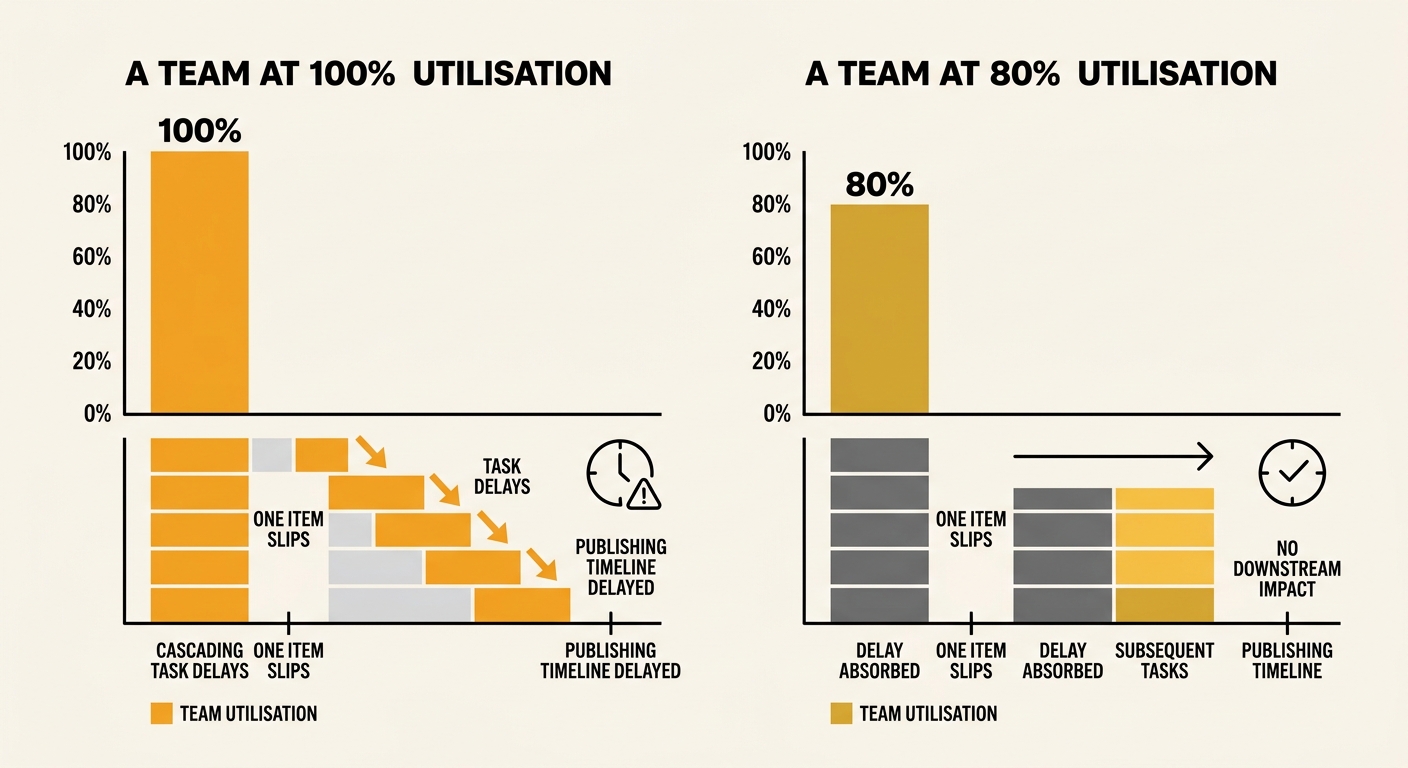
Running your content team at full utilisation is a reliability problem. When every team member’s week is fully allocated, a single delay cascades through the entire pipeline. Operating at 80-85% utilisation creates the buffer that keeps your publishing cadence intact even when individual tasks slip.
This principle applies equally to your AI agents. If your drafting agent’s output requires 4 hours of human editing per piece, and you’ve scheduled 5 pieces per week assuming 3 hours each, you’ve built a deficit that compounds weekly. Track actual editing time across your first 10 agent-assisted pieces before you commit to a production schedule. For teams looking at automating routine SEO and content tasks, the same buffer logic holds. Automate the repeatable work, but keep slack in the schedule for the judgment calls that can’t be templated.
Parallel processing for approvals is another way to compress timelines without overloading the team. If three people need to review a piece, don’t route it sequentially. Send it to all three simultaneously and consolidate feedback in a single revision pass. This alone can shave 5-7 business days off a multi-week approval chain.
Audit your output on a fixed weekly cadence
Pedro Dias documented in June 2025 that Google had begun issuing manual actions specifically for “scaled content abuse,” targeting sites mass-publishing low-effort AI content across the UK, US, and EU. Lily Ray reported cases where sites lost all search visibility overnight after aggressive AI content campaigns. Google’s Quality Rater Guidelines now explicitly rate pages with “little to no effort, originality, or added value” at the lowest level, regardless of how the content was produced.
A weekly review cadence catches quality drift before it accumulates into a penalty. Every Friday, review the week’s published pieces against three criteria: does each piece contain information a competitor’s article doesn’t? Does it include first-hand data, a named source, or original analysis? Would a human editor be comfortable putting their name on it?
The 44.3% improvement in crawl-to-refer ratios that organisations see from AI-identified structural fixes only materialises when the content itself passes Google’s quality threshold.
For Australian SMEs building out content strategy and production at scale, the weekly audit is where you decide whether to publish, revise, or kill a piece. That decision gate is the single most important step in the workflow. Monthly performance audits and quarterly strategy reviews round out the cadence. Weekly catches quality problems. Monthly reveals whether your traffic, rankings, and AI search visibility are tracking in the right direction. Quarterly is when you reassess whether your cluster strategy, tool stack, and agent configurations still fit your business objectives.
When these rules collapse
These six rules assume you have at least one person with editorial judgment reviewing output, a minimum viable tool stack with native integrations, and a content strategy that defines what you’re trying to rank for. Remove any one of those three conditions and the framework falls apart.
They also assume you’re producing content where quality variation matters to your audience. If you’re generating product descriptions for 10,000 SKUs, the stage-agent model still applies but the quality gate shifts dramatically. Consistency and accuracy matter more than originality, and the weekly audit becomes a spot-check sampling process rather than a piece-by-piece review.
And if your publishing volume is genuinely low—two to three pieces per month—the overhead of configuring and maintaining AI agents across multiple stages may exceed the time they save. The threshold where content production workflow automation pays for itself sits around 6-8 pieces per month for most SME teams. Below that number, a well-structured editorial calendar and a disciplined review process will get you further than any agent configuration. Above it, these rules are the difference between scaling content that builds authority and scaling content that erodes it.