

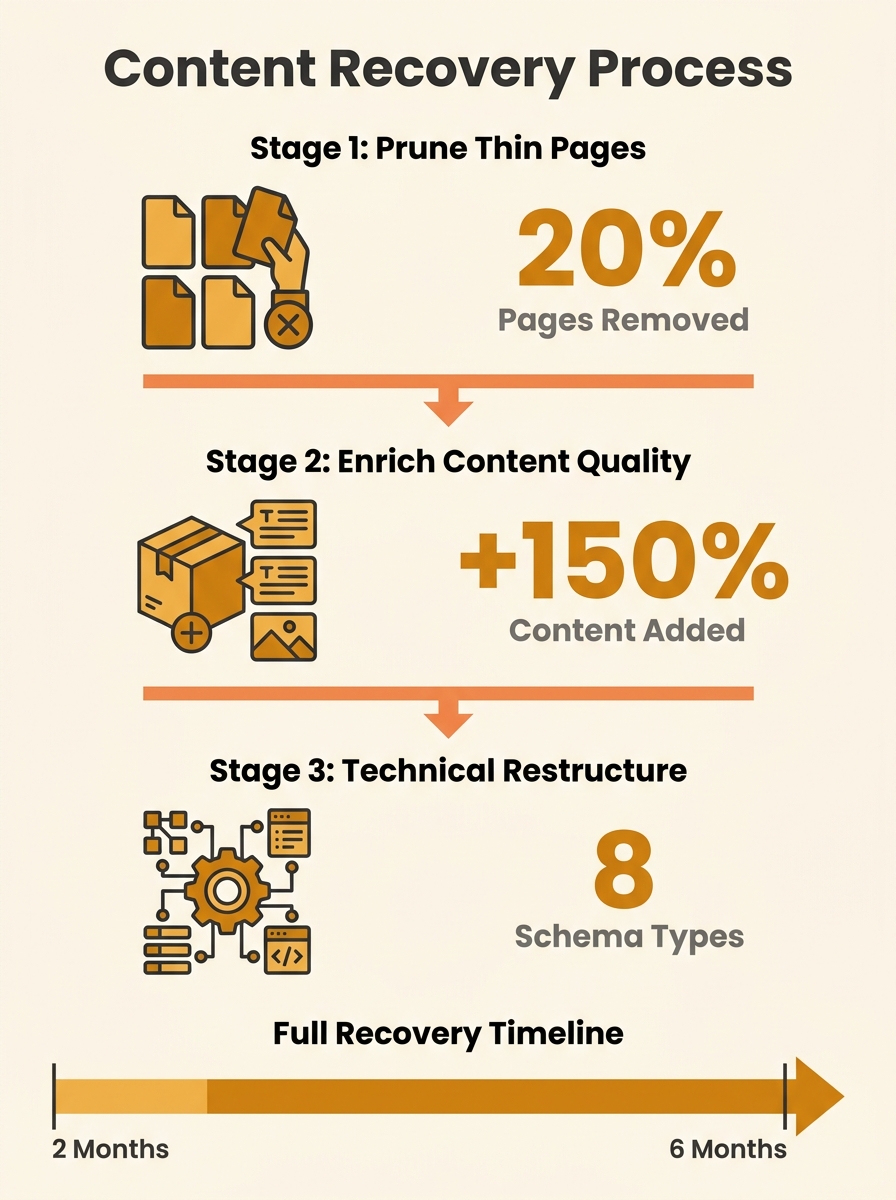
Thin product pages and bare category listings are the pages Google penalises hardest during content quality updates. Australian online stores that rebuild these pages with genuine buying expertise, original photography, and structured data recover between 36% and 302% of lost visibility, according to a 2026 ranking study by The Stacc. The mechanism runs through three stages: pruning, enriching, and restructuring.
TL;DR: Google core update recovery for e-commerce follows a repeatable pattern. Prune thin and duplicate pages to concentrate authority. Enrich surviving pages with first-hand product knowledge, original images, and comparison content. Add product schema and fix technical crawl issues. Initial movement shows within 8–12 weeks, with full recovery spanning 2–6 months.
Why Content Quality Updates Hit Online Stores So Hard
Google’s core updates from December 2025 through May 2026 reinforced existing ranking systems rather than introducing new ones. The reinforcement landed heaviest on pages with low original content. E-commerce sites carry thousands of these pages by default. Product listings pulled from manufacturer descriptions. Category pages with nothing beyond a grid of thumbnails. Filter pages that duplicate content across dozens of URL variations.
The content quality update pattern is consistent. Pages offering the same information available on every other retailer’s site get demoted. Pages adding something a shopper can’t find elsewhere get promoted. For any traffic recovery case study to show positive results, the rebuilt content needs to pass a simple test: does this page exist because the store has something unique to say, or does it exist only because the product exists?
Australian SMEs face extra pressure. Creative Orbit’s research into the September 2025 core update found that Australian businesses now compete against “increased competition from national and global brands for AI-generated answers.” Smaller stores with thinner content lose ground faster to larger retailers whose pages carry reviews, comparison tables, and detailed specifications. We’ve covered in detail why most Australian SME ranking drops trace back to content problems, and the same patterns appear across e-commerce sites of all sizes.
The Diagnosis: Identifying Which Pages Actually Lost
Recovery starts with diagnosis. OuterBox’s SEO recovery guide describes the correct sequence: “Confirm the update window, compare the right dates, look at affected pages and queries, rule out technical problems, and then improve the pages that actually lost visibility.”
Most store owners skip this step. They see total traffic drop by 40% and assume every page was hit. The reality is usually different. A typical e-commerce site loses visibility on 15–25% of its indexed pages during a core update. But those pages often contributed a disproportionate share of traffic.
The diagnostic process for Google core update recovery involves three actions. Pull your Search Console performance data for the 28 days before and after the update window. Sort pages by the largest absolute click decline. Then group the losers by page type: product, category, blog, or informational. This grouping reveals the pattern. If 80% of your losses sit on product pages, that’s where rebuilding effort belongs. If category pages dominate the decline, your e-commerce content depth problem lives there.
Pruning Thin Pages to Concentrate Authority
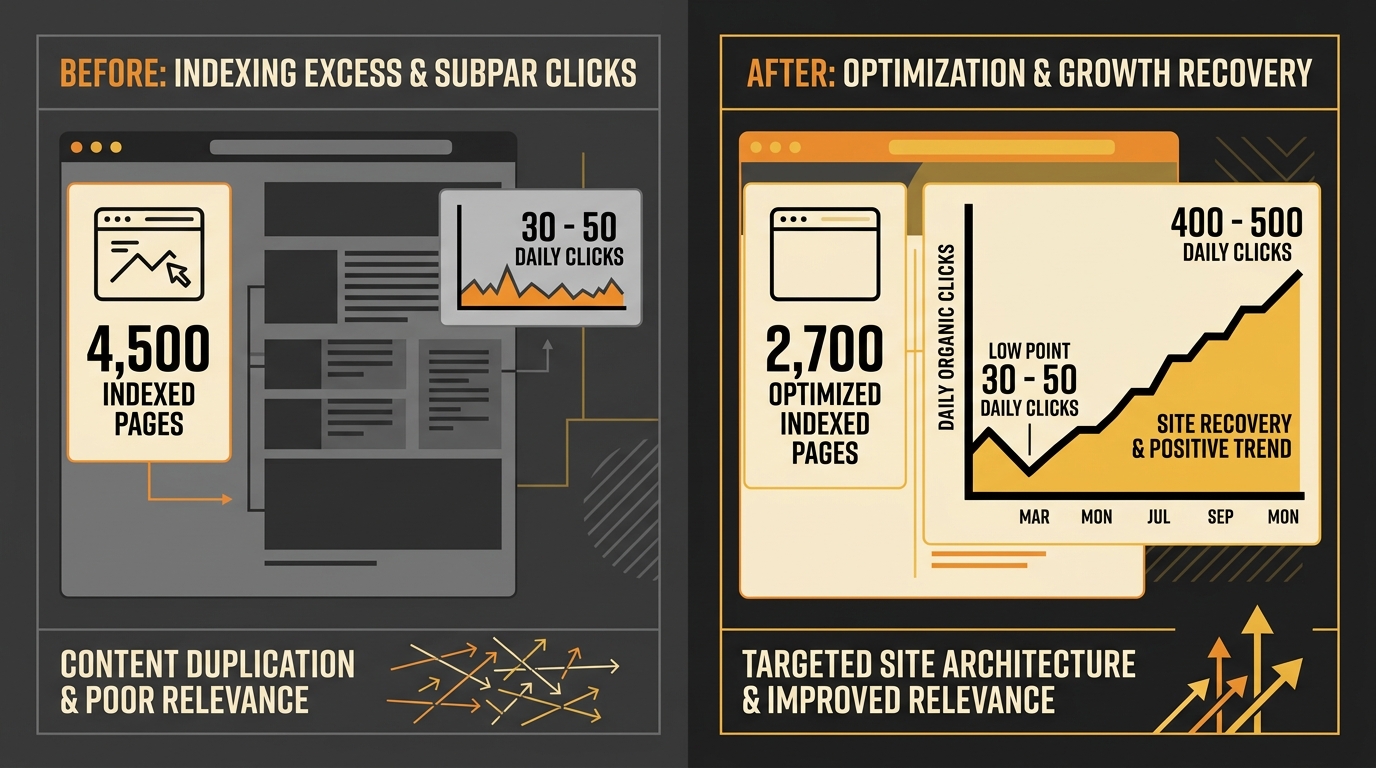
A documented recovery in the car buying services niche tracked by SEOProfy reduced total indexed pages from approximately 4,500 to 2,700. Daily clicks climbed from 30–50 after the initial hit to 400–500 following recovery. That’s a tenfold increase, achieved partly by deleting nearly 40% of the site’s pages.
Why does removing pages help? Google allocates crawl resources based on perceived site quality. When hundreds of thin or duplicate pages dilute a domain’s quality signals, everything suffers. Removing low-value pages raises the average quality score across what remains. For Australian online store SEO, this step alone often produces measurable movement within the first four weeks. You can see how crawl budgets get wasted on low-value pages and what that costs in indexation priority.
Pages worth cutting include: product pages for discontinued items with no redirects to current alternatives, filter combinations that create hundreds of near-identical URLs, and blog posts that restate manufacturer specs without adding analysis. The goal is a smaller, higher-quality index footprint.
Rebuilding Product and Category Content with Real Depth
E-commerce content depth means adding information a shopper can only get from someone who has handled, tested, or compared the product. Manufacturer descriptions fail this test. So do AI-generated product summaries that rephrase the same spec sheet in slightly different words.
Content that passes Google’s quality bar for product pages includes original product photography (not stock images from the supplier), hands-on comparison notes (“this model runs 1.5 sizes small compared to Nike equivalents”), specific use-case guidance (“best for gravel paths, not suited to wet clay”), and honest limitation callouts. E-E-A-T signals like author credentials and verifiable expertise matter because they tell Google the content comes from real product knowledge.
Category pages need the same treatment. A category page for “women’s running shoes” that shows a product grid and nothing else provides zero unique value. Adding a 300–400 word buying guide above the grid, with sizing comparisons, terrain recommendations, and a comparison table of the top 5 products by price and feature, transforms that page into something worth ranking.
A category page showing a product grid and nothing else provides zero unique value. A buying guide with sizing data, honest comparisons, and use-case recommendations transforms it into a page worth ranking.
The Stacc’s 2026 study captures the upside well: “A post that has fallen significantly has more recovery potential.” Pages that dropped from position 3 to position 40 have more room to climb than pages that slipped from 5 to 12. This means heavily penalised pages, rebuilt with genuine depth, often show the most dramatic recovery.
Structured Data and Technical Groundwork
Content quality is the primary recovery lever. But technical issues can block it from working. Product schema markup on every product page, covering price, availability, and reviews, ensures Google can generate rich results. Without it, even strong content competes at a disadvantage in search results.
Core Web Vitals targets for e-commerce sites are specific: LCP under 2.5 seconds, INP under 200 milliseconds, and CLS under 0.1. Sites with LCP above 3 seconds lost 23% more traffic than faster competitors during recent core updates. For e-commerce SEO services focused on Australian stores, these technical benchmarks are baseline requirements.
Google’s Rich Results Test catches schema errors before they cost you visibility. Search Console flags crawl issues that prevent updated content from being indexed. Both tools are free. Both get ignored by stores that focus only on content changes without checking whether Google can actually access and parse the improvements.
Recovery Timelines and What to Expect
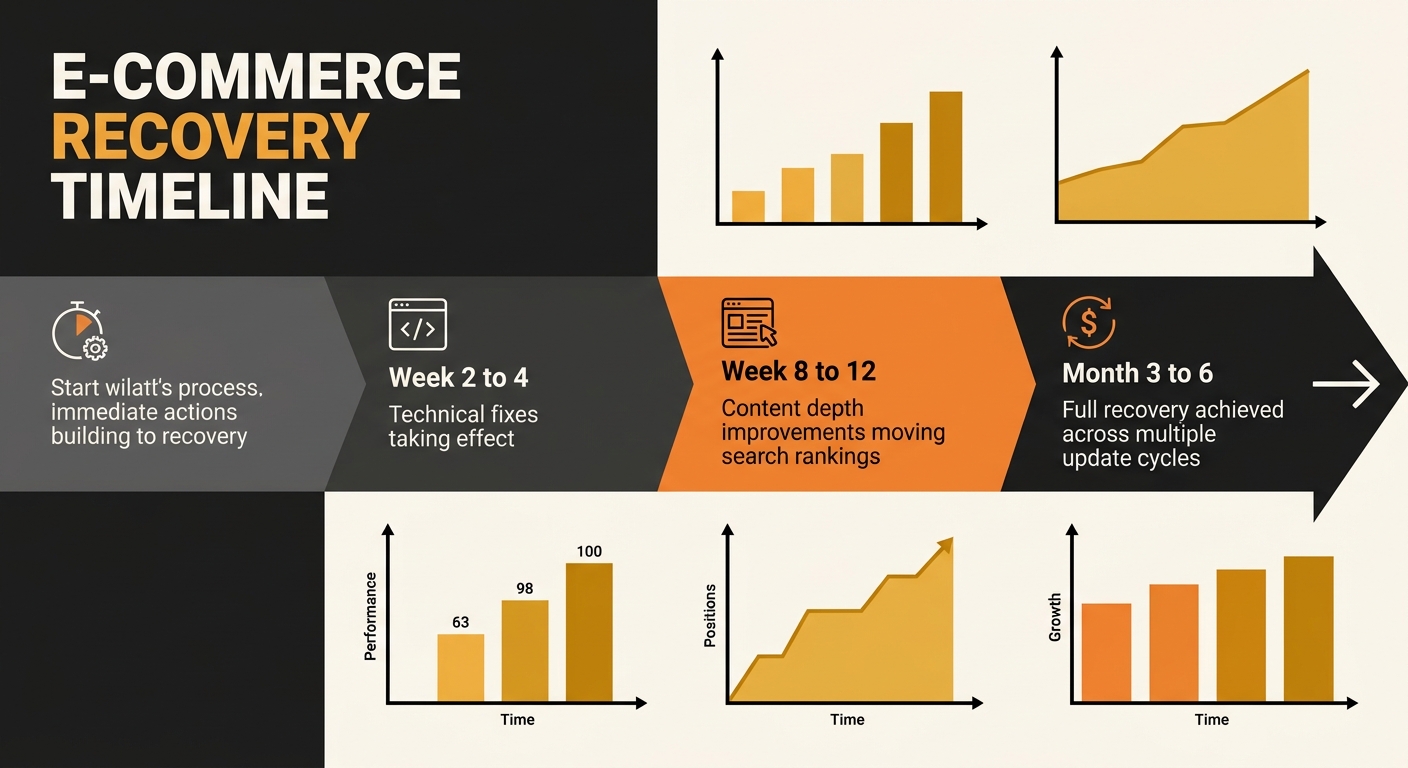
XICTRON’s recovery guide for the March 2026 core update estimates 2–6 months for standard e-commerce sites, with the timeline depending on the scope of changes and how competitive the category is. That aligns with what we see across Australian clients. Technical fixes like schema, crawl issues, and page speed show results within 2–4 weeks. Content depth improvements take 8–12 weeks to move rankings. Full recovery, where the site regains most of its pre-update positions, often spans two or three update cycles.
The May 2026 core update is still rolling out as of early June 2026. Stores that started content rebuilds after the March 2026 update are entering the window where Google re-evaluates their improved pages. This timing matters. Google’s content quality updates reward pages matching query intent over raw domain authority, so a well-rebuilt product page on a smaller Australian store can outrank a thin page on a major retailer.
Tip: Don’t change publication dates on pages without making real content changes. Google treats date manipulation without corresponding content updates as a negative quality signal.
Where This Recovery Model Falls Short
This mechanism works for stores that lost traffic because of thin content. It doesn’t cover every scenario. Sites penalised for spam, including paid links, cloaking, or doorway pages, need a different recovery path entirely. Sites that lost traffic to a competitor who simply built a better product range won’t recover through content alone.
The model also assumes your products and categories are worth writing about in depth. A store selling commodity items with no meaningful differentiation between brands (generic USB cables, plain white t-shirts) has less raw material for content depth than a store selling technical outdoor gear or specialty food products. For commodity stores, the content depth strategy shifts toward informational content around use cases, care guides, and buyer education rather than product page enrichment.
And recovery timelines aren’t guarantees. Google’s systems re-evaluate pages across multiple update cycles. A page that improves from position 40 to position 15 after one update might need another cycle to break into the top 10. Continued content investment, rather than a one-off rebuild, determines whether the 60% recovery holds or grows further over time.