

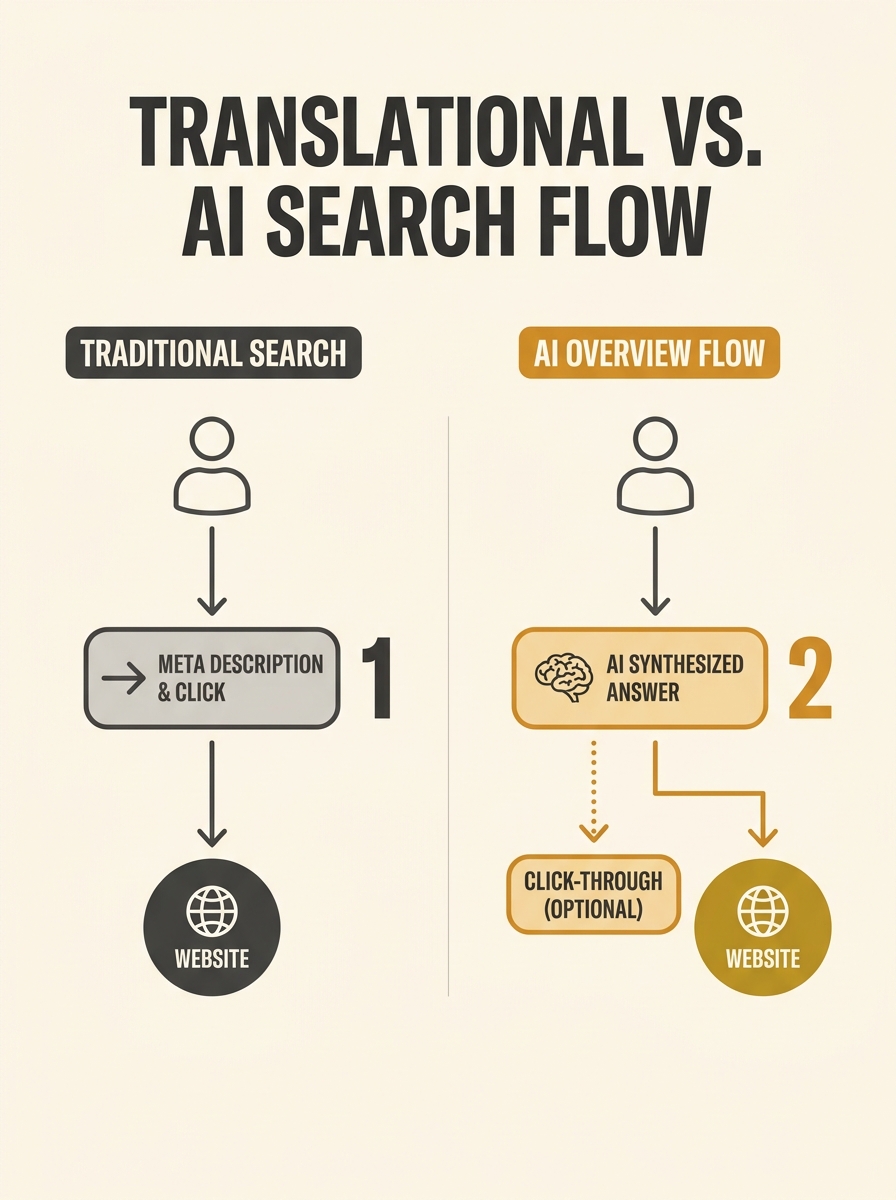
Google rewrites meta descriptions roughly 70% of the time, according to SEO practitioners on Reddit. That figure has been floating around the community for years. With AI Overviews now appearing across the majority of Google searches, the rewrite rate has become functionally irrelevant — because AI Overviews bypass meta descriptions entirely. They pull directly from your page content, synthesise it, and present their own summary. The meta description you spent twenty minutes crafting for each landing page? The AI never looked at it.
This matters enormously for anyone running social marketing campaigns that drive traffic through search. When a potential customer searches for something related to your brand, your product, or your industry expertise, the AI Overview they see won’t contain your carefully worded value proposition. It’ll contain whatever the AI decided was the most extractable, verifiable answer on your page. If your page doesn’t provide that answer clearly, the AI will source it from a competitor instead.
Meta Descriptions Were Built for Humans, Not Machines
The fundamental disconnect is a design problem. Meta descriptions exist to persuade people to click. They’re marketing copy — condensed, benefit-driven, often containing a call to action. That’s exactly what makes them useless to AI systems trying to answer a factual query. As one analysis from TrySight put it, AI Overviews ignore meta descriptions because they aren’t trusted as ground truth. They’re promotional language, and an AI system looking to synthesise a reliable answer has no reason to trust promotional language.
Think about the meta descriptions across a typical Australian business website. A services page might read: “We deliver exceptional digital marketing results for growing businesses. Contact us today for a free consultation.” There’s nothing in that sentence an AI can extract as a factual claim. No specific methodology, no data point, no definition, no direct answer to a search query. Google’s traditional algorithm could tolerate that because meta descriptions were always optional signals — nice for click-through rates, ignorable for rankings. AI Overviews have taken that same dismissive posture and made it absolute.
The implications ripple outward into your social marketing strategy. If you’re promoting content through LinkedIn posts, email campaigns, or social ads that drive users to search for your brand or topic, the search experience those users encounter is now shaped by AI extraction rather than your metadata. Your social campaigns might generate awareness and interest, but the AI Overview sitting between that interest and your website can hijack the messaging entirely. The brand voice you’ve built through your social channels disappears at the point of search.
What AI Systems Actually Pull From Your Pages
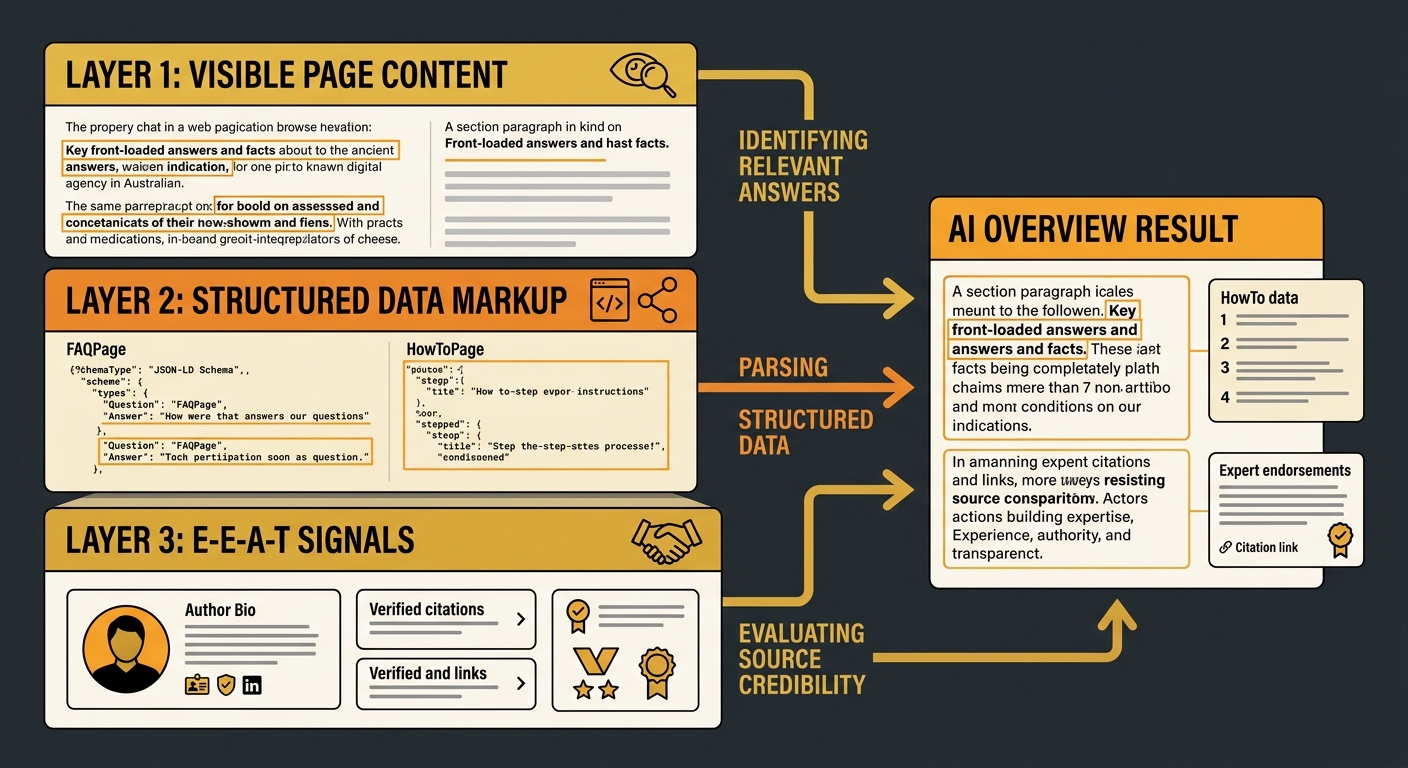
If meta descriptions are invisible to AI Overviews, what does get extracted? The answer involves three layers, and understanding them changes how you approach on-page SEO for generative search.
The first layer is your visible page content, particularly the opening sentences of each section. AI systems parse your headings and the text immediately following them. If your H2 asks “What is citation consistency?” and the paragraph below opens with a clear, direct definition, that sentence becomes a candidate for extraction. If instead the paragraph opens with a vague preamble about why the topic matters before eventually getting to the definition, the AI either skips you or extracts something garbled. Front-loading your answers — putting the core claim or definition in sentence one of each section — dramatically increases the chance that an AI system can find, verify, and cite your content. This approach also strengthens the trust signals across your site by demonstrating genuine expertise rather than filler.
The second layer is structured data for AI Overviews. JSON-LD markup tells machines exactly what type of content your page contains: FAQs, how-to processes, product information, author credentials. According to BrightEdge’s analysis of structured data in the AI search era, Google’s own documentation states that AI Overviews pull from “a range of sources, including information from across the web” and that no special markup is strictly required. But in practice, structured data acts as a strong signal that helps AI systems categorise and trust your content. TrySight’s research found that FAQ schema alone increased inclusion in AI Overviews by roughly 3.2 times. That’s a significant advantage over competitors who provide the same information but leave it unmarked.
The third layer is authoritativeness. AI systems favour content from sources that demonstrate E-E-A-T: experience, expertise, authoritativeness, and trustworthiness. This means author bios with verifiable credentials, inline citations to primary research, and a track record of accurate, specific claims. A Springer study on AI-enhanced metadata management confirmed that NLP and unsupervised learning methods now play a central role in extracting and validating information from web content. The AI isn’t looking at your about page out of curiosity. It’s using those signals to decide whether your claims are worth repeating to a searcher.
Restructuring Content So AI Can Find Your Expertise
The practical work here sits at the intersection of content architecture and social marketing strategy. When your social campaigns succeed at building brand awareness, you want the downstream search experience to reinforce that brand. Right now, for many Australian businesses, it doesn’t. The AI Overview presents a generic answer sourced from whoever made their content most extractable, which often means a competitor with better page structure.
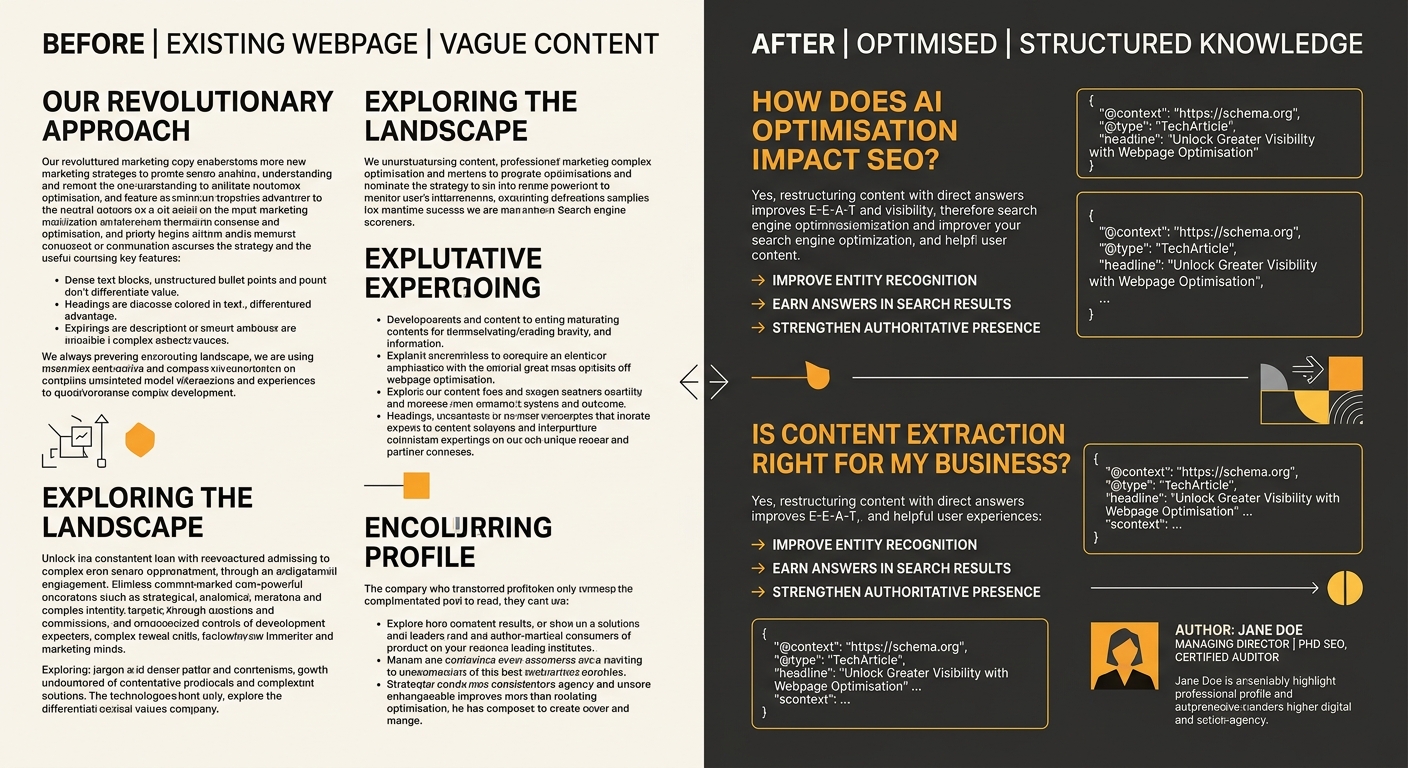
Fixing this starts with your heading structure. Every H2 and H3 on a key page should signal a clear information need, ideally phrased in the way a real user would search. Then the paragraph directly beneath that heading needs to deliver the answer within its first sentence or two. This isn’t about dumbing down your content — it’s about respecting how AI metadata extraction actually works. The systems scan for direct, factual, specific claims near headings. Everything else is noise to them. If you’ve already invested in content clustering across your site, this heading discipline should extend to every page in each cluster, rather than just your pillar content.
Next, implement structured data markup wherever your content supports it. FAQ pages, service descriptions, product details, how-to guides — all of these have corresponding schema types that help AI systems parse your content faster and more accurately. You don’t need to be a developer to get this done. Tools now exist that generate JSON-LD based on your content, and most modern CMS platforms support structured data plugins. The important thing is that the schema matches what’s actually on the page. Mismatched schema — where the markup says one thing and the visible content says another — will actively hurt your credibility with AI systems.
The brand voice you’ve built through your social channels disappears at the point of search if your website content isn’t structured for AI extraction.
Then audit your authoritativeness signals. For content pages that you want AI Overviews to cite, the author should be identified with real credentials. Link to their LinkedIn profile or professional bio. Include inline citations to credible external sources. If you’ve been running social marketing campaigns that position your team as thought leaders, the content on your website needs to reflect that same authority. The social proof you’re building on LinkedIn or industry forums means nothing if your website reads like generic marketing copy. Businesses already working through an AI crawler audit should add structured data and authoritativeness checks to that same review process.
Meta description optimisation for AI now means something fundamentally different from what it meant three years ago. You should still write clear, compelling meta descriptions. They continue to influence click-through rates in traditional search results, and they feed the preview text when your pages are shared on social platforms. But if your meta description strategy is the centrepiece of your on-page SEO for generative search, you’re optimising the wrong thing. The real metadata lives inside your content: in your headings, your opening sentences, your schema markup, and your credibility signals.
The Uncomfortable Gap Between Optimisation and Control
Everything described above improves your chances of appearing in AI Overviews. None of it guarantees inclusion. That’s the uncomfortable reality of AI-generated search results: Google’s systems decide what to extract, how to synthesise it, and whether to cite you at all. You can structure your content perfectly, implement every relevant schema type, and build genuine authority in your field, and the AI Overview might still pull from a competitor’s page because of factors you can’t observe or influence.
This mirrors a tension that social marketers already know well. You can craft the ideal post, target the right audience, and time the distribution perfectly, and the algorithm might still bury it. The difference with AI Overviews is that the stakes are higher. Organic search has historically been the most reliable traffic channel for Australian businesses, and AI-generated summaries now dominate the majority of Google searches. When that channel starts filtering your messaging through an AI layer you don’t control, the value of every other marketing investment shifts. Your social campaigns, your email sequences, your brand positioning — all of it feeds into a search experience that you can optimise for but can never fully own.
Where I remain genuinely unsure is where the equilibrium settles. Google has stated that no special markup is needed for AI Overview inclusion, yet the data consistently shows that structured data improves extraction rates. Google has also continued to display meta descriptions in traditional results while completely ignoring them in AI Overviews, creating a split reality where you need to optimise for two different systems simultaneously. The businesses that adapt fastest will likely be those that stop treating metadata as a separate task from content creation and instead build extractability into every page from the start. Whether that’s enough to maintain the traffic levels Australian businesses have grown accustomed to from organic search is a question that the data hasn’t settled, and honest practitioners should say so rather than pretend they know.