
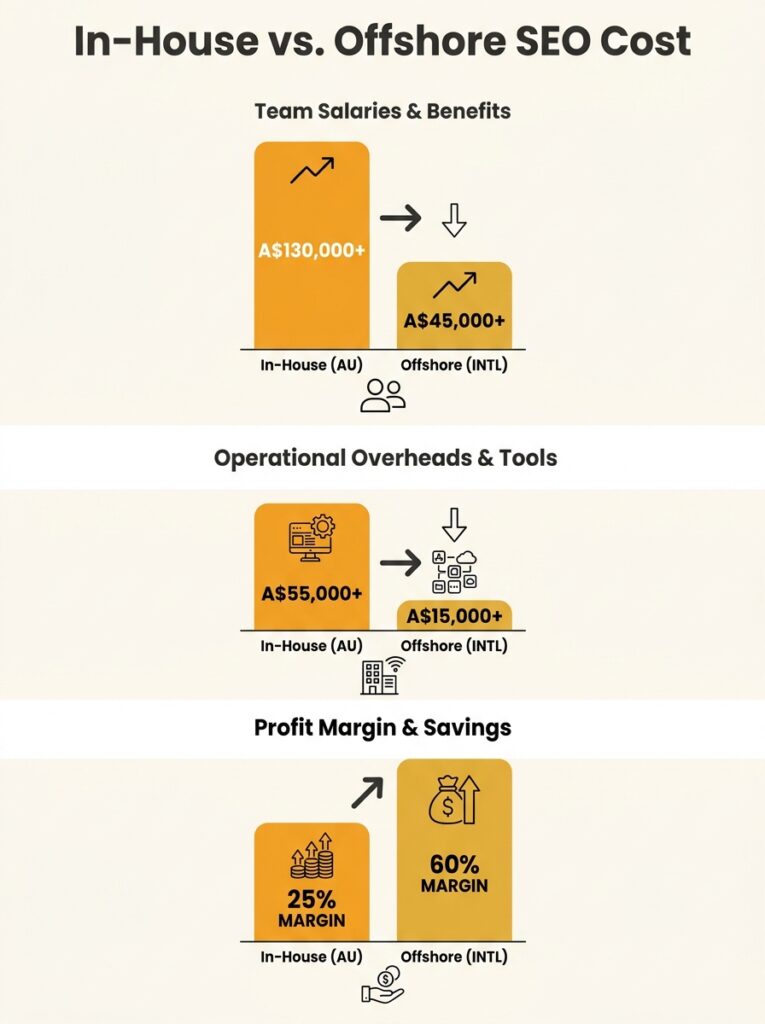
ShoreAgents published a figure that should make every Australian business buyer uncomfortable: most local SEO agencies outsource roughly 80% of their deliverables to offshore teams, charging clients $12,000 to $15,000 per month whilst paying $2,000 to $3,000 for the actual work. That margin tells a story about how the Australian SEO industry operates, and the story has almost nothing to do with quality and almost everything to do with who controls the process between the sale and the deliverable.
This piece dissects one well-documented pattern: the mid-tier Australian agency that offshores its SEO execution, hits a quality wall, and then has to decide whether to rebuild in-house or fix the offshore workflow. It’s a scenario that plays out dozens of times a year across Sydney, Melbourne, Brisbane, and Perth.
The $10,000 Margin Hidden in the Retainer
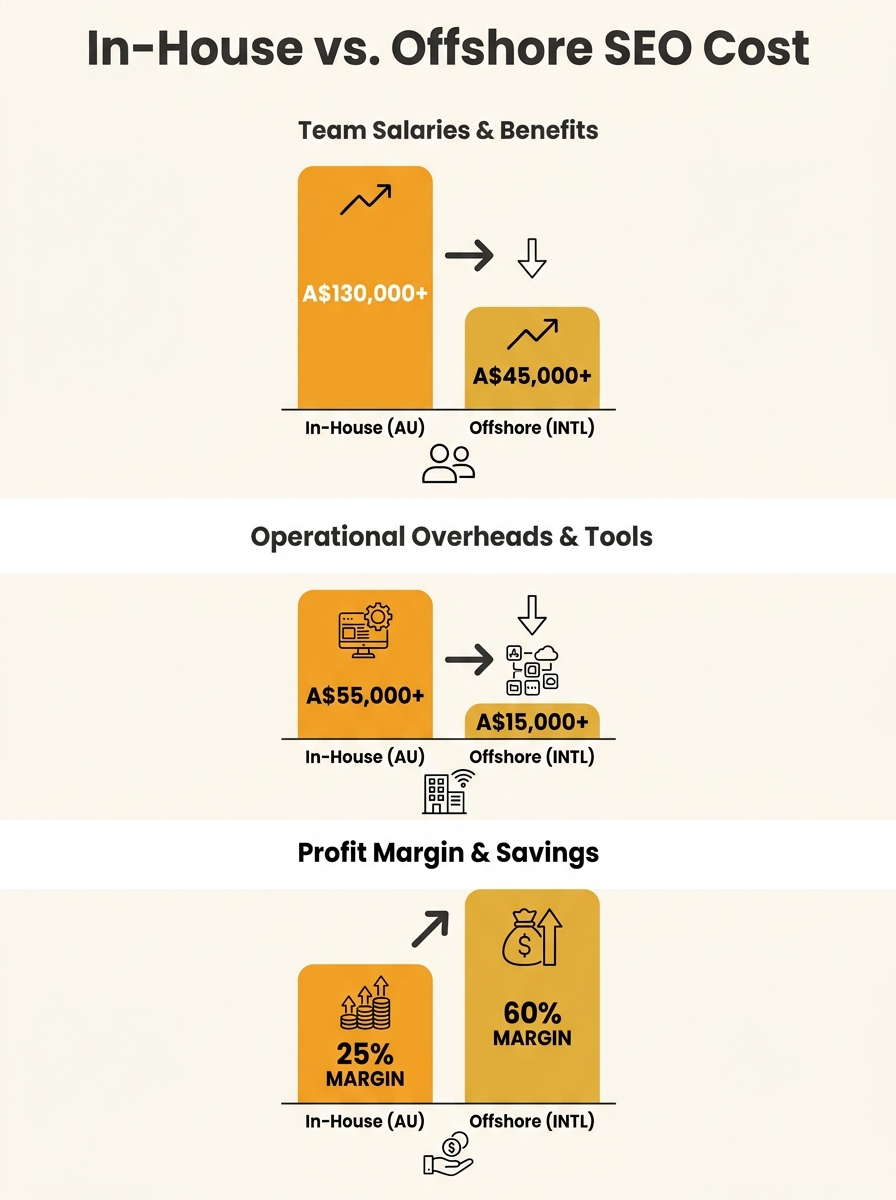
The economics are straightforward. An Australian SEO specialist with three to five years of experience commands $80,000 to $110,000 in salary. Add superannuation, software licences, training, and overheads, and you’re looking at $130,000 or more per full-time seat. A comparably experienced practitioner in the Philippines, Vietnam, or India might cost $15,000 to $30,000 all-in, depending on seniority and location within those countries.
For an agency running ten retainers at $10,000 each, that’s $100,000 per month in revenue. If the fulfilment cost drops from $60,000 with a local team to $15,000 with an offshore team, the margin expansion is enormous. And the client rarely sees the difference on paper because the reporting, the account management calls, and the strategy documents all carry the agency’s branding.
None of this is inherently unethical. Plenty of agencies run excellent offshore operations with strong training frameworks and quality assurance processes. The problem emerges when cost reduction becomes the primary driver and quality control gets treated as optional.
As one guide for Australian SMBs puts it: “The cheapest option often looks expensive later if you have to unwind weak content, poor link decisions, or inconsistent local signals. In SEO, rework has a cost.”
Where the Sub-$500 Engagements Collapse
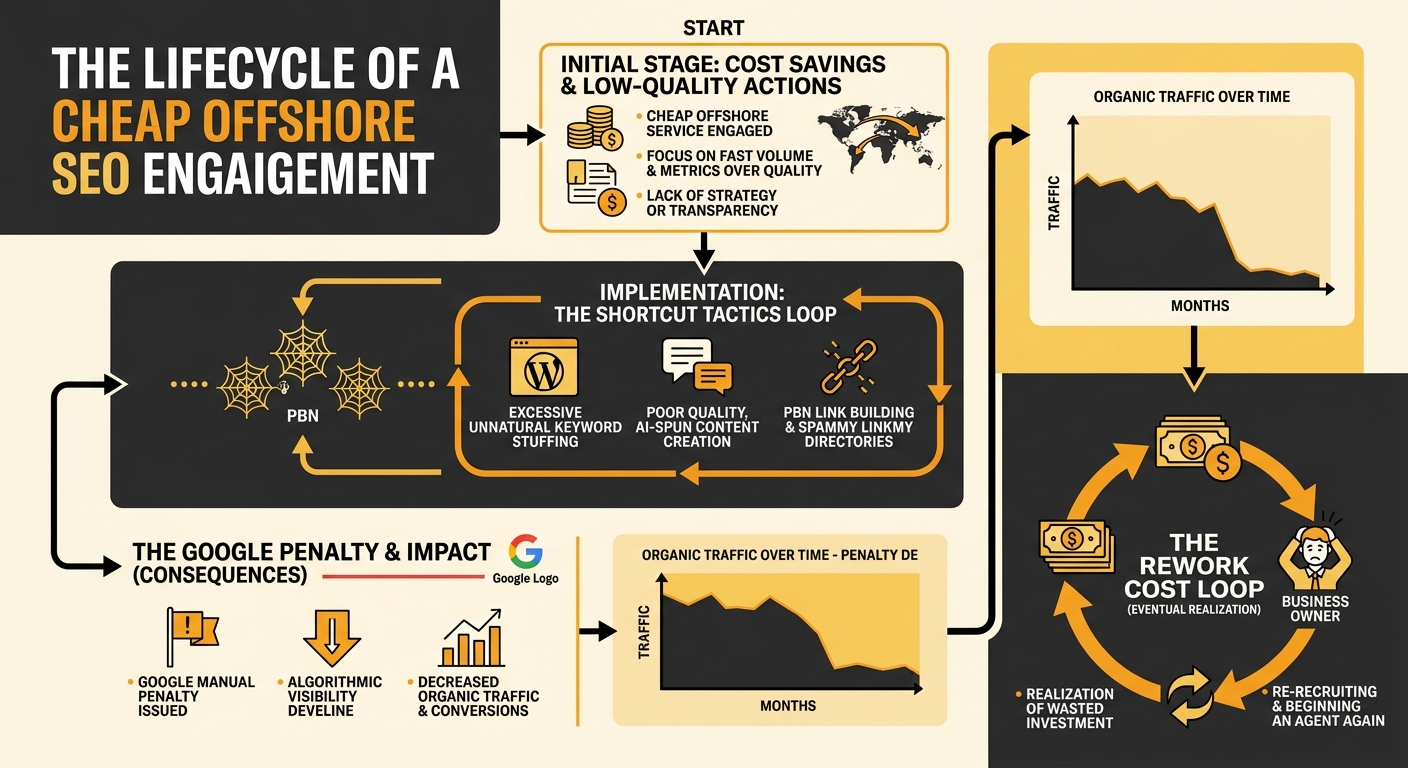
The documented failure point is sharp. According to Floowit’s analysis of agency outsourcing, agencies paying under $500 per month for SEO fulfilment consistently face issues with communication breakdowns, poor results, and Google penalties. At that price point, the offshore provider has to process volume to survive, and volume processing in SEO means shortcuts: private blog networks (PBNs), duplicate content spun through rewriting tools, and low-authority links purchased from link farms.
A common pattern looks like this. An agency lands a new client, scopes the work at 20 hours per month, then sends the execution brief to an offshore team charging $400. The offshore team, needing to complete the work in six or seven hours to maintain its own margins, skips the manual outreach, buys links from a directory it already controls, and publishes three blog posts generated from templates with superficial keyword insertion.
For the first three months, the metrics look acceptable. Domain authority ticks up slightly. Organic impressions climb. The client’s happy. The agency’s happy. Then Google runs a link spam update and the purchased links get devalued or flagged. The domain authority drops. The client’s organic traffic falls by 30% or more. And the agency now has a conversation to have that it really doesn’t want to have.
The rework is where the real cost lives. Disavowing toxic links takes time. Replacing spun content with genuinely useful pages takes budget. Rebuilding trust with a client who’s watching their traffic graph head downward takes patience and credibility the agency may have already spent.
If you’ve ever had to untangle technical SEO debt from years of neglect, you’ll recognise the dynamic. The bill always comes due, and it’s always larger than whatever was saved.
The 7AM Call That Nobody Wants to Take
Time zones create friction that most agencies underestimate until they’re living inside it. Australian Eastern Standard Time runs ahead of common outsourcing hubs in South and Southeast Asia, and the gap shifts depending on the season. A team in Manila is two hours behind Sydney. A team in Mumbai is four and a half hours behind.
The practical impact shows up in three places. First, review cycles double in length. A piece of content submitted at 5pm Philippine time arrives in an Australian inbox at 7pm AEST. If the account manager reviews it the next morning at 9am and sends feedback, the offshore writer doesn’t see those notes until their next working day. A single round of revisions that would take two hours in-person now consumes 48 hours of calendar time.
Second, urgent requests fall into a void. When a client calls at 2pm Sydney time asking for a quick technical audit because they’ve noticed a rankings drop, the offshore technical team is either at lunch or hasn’t started their day. The agency either handles it locally, defeating the purpose of offshoring, or tells the client they’ll have it by tomorrow.
Third, meeting windows shrink to a sliver. Research into remote SEO team management consistently highlights that scheduling meetings during overlapping hours when everyone is available becomes a genuine logistical constraint. For AEST and Philippine Standard Time, the comfortable overlap is roughly 10am to 2pm Sydney time. That four-hour window has to accommodate standups, client calls, strategy sessions, and any ad-hoc problem-solving. It fills up fast.
A single round of content revisions that would take two hours in-person now consumes 48 hours of calendar time when you’re working across zones.
Agencies that make offshore work well tend to restructure around asynchronous communication. Loom videos replace meetings. Detailed briefs with annotated screenshots replace Slack back-and-forths. The upfront investment in documentation is significant, but it’s the only reliable way to keep work moving when half your team is asleep.
Designing an Offshore Desk That Doesn’t Blow Up
The agencies that run offshore SEO successfully share a few structural choices. They’re not secrets, but they require discipline to maintain.
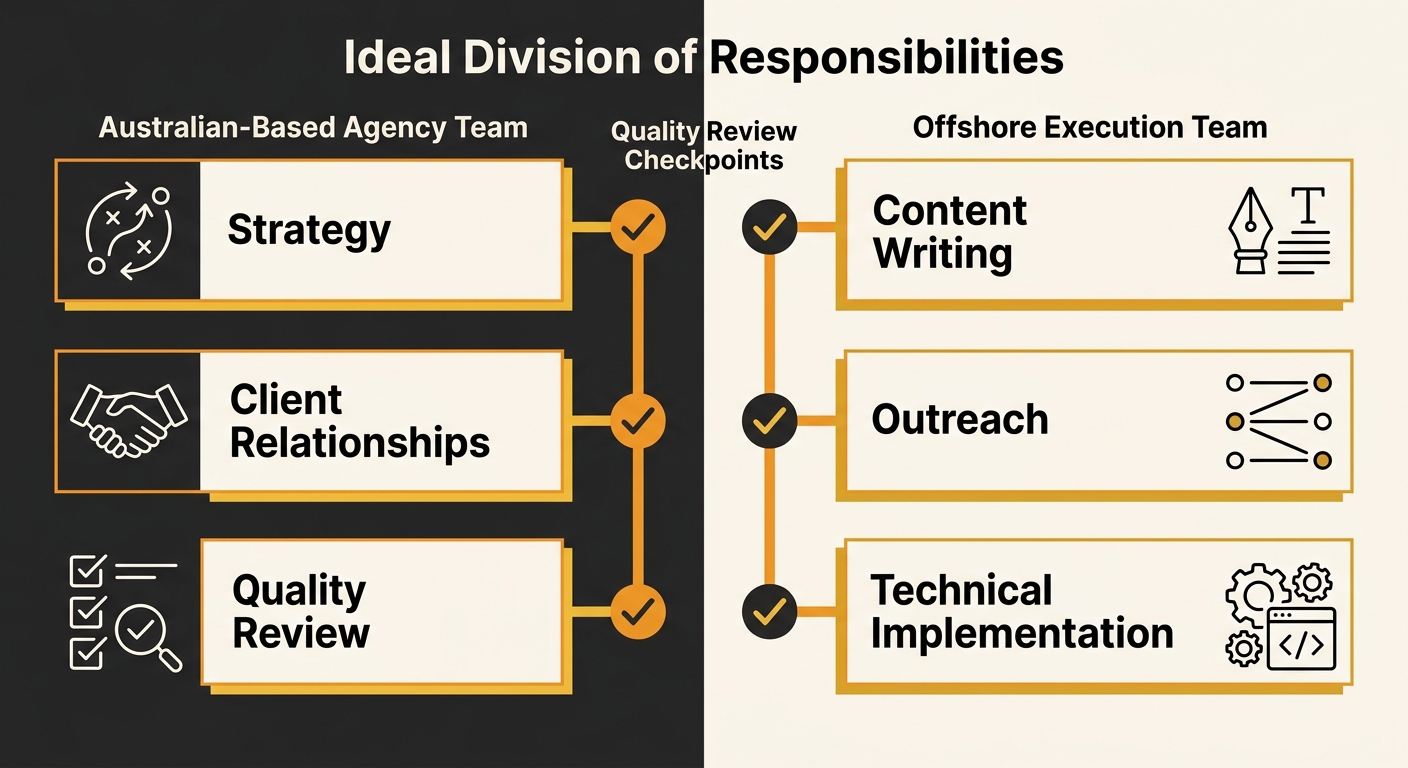
Keep strategy and client communication local. The account manager, the strategist, and the person who talks to the client on calls should be in Australia. They understand the local market, they can reference Australian competitors by name, they know the difference between a Sydney suburb and a Melbourne one, and they can react to client queries in real time. The creative and technical execution can sit offshore; the relationship and direction shouldn’t.
Invest in local link building expertise specifically. Offshore teams often lack the contextual knowledge to identify genuinely relevant Australian link opportunities. A link from a regional chamber of commerce, a local newspaper, or an industry body carries weight that an offshore team might not recognise because they’ve never lived in Toowoomba or worked with a tradie in Geelong. We’ve covered practical local link building tactics for Aussie SMEs in detail, and the knowledge gap here is one of the hardest things to train remotely.
Build quality gates into every deliverable. Every piece of content, every link placement, and every technical recommendation should pass through a local review before it reaches the client. This adds cost, but it’s the cost that separates agencies with 18-month client retention from agencies churning through contracts every quarter. There’s a reason agencies are increasingly rethinking how they handle outsourced outreach, and the quality gate principle sits at the centre of that shift.
Pay your offshore team properly. The sub-$500 engagements fail because nobody can do good SEO at those rates. Experienced SEO practitioners in the Philippines, for instance, command reasonable salaries that reflect genuine skill. If you’re working directly with SEO specialists in the Philippines, expect to invest in talent that actually understands technical audits, content strategy, and outreach rather than treating offshore as a pure cost-minimisation exercise.
Warning: If your offshore provider can’t explain their link acquisition process in detail, or if they resist sharing the specific domains they’re placing links on, treat that as a serious red flag. Transparency about methods is the minimum bar for any SEO engagement.
Audit the actual work, not the reports. Spot-check backlinks manually. Read the content that’s being published. Crawl the technical changes that were implemented. Reports can obscure a lot when they’re built to show green indicators, and we’ve explored why those green ticks often miss what actually matters before. The same principle applies when you’re reviewing offshore output.
The Margin Equation After the Rework
Here’s what this documented pattern ultimately demonstrates. The agencies that treat offshoring as a margin play without building quality infrastructure around it end up spending more than they saved. The rework costs, the client churn, the reputational damage from a Google penalty on a client’s site, the hours spent disavowing links and rewriting content all compound into a figure that dwarfs whatever the cheap offshore engagement seemed to save.
The agencies that treat offshoring as an operational decision, with proper investment in training, documentation, review processes, and fair compensation for offshore staff, often build something genuinely sustainable. They serve more clients at competitive rates, they free up their local team for strategy and relationship work, and they maintain quality because they’ve built systems that enforce it.
The $10,000 margin gap between what agencies charge and what they pay offshore isn’t inherently a problem. Where that margin goes determines whether the model holds together. If it funds quality assurance, local account management, and ongoing training for the offshore team, the arrangement can work for everyone involved. If it goes straight to the bottom line whilst the offshore team operates unsupervised with a $400 monthly budget and a brief written on a napkin, the arrangement fails. The maths always catches up, usually around month four or five, and usually in the form of a client picking up the phone to ask why their traffic graph has gone off a cliff.