
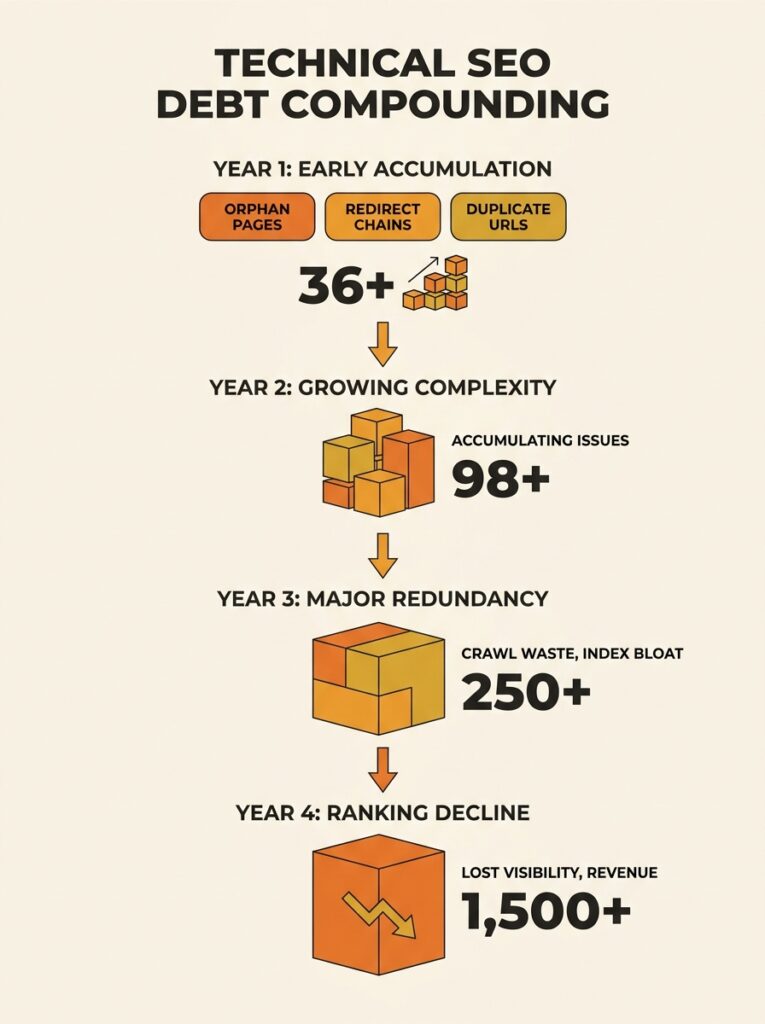
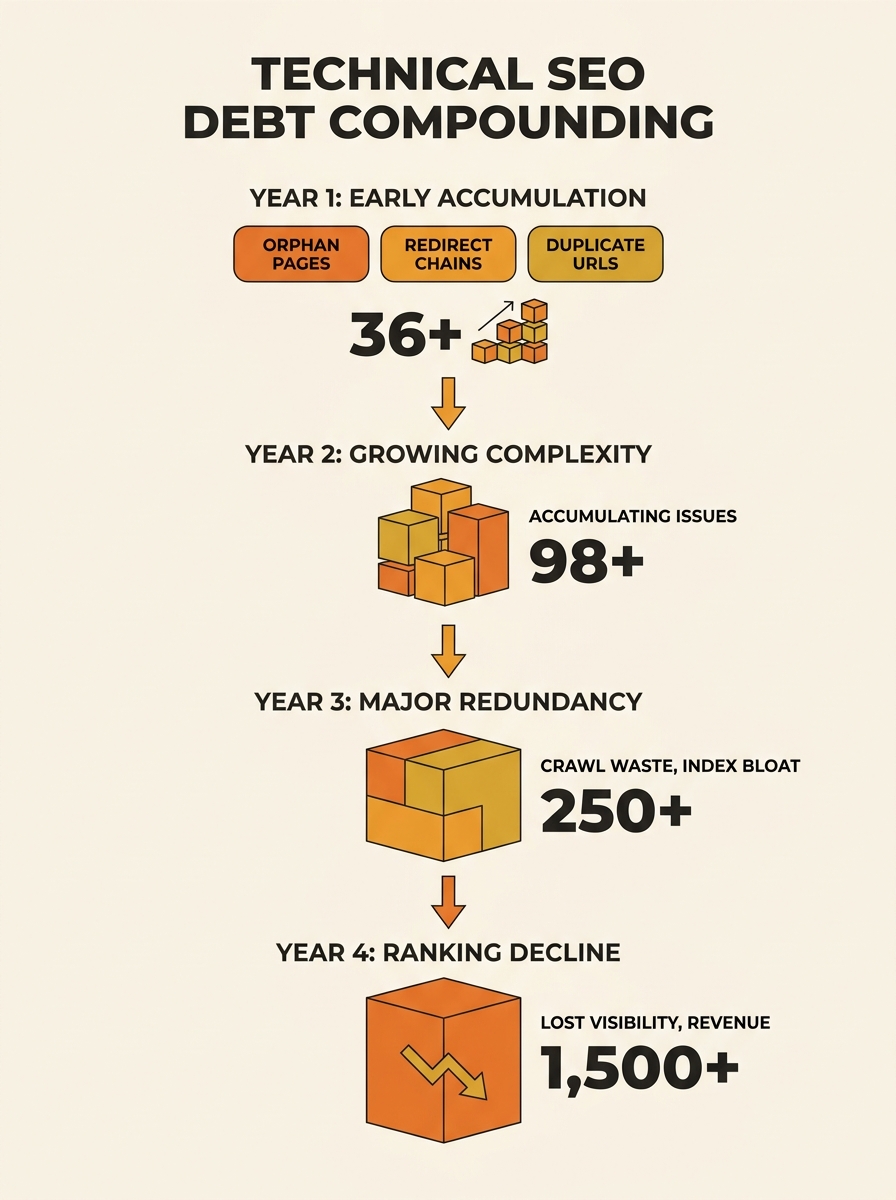
Googlebot allocated a fixed number of resources to crawl your website today. It visited some pages, skipped others, and made quiet decisions about what deserved indexing. If your site has thousands of parameter-driven URLs, orphaned product pages from a 2022 catalogue, or tag archives that duplicate your category structure, a meaningful portion of that crawl budget was burned on pages that will never earn you a single visitor. This is what technical SEO debt looks like in practice: invisible to the marketing team, irrelevant to the board, and compounding every single day until the damage surfaces in a traffic report nobody can explain.
The term borrows from software engineering, where “technical debt” describes shortcuts and deferred maintenance that accumulate interest over time. In SEO, it covers everything from broken redirect chains and bloated sitemaps to JavaScript rendering failures and inconsistent canonical tags. Australian businesses are particularly prone to letting this debt pile up, and the reasons are structural rather than accidental.
How the Debt Accumulates Without Anyone Noticing
The pattern is almost always the same. A business launches a site, invests in content and paid media, and sees reasonable organic performance for the first year or two. Development teams push new features, marketing adds landing pages for campaigns, and someone migrates the blog to a different CMS without updating internal links. Each of these changes introduces small technical issues that individually seem trivial. A few 404 errors here, a redirect loop there, an XML sitemap that still references URLs from a deprecated product line. Nobody files a ticket because nothing visibly breaks.
The disconnect between SEO teams and development teams makes this worse. As DebugBear’s 2026 technical SEO checklist points out, bots wasting time on URLs of no value reduces crawl frequency and can delay indexing of the pages you actually want ranking. But the developer who introduced the problem was solving a different brief entirely. They were shipping a feature, not thinking about how Googlebot would interpret the new URL structure. And the SEO person who might have caught it wasn’t consulted until after deployment, if at all.
This is where the “debt” metaphor becomes precisely accurate. Each unresolved issue doesn’t sit neutral on the balance sheet. It compounds. A few hundred low-value URLs in your index become a few thousand when you add faceted navigation filters for colour, size, and price. Those thousands of junk pages dilute the signals Google uses to understand which pages on your site actually matter. The interest rate on that debt is your declining organic visibility, and the repayments get more expensive every quarter you delay.
Crawl Budget and Indexation Are Where the Pain Hits First
For small brochure sites with fifty pages, crawl budget optimisation is mostly academic. Google will find and index everything without much effort. But the moment your site crosses into hundreds or thousands of pages, the economics of crawling start to matter. Google’s own documentation on crawl budget management advises site owners to check for availability issues during crawling and to make their infrastructure more efficient, including adding server resources if capacity is a bottleneck. That’s Google telling you directly: we have limits on how much attention we’ll give your site, so don’t waste it.
The typical Australian e-commerce site running on Shopify, WooCommerce, or Magento generates hundreds of filterable URL combinations per category. A clothing retailer with 30 categories, each with colour, size, and brand filters, can easily produce tens of thousands of indexable URLs that contain identical or near-identical content. As Search Engine Land’s guide to index bloat explains, overlapping categories and tags compete with each other in the index. The common fix — deindexing tags and consolidating thin filter pages — is straightforward in theory but requires a site architecture audit to implement properly without breaking internal link equity.
Indexation issues hit Australian businesses hard when they’re running multi-region sites, too. If you’re serving content to both Australian and New Zealand audiences with separate URL structures, the canonical and hreflang signals need to be airtight. We’ve written about how messy hreflang and canonical setups cause international SEO cannibalisation, and the underlying problem is almost always deferred maintenance. Someone set up the initial configuration, nobody audited it when new pages were added, and now Google is confused about which version of your content to serve in which market.
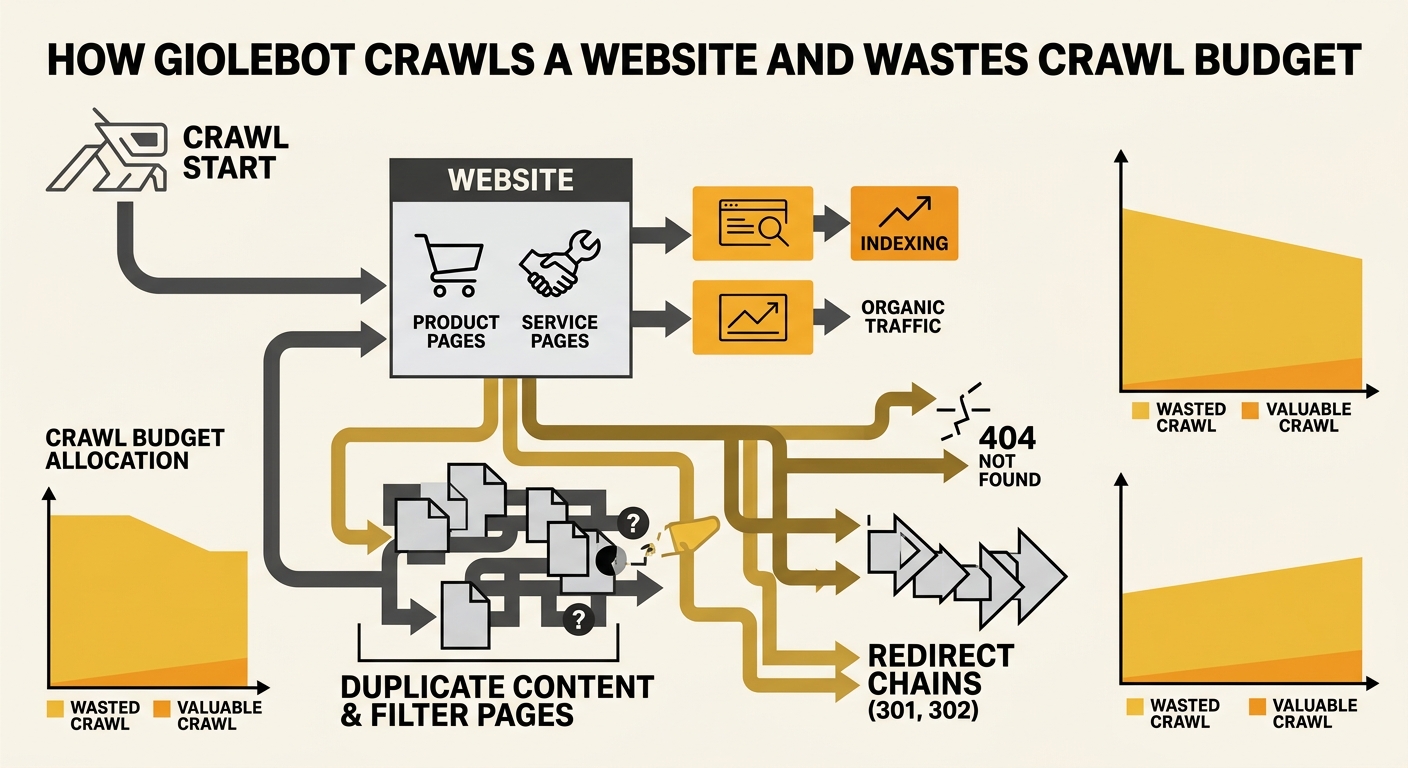
Each unresolved technical issue doesn’t sit neutral on the balance sheet. It compounds. The interest rate on that debt is your declining organic visibility, and the repayments get more expensive every quarter you delay.
Why Australian Businesses Specifically Defer This Work
There’s a cultural element to this that’s worth naming. Australian businesses, particularly in the SME segment, tend to treat SEO as a marketing channel you switch on and measure by leads or revenue. That framing naturally prioritises content creation, link building, and local optimisation because those activities have visible, attributable outputs. Technical SEO work, by contrast, feels like maintenance. It’s defensive rather than offensive, and it’s hard to tie a crawl budget improvement to a specific dollar figure in the next quarter’s report.
This creates a budgeting problem. When a business allocates $5,000 per month to SEO, the agency or in-house team faces a choice: spend two weeks on a technical audit and remediation sprint that might prevent future decline, or publish eight new blog posts and build fifteen links that might generate traffic growth this month. The incentive structure pushes everyone toward the visible work, and the technical debt keeps accumulating. The situation is compounded when businesses hop between agencies every twelve months, each new provider inheriting the last one’s unresolved issues and adding their own layer of quick-fix patches.
The consequences show up unevenly, which makes them harder to diagnose. A site might lose 15% of its organic traffic over six months and attribute it to algorithm changes or seasonal variation. The real cause might be that three hundred high-value product pages dropped out of the index because a developer’s robots.txt change inadvertently blocked a subdirectory, or because a staging environment was accidentally left crawlable and Google chose it as the canonical version. These aren’t hypothetical scenarios. They’re the kinds of issues that surface during a proper site architecture and content structure audit, and they’re almost always older than anyone expects.
Building a regular SEO monitoring practice is one of the most effective ways to catch these issues before they become expensive. Tracking crawl stats, index coverage reports, and Core Web Vitals weekly rather than monthly gives you a much shorter feedback loop. When a new deployment introduces a rendering problem or an internal link restructure accidentally orphans a cluster of pages, you’ll see the crawl data shift within days rather than discovering the damage three months later in a traffic dip.
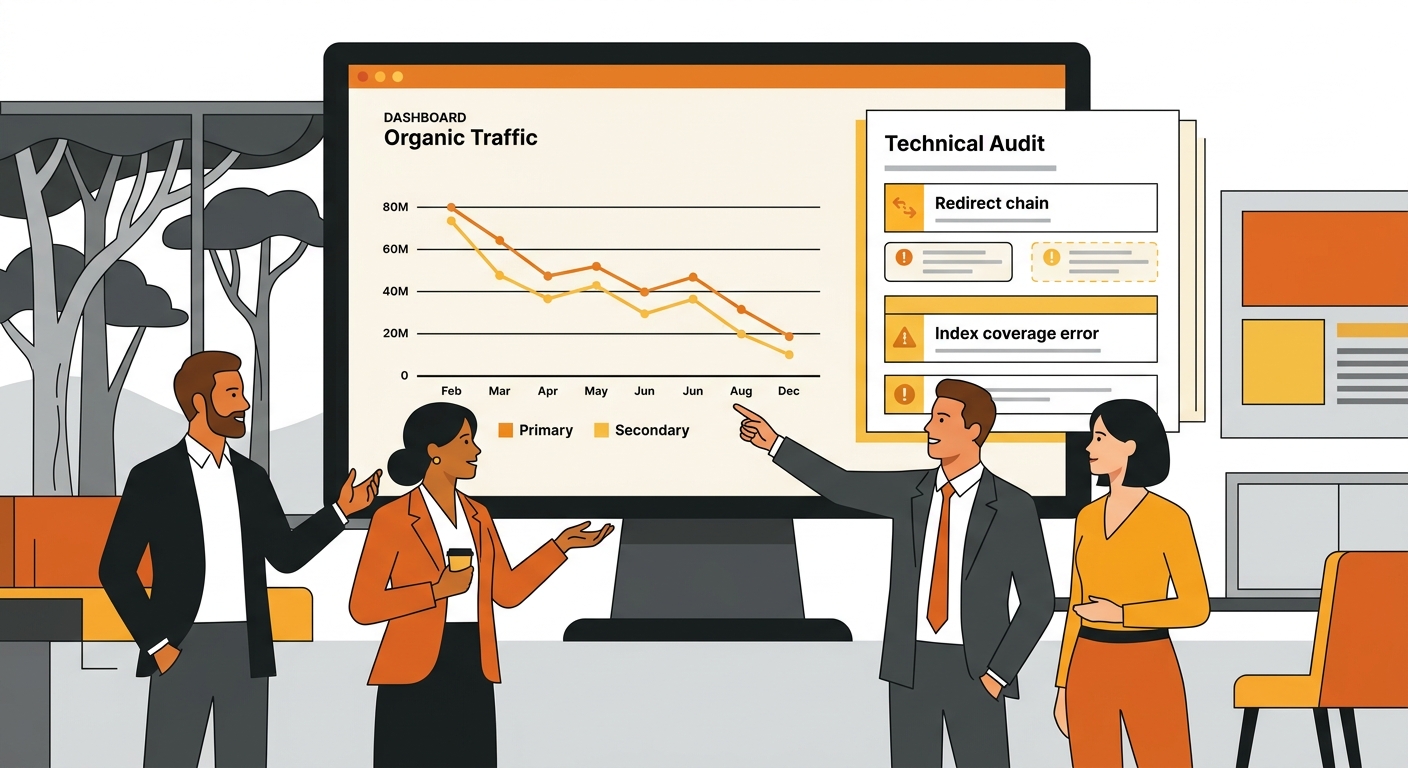
Warning: If your site has been through a platform migration, CMS change, or major redesign in the past two years without a follow-up technical audit, there’s a high probability you’re carrying undiagnosed SEO debt. Google Search Console’s index coverage report is the fastest free diagnostic — check it this week.
Where the Real Difficulty Lives
The uncomfortable truth about technical SEO debt is that knowing about it and fixing it are separated by an organisational gap that good intentions alone can’t bridge. The fix requires development resources, which means competing with product features, security patches, and infrastructure work for engineering time. It requires someone who understands both the technical implementation and the SEO implications, and those people are rare. And it requires ongoing discipline, because technical debt isn’t something you resolve once; it regenerates every time someone publishes a page, changes a template, or updates a plugin.
For long-term SEO performance, Australian businesses need to treat technical health the same way they treat financial accounting: as a continuous practice with regular reviews, not a crisis response. That means baking internal linking and crawlability checks into content publishing workflows, requiring SEO sign-off on development deployments that touch URL structures, and running quarterly audits even when nothing appears broken. The businesses that do this well don’t experience sudden organic traffic collapses. They experience the boring, steady kind of growth that compounds in their favour.
Whether that shift happens before or after the crisis is, for most organisations, still an open question. The technical knowledge exists. The tools exist. The gap is cultural, and closing it requires someone with enough authority to make the unsexy work a priority before the traffic chart forces their hand.