

The schema markup priority list that dominates Australian SEO advice gets the order backwards. Organisation and LocalBusiness schema now deliver measurably more visibility than FAQ schema, particularly for how AI platforms and local social discovery surface small businesses to their communities.
TL;DR: Australian SMEs should implement Organisation and LocalBusiness schema first, FAQ schema last. Google’s March 2026 core update caused a 47% drop in FAQ rich result impressions for misaligned pages, while LocalBusiness schema aligned with Google Business Profiles drives local pack appearances and AI citations. Fewer than 15% of Australian SMEs have proper schema markup, so the competitive window is wide open.
LocalBusiness Schema Powers Social Discovery
LocalBusiness schema matters more than FAQ schema for Australian SMEs because local search and conversational AI are the two channels where small businesses actually get discovered, and both depend on it.
When a potential customer asks ChatGPT or Perplexity “best plumber near me in Brisbane,” those AI systems pull from structured data to verify business details and construct answers. A 2026 implementation guide from SEO Sydney documents that sites with clean entity schema see measurable improvements in AI Mode citations. A controlled experiment demonstrated that only the page with well-implemented JSON-LD appeared in an AI Overview, while the no-schema version failed to surface at all. Cited pages earn 35% more organic clicks on average.
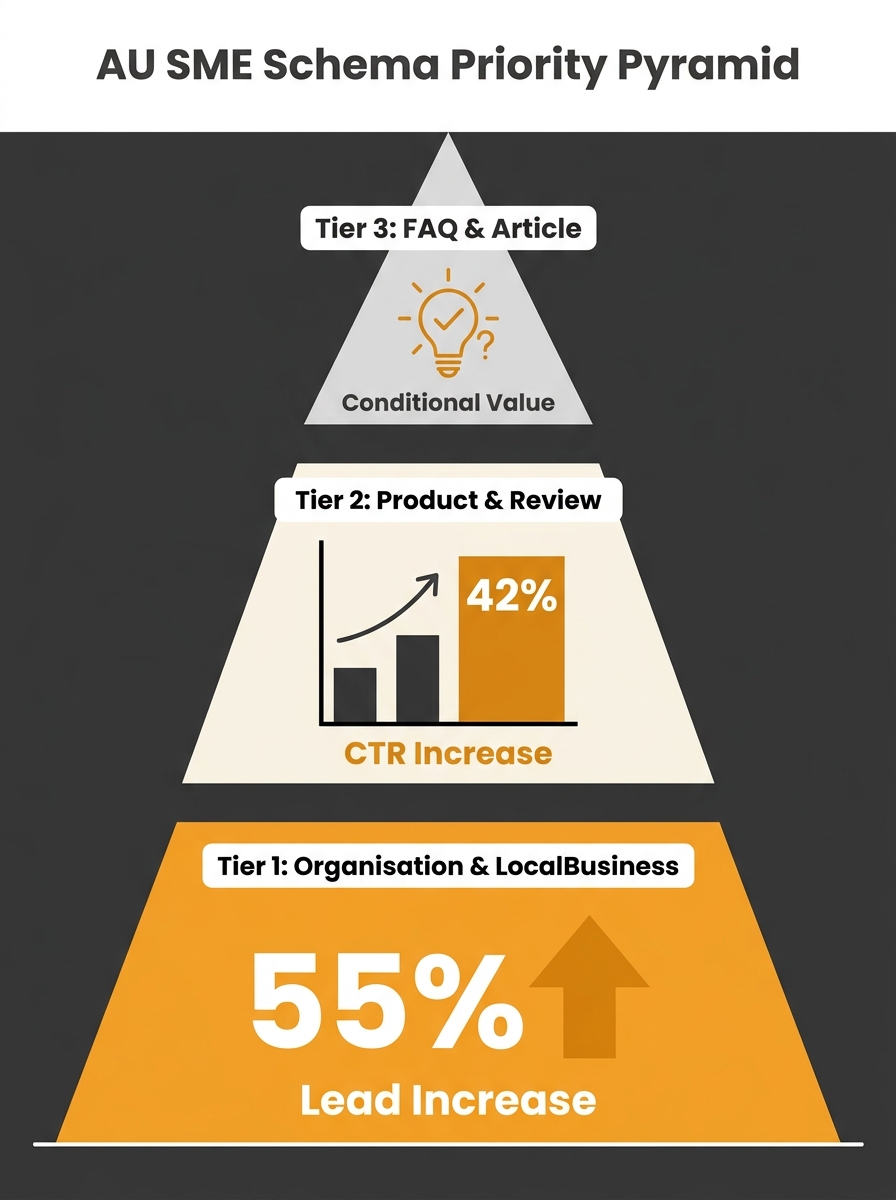
Real implementation numbers from Australian businesses reinforce the point. Precision Tax Partners in Brisbane added Service, LocalBusiness, and FAQ schema and recorded a 55% increase in qualified leads from organic search within six months. A Melbourne outdoor adventure company implemented Product, Review, and Organisation schema and saw a 42% lift in organic click-through rates alongside a 28% jump in organic revenue within three months.
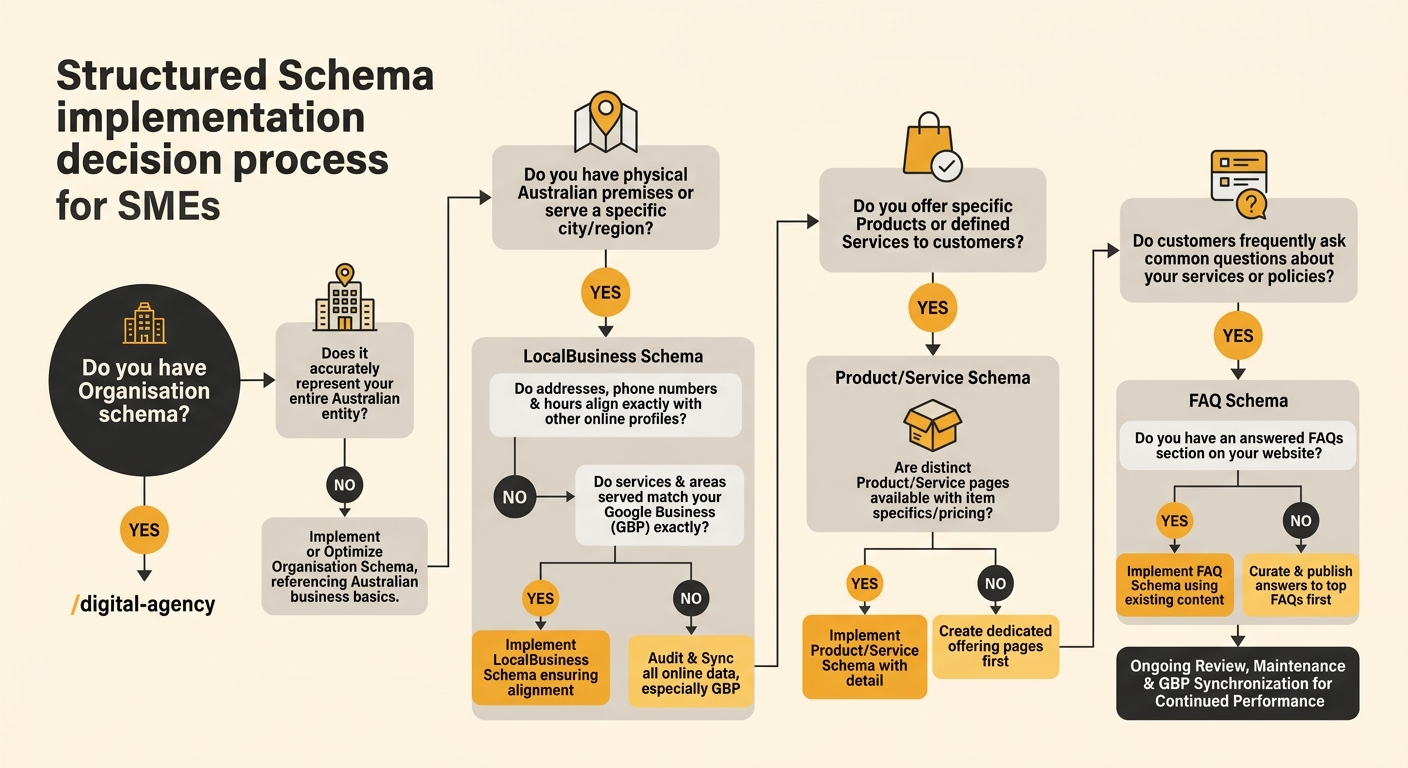
The critical detail that most guides skip: your LocalBusiness schema needs to match your Google Business Profile exactly. Name, address, phone number, opening hours, service areas. Any mismatch between your structured data and your GBP listing weakens both signals. If you’ve already worked through a local SEO audit of your Google Business Profile, you’ve got the raw data ready. Schema markup implementation becomes a matter of encoding what you’ve already verified.
For Australian SMEs in services, roughly 30% of local searches now come through voice, and voice assistants rely on LocalBusiness schema to construct spoken answers. A business without this markup is invisible to an entire channel that functions as social word-of-mouth at scale.
FAQ Schema’s Ranking Boost Has Been Overstated
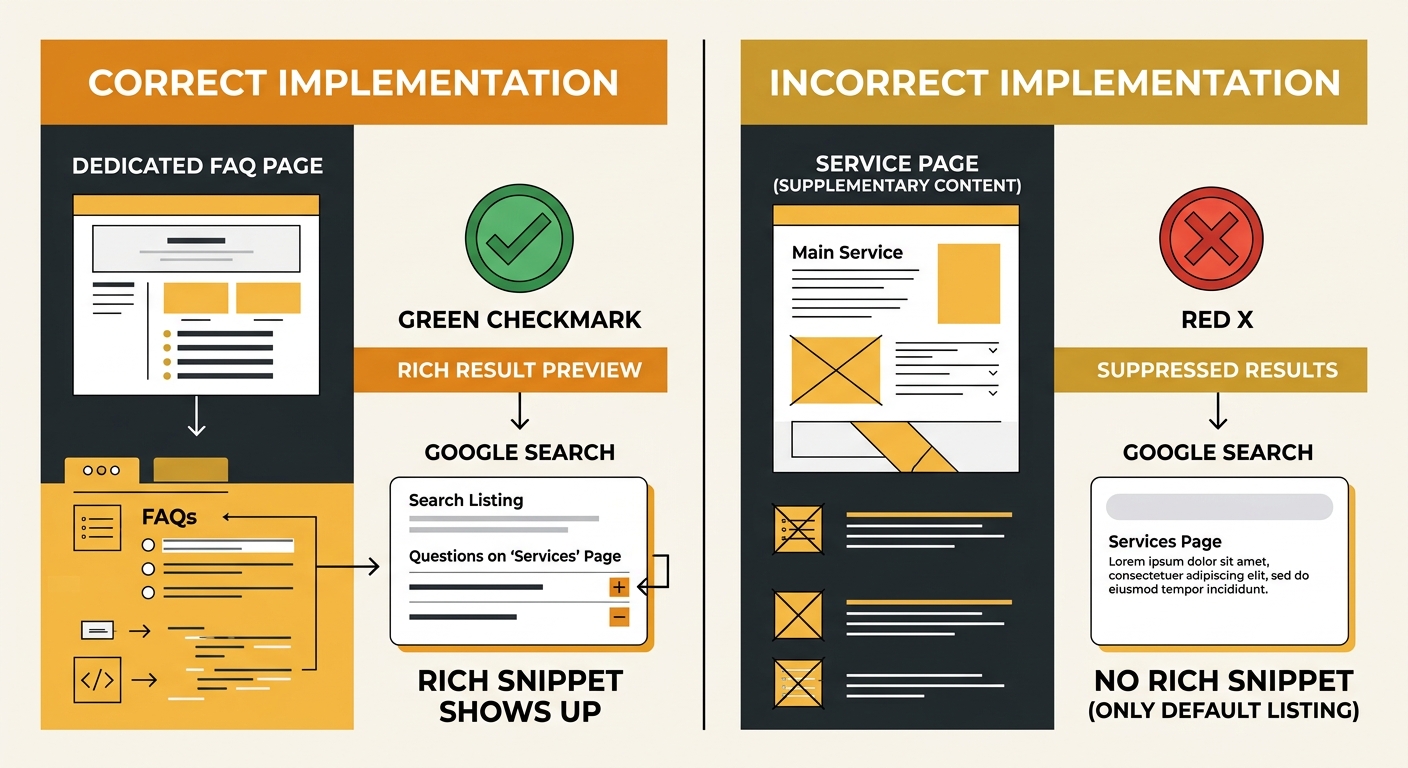
Google’s March 2026 core update fundamentally changed how FAQ schema works. Pages where FAQ markup described supplementary content rather than the page’s primary topic saw a 47% drop in FAQ rich result impressions. The old playbook of adding FAQ schema to every page to grab extra SERP real estate stopped working.
FAQ schema still has a role, but it’s narrower than the SEO community typically suggests. When implemented correctly on pages where FAQs genuinely are the primary content, it turns standard question-and-answer lists into rich results that AI models also extract for citations. The format must be JSON-LD in the document head. Google explicitly recommends JSON-LD over Microdata and RDFa for new builds, and the questions need to reflect what users actually search for.
AI models like Gemini and ChatGPT still use FAQ schema for answer extraction, which gives it ongoing value as a social discovery mechanism through conversational platforms. But the FAQ schema ranking boost is conditional on content alignment. A service page with three tacked-on FAQs at the bottom doesn’t qualify.
Schema must describe the primary content of the page. Supplementary schema on off-topic pages was demoted in the March 2026 update, triggering a 47% drop in FAQ rich result impressions.
The practical implication for structured data Australian SMEs are implementing: create dedicated FAQ pages for your most-asked questions, mark those up with FAQ schema, and leave it off your homepage and service pages unless FAQs are genuinely central to those pages. If you’re already structuring content into topic clusters, FAQ pages fit naturally as supporting nodes within your site hierarchy.
Schema Bloat Undermines Core Web Vitals
Adding structured data to a page isn’t free. Every block of JSON-LD adds to the document payload, and poorly implemented schema can contribute to layout shifts and slower initial renders. The relationship between Core Web Vitals schema performance and implementation approach matters more than most developers acknowledge.
According to FlyRank’s analysis, dynamic content driven by schema markup can cause visual shifts that hurt Cumulative Layout Shift scores. Their guidance is direct: properly place dynamic content, defer loading of non-essential schema-enhanced elements, and continuously monitor Core Web Vitals after any schema deployment.
Schema markup indirectly improves Core Web Vitals by increasing search engine processing efficiency, which contributes to better overall site performance. But that benefit only materialises when you’re selective. A page carrying Organisation, LocalBusiness, FAQ, Product, Review, BreadcrumbList, and SiteNavigationElement schema simultaneously isn’t getting seven times the benefit. Diminishing returns set in fast, and a heavier document drags page speed down.
Warning: Validate every schema block through Google’s Rich Results Test before publishing. Incomplete data with missing required properties suppresses rich results entirely. You end up worse off than having no schema at all.
The framework I’d propose for Australian SMEs is the Three-Tier Schema Stack:
- Tier 1 (implement first): Organisation schema with SameAs identifiers linking to your LinkedIn, Facebook, and industry directories. LocalBusiness schema matching your GBP listing exactly. These establish entity identity for AI systems and search engines.
- Tier 2 (implement within 30 days): Product or Service schema with attribute-rich data including pricing, availability, and ratings. Review schema pulling verified customer reviews. Detailed Product markup drives approximately 30% higher organic CTR compared to generic implementations.
- Tier 3 (implement only where content warrants it): FAQ schema on dedicated FAQ pages where questions are the primary content. Article or BlogPosting schema on content hubs, using dateModified as a freshness signal that AI systems read when selecting sources.
If your site already carries technical issues from conflicting markup, resolve those before adding more structured data. And if you’re concerned about performance impacts, run the same audit process you’d use for diagnosing page speed problems after each schema deployment.
The Priority List, Rewritten
Fewer than 15% of Australian SMEs have proper schema markup. That gap represents a genuine competitive advantage for businesses willing to implement structured data methodically rather than chasing whatever schema type the latest SEO blog recommends.
The conventional priority list — FAQ first because it’s “easy,” Product second because it’s “visible” — ignores what actually drives rankings and AI citations after Google’s March 2026 core update. Organisation and LocalBusiness schema establish entity identity. They tell Google, ChatGPT, and Perplexity who you are, where you operate, and what you’re connected to via SameAs properties. Every other schema type builds on that foundation.
FAQ schema isn’t worthless, but it belongs at the end of the implementation queue, deployed selectively on pages where frequently asked questions are the primary content. Spreading it across your entire site after the March 2026 update is a liability that suppresses the very rich results you’re trying to earn.
The Three-Tier Schema Stack puts Organisation and LocalBusiness first, keeps the document payload lean enough to protect Core Web Vitals, and reserves FAQ schema for pages that genuinely earn it. Australian SMEs that follow this order will be the ones showing up in AI answers, local packs, and the social discovery channels where 85% of their competitors have no structured data presence at all.