

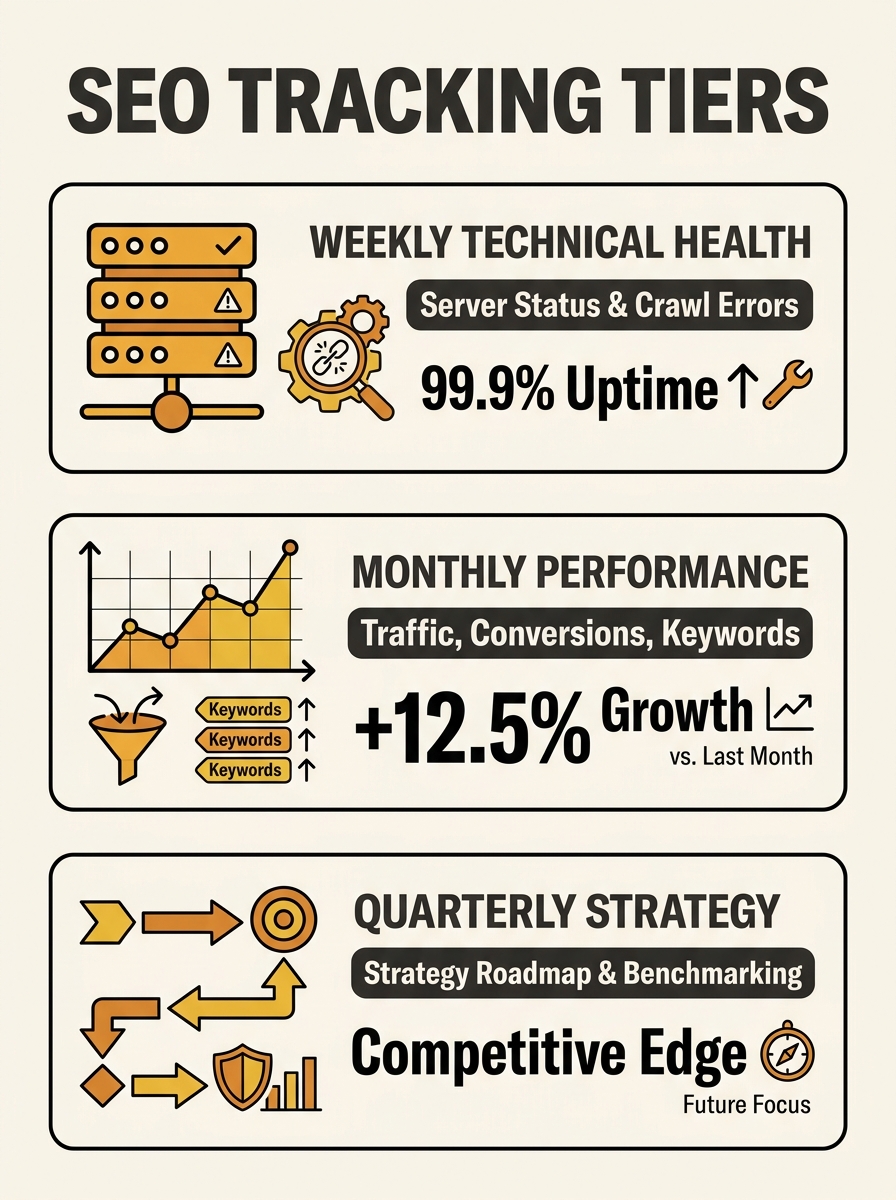
Every major SEO reporting framework published in 2026 converges on the same tiered structure: weekly checks for technical breakages, monthly reviews for performance trends, quarterly sessions for strategy. Affiliate site operators who deviate from this pattern, particularly those pulling rank data daily, tend to make worse optimisation decisions rather than better ones.
The reasoning is straightforward. SEO data is noisy on short timescales. Google recrawls pages at different intervals, personalisation skews results between sessions, and ranking fluctuations of three to five positions within a single week are completely normal. When you check daily, you’re reading signal and noise together without any way to distinguish one from the other. Factors.ai’s benchmarking guide puts the recommended rhythm plainly: “Weekly on issues, monthly on progress, quarterly on strategy.” That three-tier cadence applies to every Australian SME running an affiliate operation, whether you’re monetising product review content, comparison pages, or lead generation funnels.
The rest of this piece breaks down what belongs at each frequency, which metrics matter at each tier, and how to recognise when your SEO performance tracking cadence has tipped from useful into anxious.
Why Affiliate Sites Are Especially Prone to Over-Tracking
Affiliate revenue depends almost entirely on organic search visibility. There’s no brand-query safety net. If your affiliate site drops from position 3 to position 8 for a “best [product category] Australia” keyword, commissions can halve within a fortnight. That financial exposure creates a strong psychological pull toward constant monitoring.
The problem is that acting on daily data leads to a pattern of overreaction. You see rankings dip on a Tuesday, panic-publish a new supporting article on Wednesday, then restructure internal links on Thursday. By the following Monday, the original rankings would have recovered on their own because the dip was algorithmic churn. But now you’ve introduced three uncontrolled changes, making it impossible to attribute any future movement to a specific cause.
This is the core issue with daily rank tracking for Australian affiliate SMEs: it doesn’t give you more control. It gives you more opportunities to make unforced errors. As SpyFu’s research on SEO metrics notes, monitoring too many metrics creates more confusion than clarity, with bloated dashboards producing conflicting signals and no coherent story.
What Weekly Checks Should Actually Cover
Weekly monitoring belongs strictly in the technical health lane. You’re looking for breakages, not trends. The list is short:
- Crawl errors and indexation status. Did Google suddenly drop pages from the index? Did a CMS update introduce noindex tags you didn’t intend? If you’ve recently run an internal link audit to find orphaned pages, weekly spot-checks confirm those fixes are holding.
- Site uptime and server response times. For affiliate sites on shared hosting (common with Australian SMEs keeping costs down), server issues can crater visibility within days.
- Tracking code integrity. GA4 tags break silently. If your analytics stopped recording conversions on Monday and you don’t notice until the monthly review, you’ve lost weeks of data.
- Manual action notifications. Check Google Search Console for any flags. This takes thirty seconds.
That’s it. No keyword rank analysis, no traffic trend review, no conversion rate comparisons. Those metrics need a longer baseline to mean anything. TapClicks’ reporting best practices guide reinforces that weekly reports are most useful after technical fixes, confirming that crawl error resolutions and tracking implementations actually took effect.
If your weekly check takes longer than fifteen minutes, you’re checking things that belong in the monthly review.
If your weekly check takes longer than fifteen minutes, you’re checking things that belong in the monthly review.
Monthly Reviews Carry the Weight
For the benchmark review frequency Australian SMEs should follow, monthly is where the real analysis lives. A month gives you enough data points to separate genuine movement from noise, especially for affiliate sites that might receive only a few hundred organic sessions per day.
Your monthly review should cover:
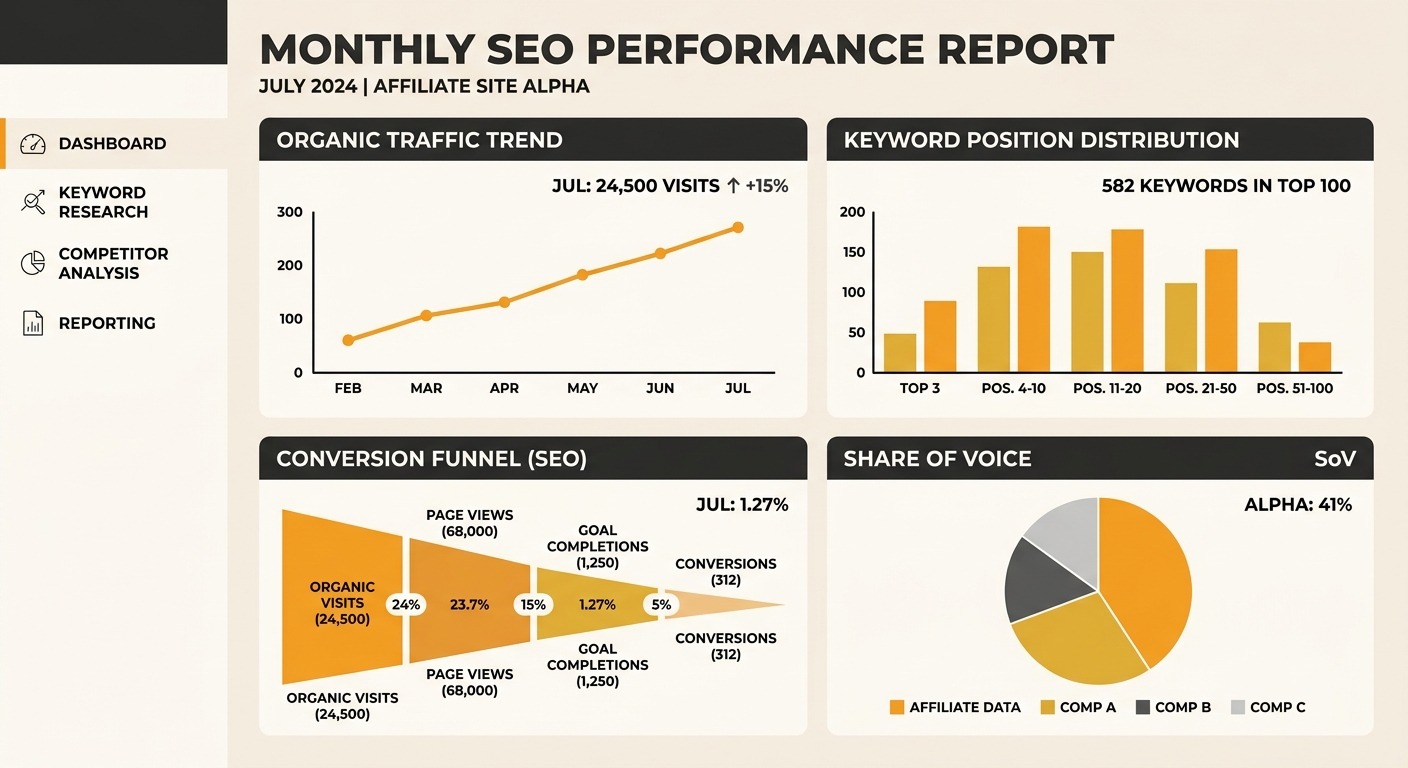
Organic traffic by landing page cluster. Don’t look at sitewide traffic in isolation. Break it down by your affiliate content clusters. If your “best vacuum cleaners” cluster is growing while “best air purifiers” is declining, that tells you something actionable. Sitewide traffic might look flat and hide both signals. This approach pairs well with how content clustering creates structural SEO advantages for smaller sites.
Keyword position changes across your money pages. Track the top 50 to 100 keywords that actually drive affiliate clicks and conversions. Ignore the long tail unless specific long-tail pages are revenue generators. A healthy affiliate site should see 5 to 10 per cent organic traffic growth month-over-month. Anything above 15 per cent is strong. Flat or declining months deserve investigation, but a single flat month rarely warrants panic.
Conversion and revenue attribution. How many affiliate link clicks came from organic search? What was the conversion rate? If you’re running Australian affiliate programmes, match your GA4 data against your affiliate network’s reporting to catch discrepancies.
Share of voice against competitors. As Promodo’s SEO benchmarks guide recommends, measure your share of voice across core keyword sets compared to your top three to five competitors, measured monthly. The goal is steady growth and closing the gap with whoever leads your niche.
Backlink profile changes. New referring domains, lost links, and any suspicious link patterns that might indicate negative SEO or link rot. For affiliate sites, lost links from product review roundups or “best of” articles on other sites can directly impact rankings for your most valuable pages.
The monthly review should take one to two hours for a typical Australian affiliate SME. If it’s taking a full day, you’re probably tracking too many metrics or generating reports nobody reads. The tools themselves can contribute to this problem, and we’ve covered why all-in-one SEO platforms tend to create noise for smaller operators rather than cutting through it.
When Your Dashboard Becomes the Problem
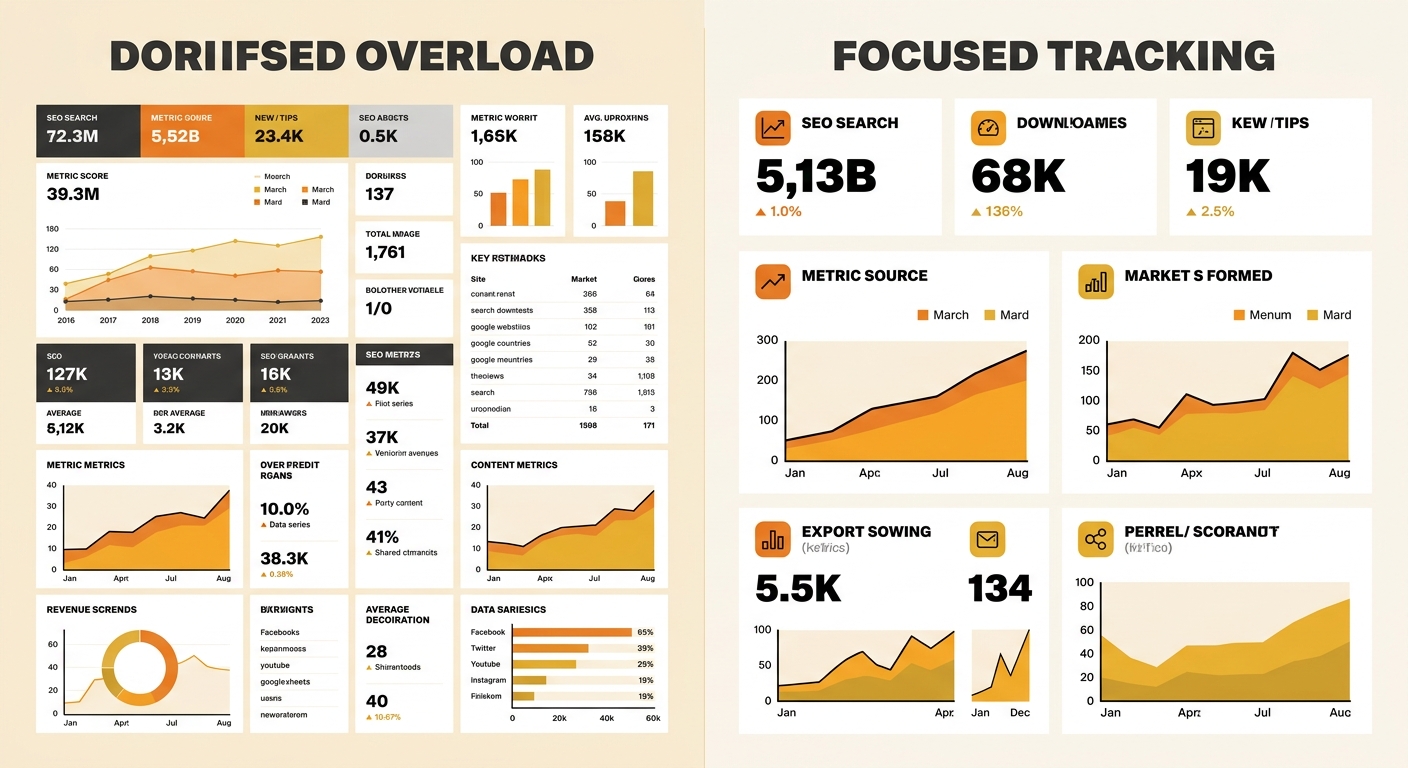
SEO dashboard overload is real, and affiliate marketers are prime candidates for it. Every affiliate network has its own reporting interface. GA4 has dozens of custom reports you could build. Ahrefs, Semrush, and Search Console each present overlapping data in slightly different ways. Before you know it, you’ve got six tabs open and you’re comparing numbers that were calculated using different methodologies.
The fix is constraint. Pick one source of truth for each metric category:
- Rankings: One tool (Semrush or Ahrefs, not both).
- Traffic and behaviour: GA4, full stop.
- Conversions: Your affiliate network’s dashboard, cross-referenced with GA4 events monthly.
- Technical health: Google Search Console for indexation, your preferred crawler for on-site issues.
If you’re running weekly vs monthly SEO reporting across three or four different platforms, you’re spending time reconciling data rather than acting on it. That reconciliation time is pure waste for a small affiliate operation. Tools that promise to centralise everything often produce a false sense of completeness that masks the metrics requiring human interpretation.
The actionable SEO metrics tracking that actually matters for affiliate revenue fits on a single page. If your report doesn’t fit on one page, question whether every metric on it has driven a decision in the past three months. If a metric has never prompted you to do something different, remove it.
Quarterly Strategy Is Where You Zoom Out
The quarterly review is where you ask bigger questions. Is the affiliate niche still viable? Are AI Overviews displacing your click-through rates on key queries? Has a competitor launched a content hub that’s eroding your share of voice?
This session should include competitive benchmarking against at least three rivals, an honest assessment of which content clusters are generating revenue versus consuming resources, and a budget review. For seasonal affiliate niches common in Australia (outdoor gear peaking before summer, tax software peaking before July), quarterly reviews let you adjust content production schedules before peak periods rather than reacting mid-season.
Quarterly is also when you should reset your benchmarks. Comparing against the same baseline from twelve months ago becomes meaningless once your site has grown or contracted significantly. Update your targets to reflect current reality.
The Open Threads
A few things the “weekly-monthly-quarterly” framework doesn’t resolve cleanly for Australian affiliate operators:
Algorithm update responses. When Google rolls out a broad core update (which happened multiple times in the past year), should you accelerate to weekly performance reviews? Probably yes, but only for four to six weeks, and only on the pages that moved. The risk is that temporary weekly tracking becomes permanent daily tracking once the anxiety sets in.
New site launches. If you’ve just launched an affiliate site, there’s very little meaningful SEO data for the first two to three months. Monthly reviews during this phase often produce reports that say “not enough data yet” in every section. Setting expectations with stakeholders (or with yourself) that the first quarterly review is when real analysis begins saves everyone frustration.
Multi-location affiliate models. Australian affiliate operators targeting city-specific keywords (e.g., “best electrician Sydney” versus “best electrician Brisbane”) face a multiplication problem: every location adds another set of keywords to track. The tiered cadence still applies, but the monthly review balloons in scope. Whether to track all locations monthly or rotate locations on a six-week cycle is a genuine open question that depends on your team’s capacity.
The discipline of checking less often runs counter to every instinct an affiliate operator has. Revenue depends on visibility, visibility fluctuates constantly, and the dashboards are always one click away. But the evidence from every credible SEO reporting framework points in the same direction: the operators who review monthly and act decisively outperform the ones who review daily and fidget constantly. Building a rhythm you can sustain matters more than building one that feels thorough.