
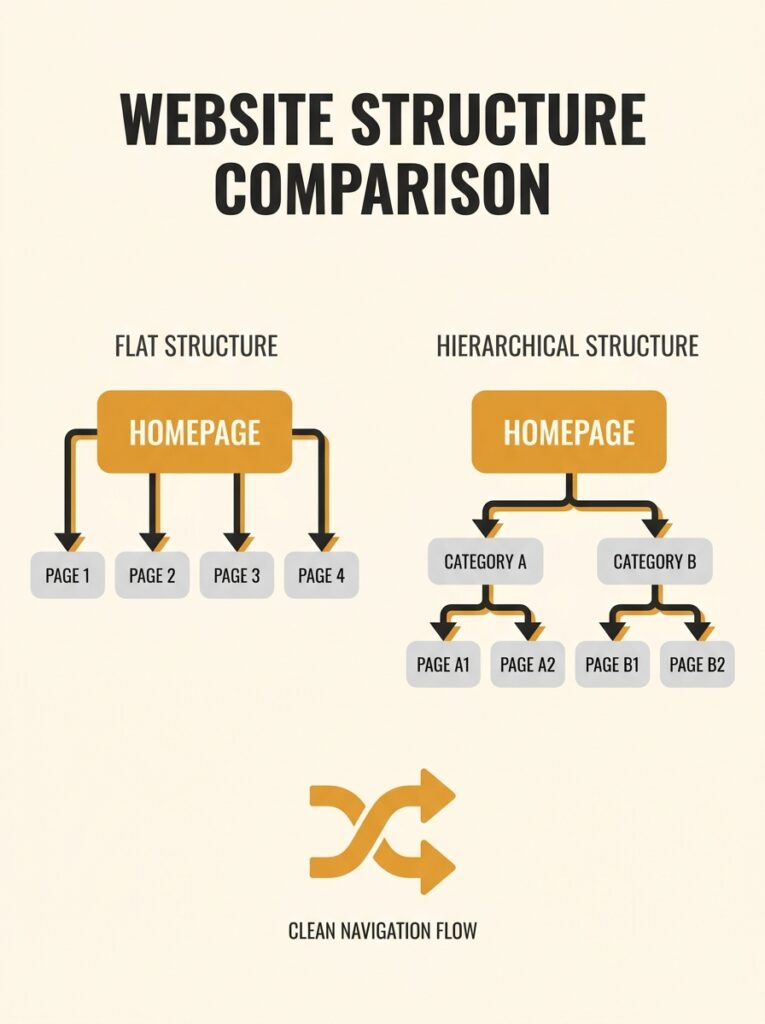
Flat site architecture is the wrong default for any Australian SME publishing more than about 30 pages of content. The standard advice (keep everything within three clicks of the homepage) is solid for crawlability, but it quietly undermines the topical authority signals that Google uses to decide whether your site deserves to rank for competitive terms. A shallow hierarchy with deliberate content clusters performs better across the board, and three bodies of evidence make this case convincingly.
Before you reorganise your entire sitemap, though, let’s be precise about what “flat” and “hierarchical” actually mean in practice, because the terms get thrown around loosely enough to cause real confusion.
A flat structure places every page within one or two clicks of the homepage. There’s minimal nesting. Your URL paths look like /services/, /seo-audit/, /contact/, /blog-post-title/. According to TEAM LEWIS’s site structure guide, flat site structures have fewer levels, typically three or fewer, making content accessible quickly. A hierarchical structure (sometimes called a “deep” or “siloed” architecture) nests pages under parent categories: /services/seo/technical-seo-audit/. The depth creates relationships between pages that signal topical grouping.
The debate usually gets framed as a binary choice. It shouldn’t be.
Flat Structures Distribute Link Equity Well but Create Topical Ambiguity
The case for flat architecture is genuinely strong on two fronts: crawl efficiency and link equity distribution. When every page sits close to the homepage, Googlebot finds and indexes content faster. Internal PageRank flows more evenly because there are fewer layers to dilute it through. For a 15-page brochure site (a tradesperson’s website, say, or a small accounting firm), flat is the correct choice without qualification.
The problem emerges once you cross roughly 30 to 50 pages. At that point, a flat structure starts presenting Google with a pile of loosely related content and no clear signal about what the site is authoritative on. Think of it this way: if your plumbing business has service pages, suburb landing pages, and a blog with 25 posts covering everything from blocked drains to bathroom renovation tips to water heater comparisons, a flat structure makes all of those pages structural equals. Google sees a collection. It doesn’t see a subject matter expert.
This matters because website structure rankings depend heavily on how well Google can identify thematic relationships between pages. If you’ve dealt with crawling rule conflicts that sabotage indexing, you already know that what Google can see and what Google chooses to value are two different things. A flat structure makes everything visible. It doesn’t make everything meaningful.
Search engines do prefer flat structures for raw crawling purposes. As Flowmatters notes, important pages closer to the homepage tend to get better visibility in search engine rankings. But visibility and authority are separate outcomes, and for any SME competing in a moderately contested niche, authority is where the actual rankings come from.
Content Cluster Architecture Produces Compounding Returns
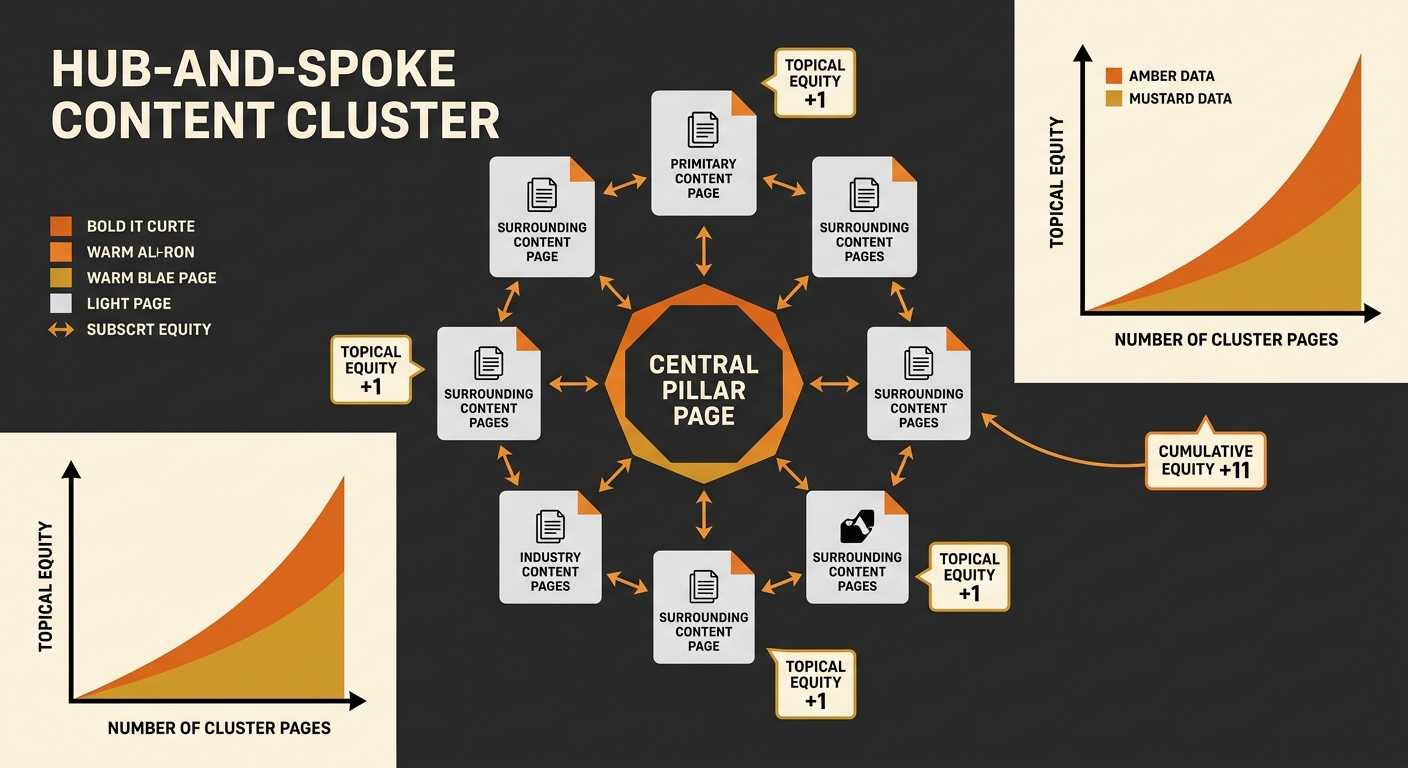
The concept behind content cluster architecture is straightforward: you create a pillar page that covers a broad topic, then build out supporting pages (cluster content) that explore specific subtopics in depth. Every cluster page links back to the pillar, and the pillar links out to each cluster page. Semrush defines pillar pages as content that serves as the cornerstone of a topic cluster, and that’s a useful way to frame it.
What makes this structure particularly valuable for Australian SMEs is a phenomenon that Sticky Digital calls “topical equity.” Once you’ve established authority in a specific content hub, each subsequent piece of content you publish in that cluster ranks faster. The site’s existing authority in that topic gives the new page a head start. For a Brisbane electrician who’s built a thorough cluster around commercial electrical safety, a new post about updated AS/NZS wiring standards won’t need to fight from zero. The existing cluster has already established the site’s credentials in that subject.
Once you’ve established authority in a specific content hub, each subsequent piece of content you publish in that cluster ranks faster.
This is where the structure intersects with topical authority structure in a meaningful way. The hub-and-spoke model creates the kind of thematic depth that Google’s systems reward. It answers adjacent questions without forcing users or bots to leave the domain. And it does something a flat structure fundamentally can’t: it demonstrates that your site has covered a topic from enough angles to be treated as a genuine authority.
For pillar pages Australia-based SMEs should focus on, the sweet spot is usually a topic broad enough to warrant 800 to 2,000 words of overview content, with five to ten subtopics that each justify their own dedicated page. If you’re a Melbourne financial planner, your pillar might cover superannuation strategies, with cluster pages on salary sacrifice, SMSF setup costs, contribution caps, transition-to-retirement pensions, and so on.
We’ve written at length about how to organise site structure for better rankings, and the practical steps haven’t changed much. What has changed is how aggressively Google rewards sites that get this right. The compounding effect is real, and it’s measurable in Search Console data within three to six months of building out a well-linked cluster.
The Hybrid Model Outperforms Both Extremes
The architecture that works best for the vast majority of Australian SMEs is neither purely flat nor deeply hierarchical. It’s a shallow hierarchy (two to three levels of depth maximum) organised into deliberate content clusters with strong internal linking between them.
Concretely, this means:
- Homepage links to main category or service pages (Level 1)
- Category pages link to individual service pages, location pages, or pillar content (Level 2)
- Cluster content sits at Level 2 or Level 3, linked to and from its parent pillar page
Every important page remains within three clicks of the homepage, preserving the crawl efficiency benefits of flat architecture. But the logical grouping into clusters gives Google clear site hierarchy SEO signals about what your site is actually about.
Internal linking is the glue that holds this together. When you’re choosing anchor text for internal links, use descriptive phrases that tell both users and search engines what the target page covers. Generic anchors like “click here” or “read more” waste an opportunity to reinforce topical relevance.
And this isn’t a structure you can set and forget. As your content library grows, the architecture needs periodic review. We covered how technical SEO debt accumulates when businesses ignore structural issues, and site architecture is one of the most common areas where debt builds up silently. Pages get published outside the cluster framework, internal links decay, and the structure gradually flattens into the exact topical ambiguity you were trying to avoid.
Tip: Run a quarterly crawl audit (Screaming Frog or Sitebulb both work well for this) to identify orphan pages, broken internal links, and content that’s sitting more than three clicks from the homepage. Fix structural drift before it compounds.
The implementation side matters too. If you’re working with a team handling your web development, make sure they understand the cluster model before building out navigation and URL structures. Retrofitting a flat site into a clustered hierarchy is significantly more work than building the hierarchy in from the start. Similarly, if your web design process treats navigation as a visual decision rather than an architectural one, the structure will reflect design preferences rather than topical logic.
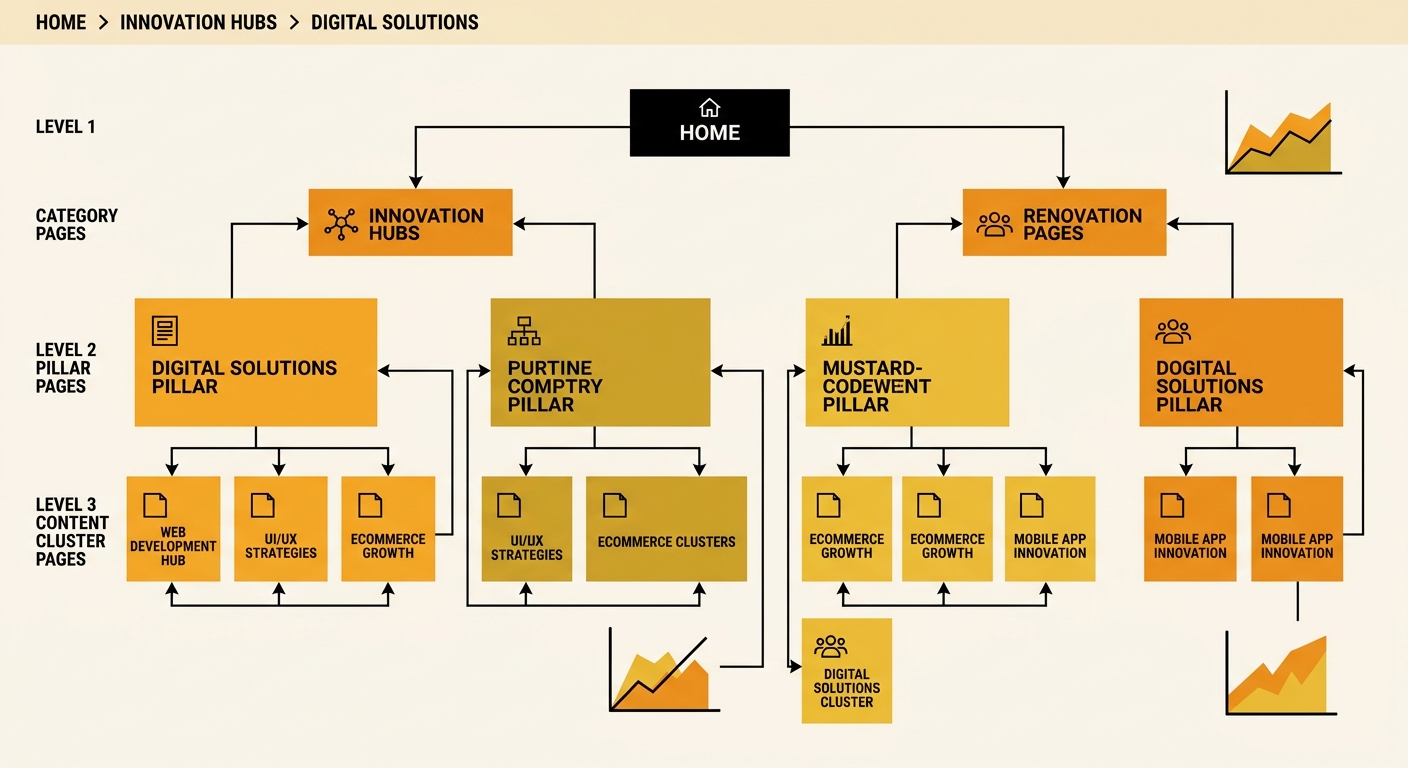
Breadcrumb navigation and schema markup reinforce this hybrid structure for search engines. One case study documented a roughly 40% drop in organic click-through rates after a site removed breadcrumb schema, which underscores how much Google values clear hierarchical signals in structured data.
Where This Leaves the Flat-vs-Deep Debate
The contrarian claim here isn’t that flat structures are bad. For small brochure sites, they’re ideal. The claim is that flat architecture becomes actively counterproductive once an SME starts building content at any real scale, because it prevents the formation of the topical authority signals that drive competitive rankings.
Australian SMEs sitting in the 30 to 200 page range (which covers most small businesses with an active blog or multiple service lines) will almost always rank better with a shallow hierarchy organised around content clusters. The structure preserves everything good about flat architecture: fast crawling, strong link equity distribution, easy navigation. And it adds the one thing flat architecture can’t provide on its own: a clear, machine-readable signal that this site knows its subject deeply enough to deserve a ranking.
The work of building this structure is unglamorous. It involves mapping out your topics, identifying which pages belong to which clusters, writing pillar content that genuinely earns its hub status, and maintaining internal links as you publish new material. None of that is exciting. But the compounding authority it creates is the single most reliable ranking advantage available to SMEs competing against larger sites with bigger budgets and more backlinks. The architecture itself becomes the competitive edge, quietly accumulating topical equity with every well-placed page you add to the cluster.