
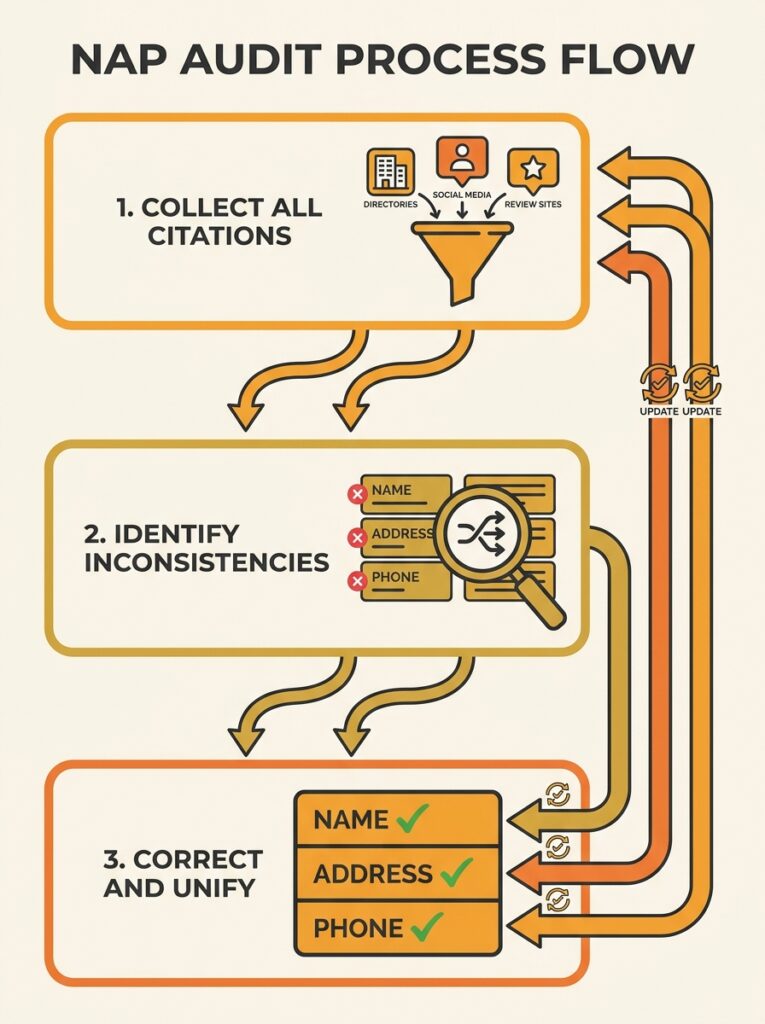
Google Business Profile shows your trading name as “Smith & Co Electrical.” Yellow Pages has “Smith and Co Electrical Services.” TrueLocal lists a mobile number you ported two years ago. Each listing tells a slightly different story about the same business, and Google’s response to that contradiction is predictable: it trusts you less. The frustrating part is that most business owners don’t realise the inconsistency exists until they run a proper local SEO citation audit. For Australian businesses competing in the Map Pack and now in AI-generated search results, this kind of quiet data rot is one of the most common reasons they lose ground to competitors who aren’t necessarily better, just cleaner in the eyes of the algorithm.
What a Local SEO Citation Audit Actually Involves
The concept is simple enough: your business’s Name, Address, and Phone number (commonly referred to as NAP) should be identical everywhere it appears online. Your Google Business Profile, your website footer, your social media pages, Yellow Pages, TrueLocal, Yelp Australia, industry-specific directories, and anywhere else your business has ever been listed. As This Jay’s 2026 GBP guide puts it plainly, “Jay’s Plumbing” on one directory and “Jay’s Plumbing Services Pty Ltd” on another creates noise in Google’s data, and noise hurts rankings. Google cross-references your NAP details against directories, review sites, social media profiles, and your own website to build a confidence score about who you are and where you operate.
The audit itself means pulling together every listing you can find and comparing them field by field. You’re looking for abbreviation differences (St vs Street, Pty Ltd vs nothing), outdated phone numbers from old tracking campaigns, suburbs that were correct for a previous office, and categories that don’t match your actual services. According to Moz’s Local Search Ranking Factors research, citation consistency and external location signals rank among the top four factors Google uses to validate a local business. That ranking isn’t a surprise when you think about it from Google’s perspective: if the web can’t agree on your basic contact details, why would it trust you with a prominent local search position?
Service-area businesses and practitioners within larger firms get hit especially hard here. A physiotherapy clinic with three practitioners might end up with separate listings that Google treats as distinct businesses, splitting review signals and diluting the practice’s authority. For anyone providing Brisbane SEO or Perth SEO services, cleaning up Google Business Profile citation consistency for local clients is one of the first tasks in any engagement, because nothing else works properly until the foundation data is right. You can’t rank well in the Map Pack when Google isn’t sure which version of your business is the real one.
AI Overviews Are Pulling From Your Listings
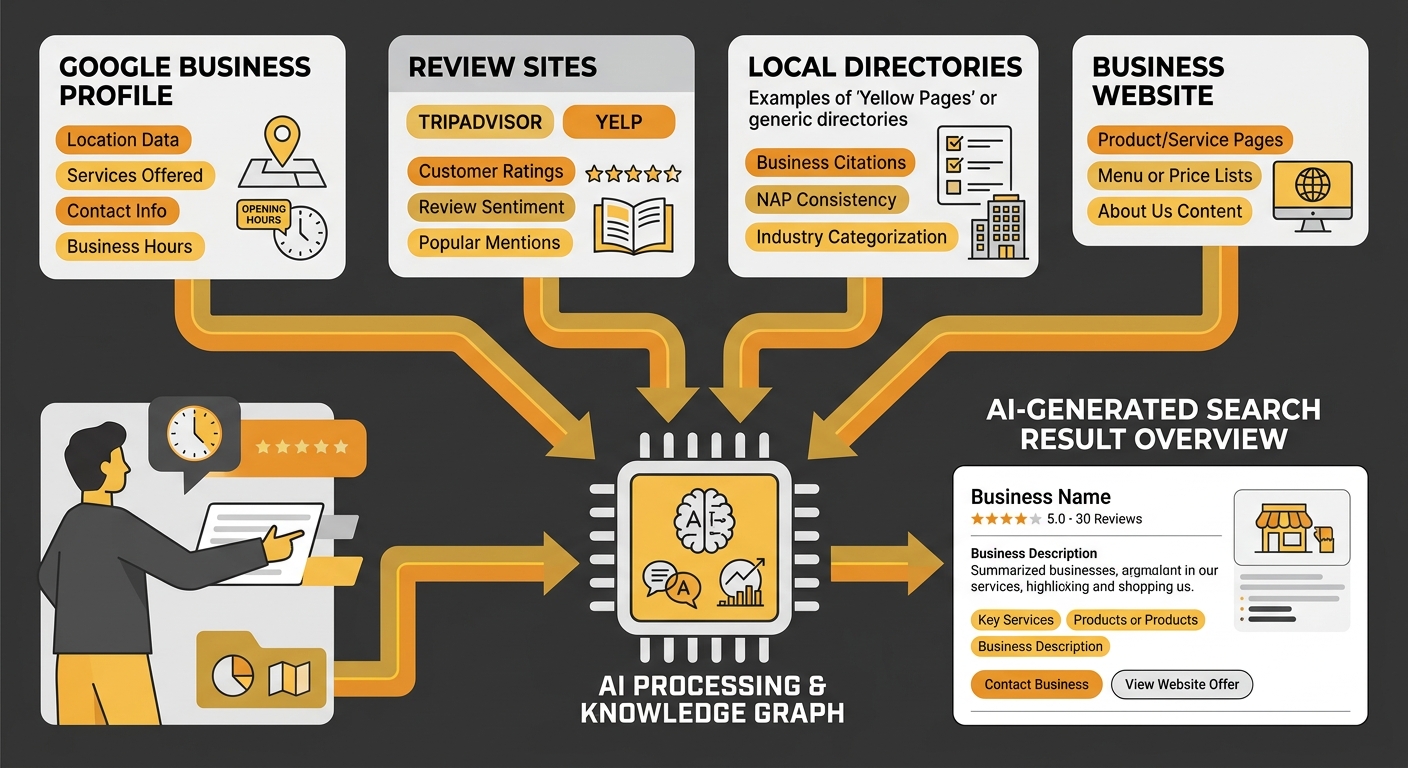
The urgency around citation accuracy has increased now that AI-generated summaries dominate search results. We’ve covered how AI-generated summaries now appear in the vast majority of Google searches, and those summaries don’t just draw from web pages. They pull from Google Business Profiles, from review aggregators, from directory listings. When Google’s AI needs to answer “best emergency plumber near me,” it’s assembling an answer from multiple sources, and the businesses with consistent, well-maintained citations across those sources get cited. The ones with conflicting data get skipped.
Search Engine Land’s reporting on how AI is impacting local search shows that AI platforms are actively scraping, summarising, and citing review content. Google’s AI Overviews have been observed pulling directly from TripAdvisor reviews, Yelp ratings, and directory descriptions to generate local answers. This means your citation strategy now affects two separate search surfaces: the traditional local pack and the AI-generated result that increasingly sits above it. Research from multiple sources indicates that over 92% of AI Overview citations come from pages already ranking in the top ten organic results, so the relationship between traditional local SEO performance and AI visibility is direct and measurable.
Your citation strategy now affects two separate search surfaces: the traditional local pack and the AI-generated result that increasingly sits above it.
For AI Overviews local search optimisation, the practical implication is that keeping your listings accurate, your reviews fresh, and your business information structured with proper schema markup gives the AI system the confidence signals it needs to include you. Pages with LocalBusiness and Review schema are significantly more likely to surface in AI-generated summaries, and businesses that earn brand mentions across the web through press coverage, community involvement, or industry publications build the kind of entity recognition that AI systems weigh heavily when deciding which businesses to cite.
The Multi-Location Problem
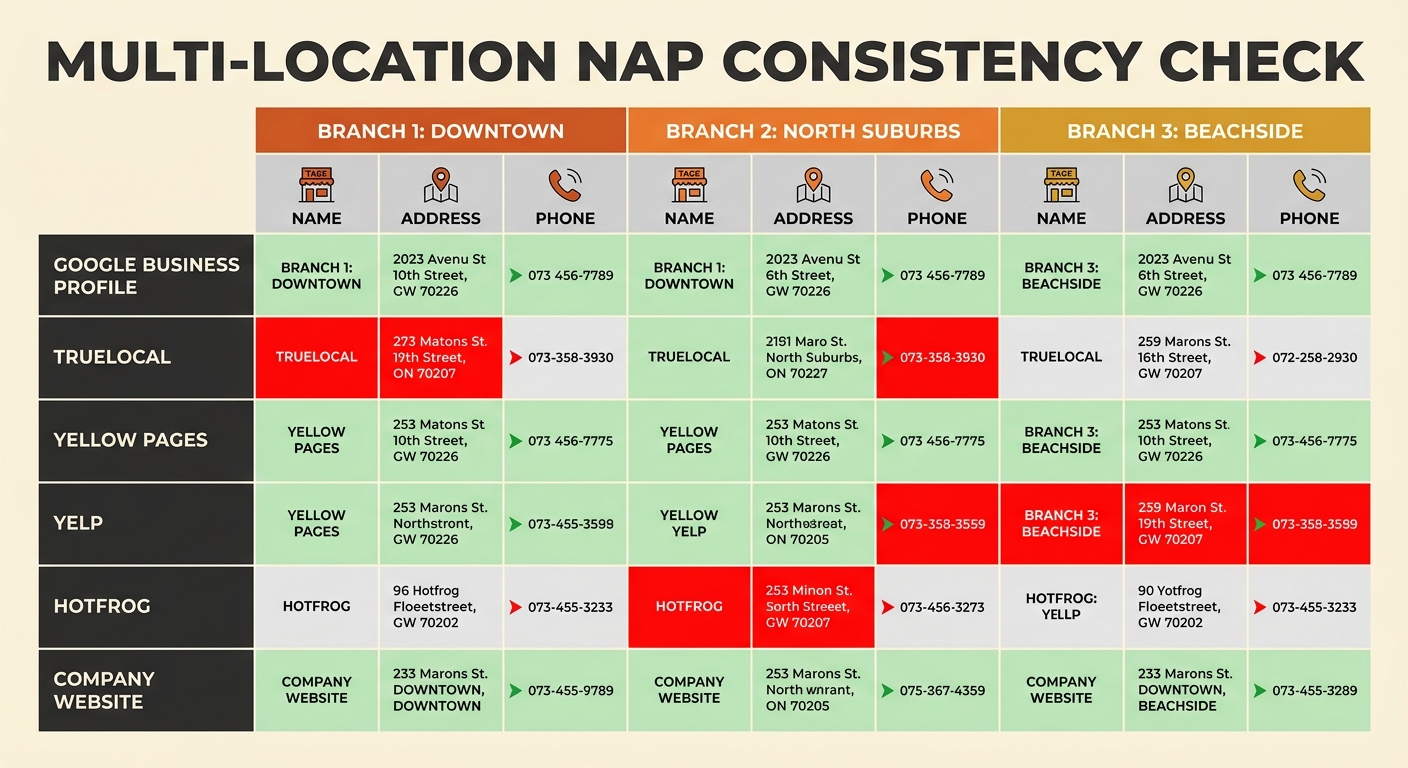
Everything described above gets harder when you’re managing more than one location. A multi-location citation strategy requires consistency across every branch, and the opportunities for data rot multiply with each new office, franchise, or service area. A dental group with practices in Sydney, Melbourne, and Brisbane needs separate, accurate listings for each location, and if the head office ever changed its booking phone number or if one location moved down the street, every single directory needs updating. Data aggregators can help distribute correct information at scale, but they also propagate errors at scale if the source data isn’t clean.
We’ve explored how AI Overviews are reshaping multi-location SEO strategy and the citation gaps that emerge when individual branches fall out of sync. The pattern is consistent: businesses that run routine audits across all locations, treating citation management as ongoing maintenance rather than a one-time setup, maintain their local rankings more reliably than those that set and forget. Routine audits help eliminate false citations, catch out-of-date information, and prevent the kind of slow ranking decay that’s hard to diagnose because it doesn’t arrive as a single dramatic drop. It shows up as a gradual slide from position two to position five to off the first page entirely, and by the time you notice, the inconsistent data has been compounding for months.
Tip: If you’ve ever changed phone numbers, moved locations, used call tracking numbers on listings, or had different staff members create listings over the years, you almost certainly have citation inconsistencies that need resolving. An audit is worth doing before any other local SEO investment.
The Australian market has its own quirks here. Directories like TrueLocal, Hotfrog, and StartLocal are still active citation sources that Google references, but they’re not always top of mind when businesses think about their online presence. And unlike US-focused guides that emphasise Yelp and the Better Business Bureau, an Australian local SEO citation audit needs to account for these local directories alongside the global platforms. Missing even one high-authority local directory can leave a gap that competitors fill.
Where the Certainty Runs Out
The relationship between citation consistency and local rankings is well-established. The connection between clean citations and AI Overview inclusion is newer, and the evidence is still accumulating. We know that AI systems prefer structured, consistent data sources. We know that businesses with strong local SEO fundamentals are more likely to appear in AI-generated results. But the exact weighting that AI Overviews give to citation signals versus review sentiment versus content freshness versus schema markup is something nobody outside Google can state with precision, and anyone claiming otherwise is extrapolating beyond the data.
What does seem clear is that the fundamentals haven’t changed as much as the hype cycle suggests. Keeping your NAP data consistent, earning genuine reviews, maintaining accurate structured data on your site, and building real brand mentions across the web are the same activities that drove local rankings five years ago. The difference is that these activities now serve a second purpose: feeding accurate data to AI systems that decide which businesses get cited in the answers that increasingly replace traditional search results. Whether that dual purpose makes citation management twice as important or whether it was always this important and businesses just didn’t take it seriously enough is a question I don’t think anyone can answer cleanly. What’s harder to argue with is that the downside of getting it wrong has grown, because you’re no longer losing visibility in one place. You’re losing it in two.