
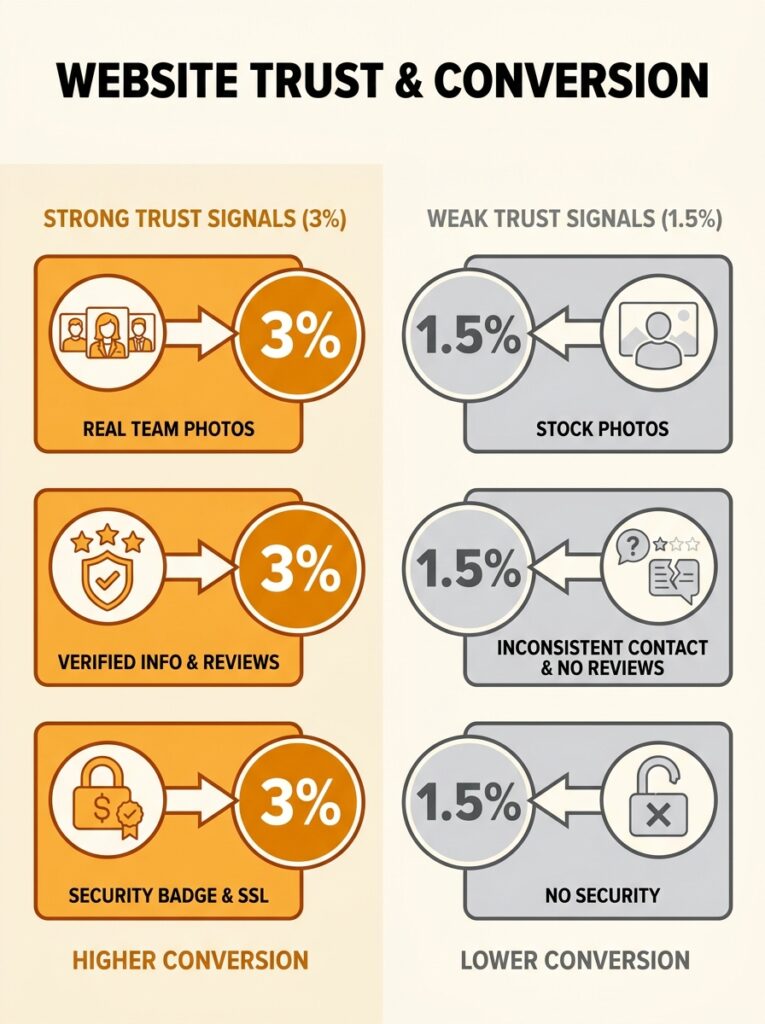
Two ecommerce stores with comparable traffic volumes and identical product categories, one converting at 3% and the other at 1.5%. According to Nector’s 2025-26 conversion benchmarks, the difference usually comes down to checkout latency, payment flexibility, mobile usability, or post-add-to-cart friction. But there’s a variable those benchmarks don’t name directly: whether the visitor believed the business was credible before they ever reached the cart. That belief, built or destroyed in the first seconds of a page load, determines whether a top-three ranking generates revenue or merely generates impressions.
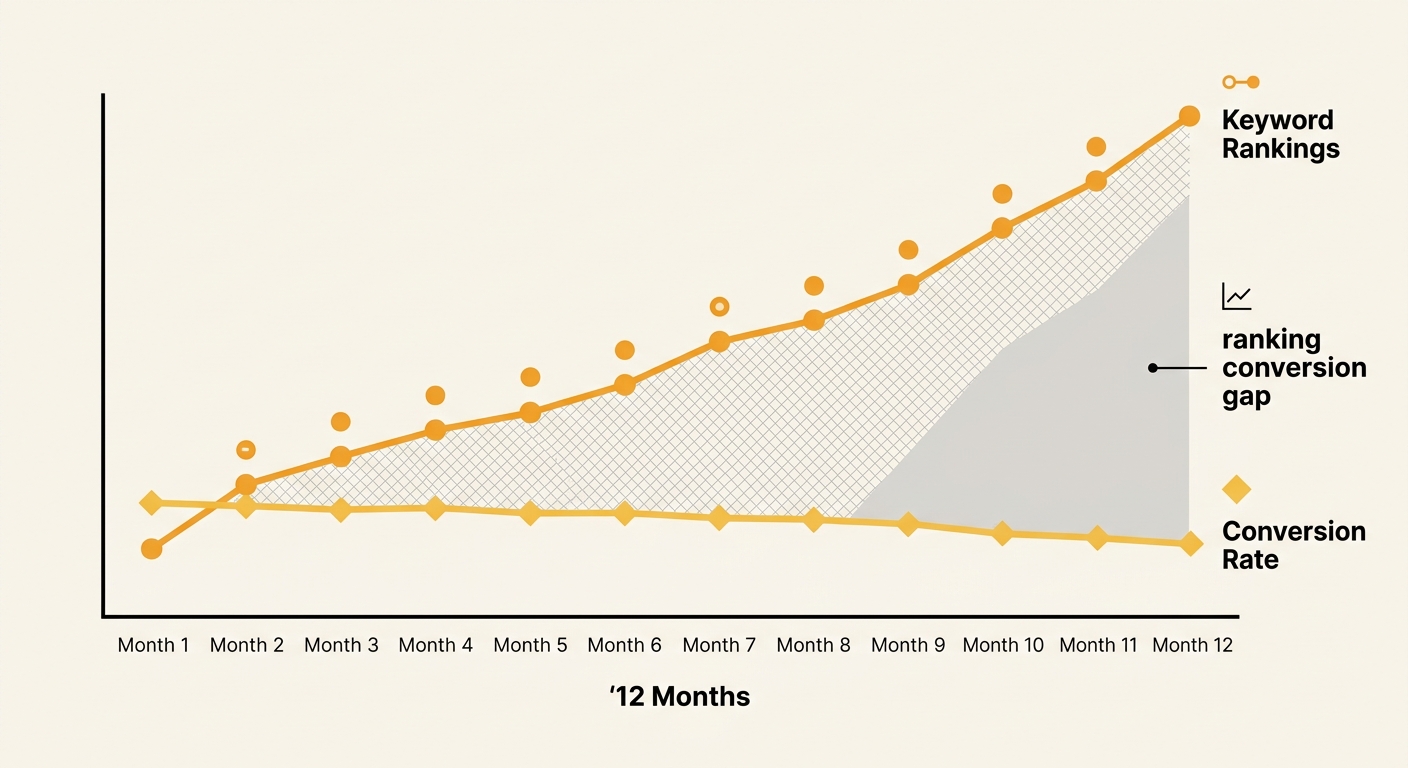
Australian companies spent over $1.5 billion on SEO services in 2025, according to Red Search’s industry data reported by Website Builder Australia. That figure reflects a market where 97% of businesses are SMEs and where search visibility has become table stakes. Yet a growing share of that spend produces traffic that doesn’t convert, and the pattern repeats across industries. The ranking-conversion gap, as practitioners have started calling it, is widening precisely because technical optimisation has outpaced credibility building. Businesses rank well and sell poorly because they’ve treated search engines as the customer rather than treating the human behind the screen as one.
Credibility Is the Variable That Audits Keep Missing
The standard credibility audit in technical SEO focuses on structured data, crawlability, page speed, mobile responsiveness, and schema markup. These are necessary. They are also insufficient. As The Providence Journal reported in a piece on brand trustworthiness, a brand might rank highly through strong technical optimisation yet fail to convert visitors if trust signals are absent. The article makes a clean distinction between relevance and trust, and that distinction matters enormously for Australian small business rankings where local reputation carries outsized weight.
Think about what a visitor actually evaluates in the three to five seconds after clicking a search result. They’re scanning for evidence that this business is real, competent, and safe to transact with. That evidence includes visible customer reviews (ideally from third-party platforms, not just curated testimonials), a physical address that matches what Google Business Profile shows, consistent contact details across the web, visible security indicators, and identifiable humans behind the business. When any of these signals are missing or contradictory, the visitor’s confidence drops, and they hit the back button regardless of how technically clean the page loads.
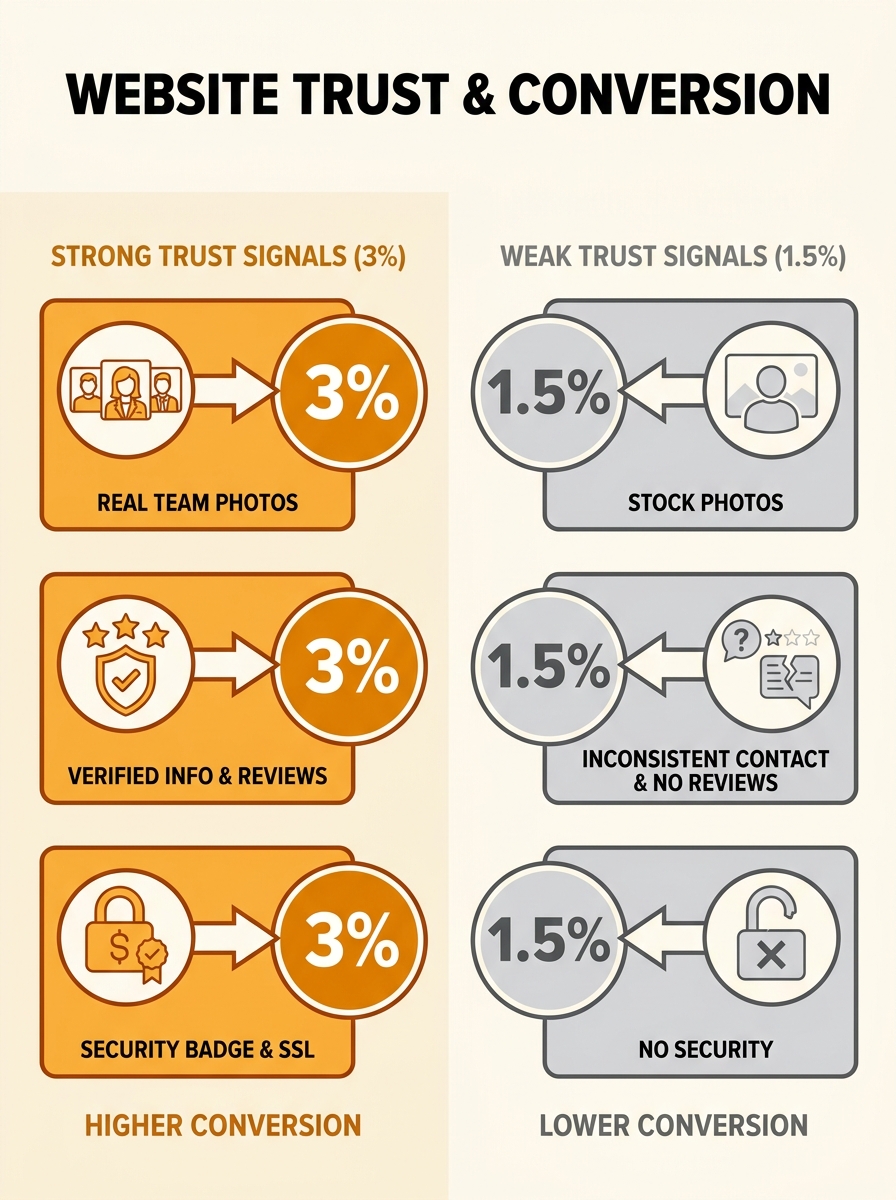
The data on this perception gap is striking. Envive’s 2026 brand trust metrics analysis found that only 30% of consumers trust the brands they buy from, while 90% of executives at those same companies believe their customers trust them deeply. That 60-percentage-point gap between perception and reality represents lost revenue at every stage of the funnel. Australian SMEs aren’t immune to this. If anything, smaller businesses with thinner brand recognition face a steeper credibility hill to climb, which means their trust signals SEO work needs to be more deliberate, not less.
Where Trust Signals Live in the Technical Stack
It’s tempting to think of trust as a soft, unmeasurable concept that lives outside the domain of technical SEO. That’s wrong. Trust signals have concrete, auditable expressions throughout a website’s architecture, its linked data ecosystem, and its search presence. A proper credibility audit touches all three layers.
The first layer is on-page. This includes whether review schema is implemented correctly and reflects genuine third-party reviews, whether author information is present and verifiable on content pages, whether contact pages contain a real ABN (for Australian businesses this is a baseline expectation), and whether HTTPS is properly configured without mixed content warnings. If your technical SEO foundation has unaddressed debt, trust signals degrade even when the content itself is solid. A page that loads with a broken SSL indicator or throws console errors doesn’t inspire confidence, even subconsciously.
A 60-percentage-point gap exists between how much executives think customers trust their brand and how much customers actually do. That gap is where revenue disappears.
The second layer is off-page consistency. Your business name, address, and phone number need to match exactly across Google Business Profile, Apple Maps, industry directories, and social platforms. We’ve written before about how citation consistency and AI overview optimisation work together for local businesses, and the principle applies directly here. Every inconsistency is a micro-signal to both search engines and humans that something is off. When a prospective customer Googles your business name and finds three different phone numbers across three directories, the trust calculation shifts against you.
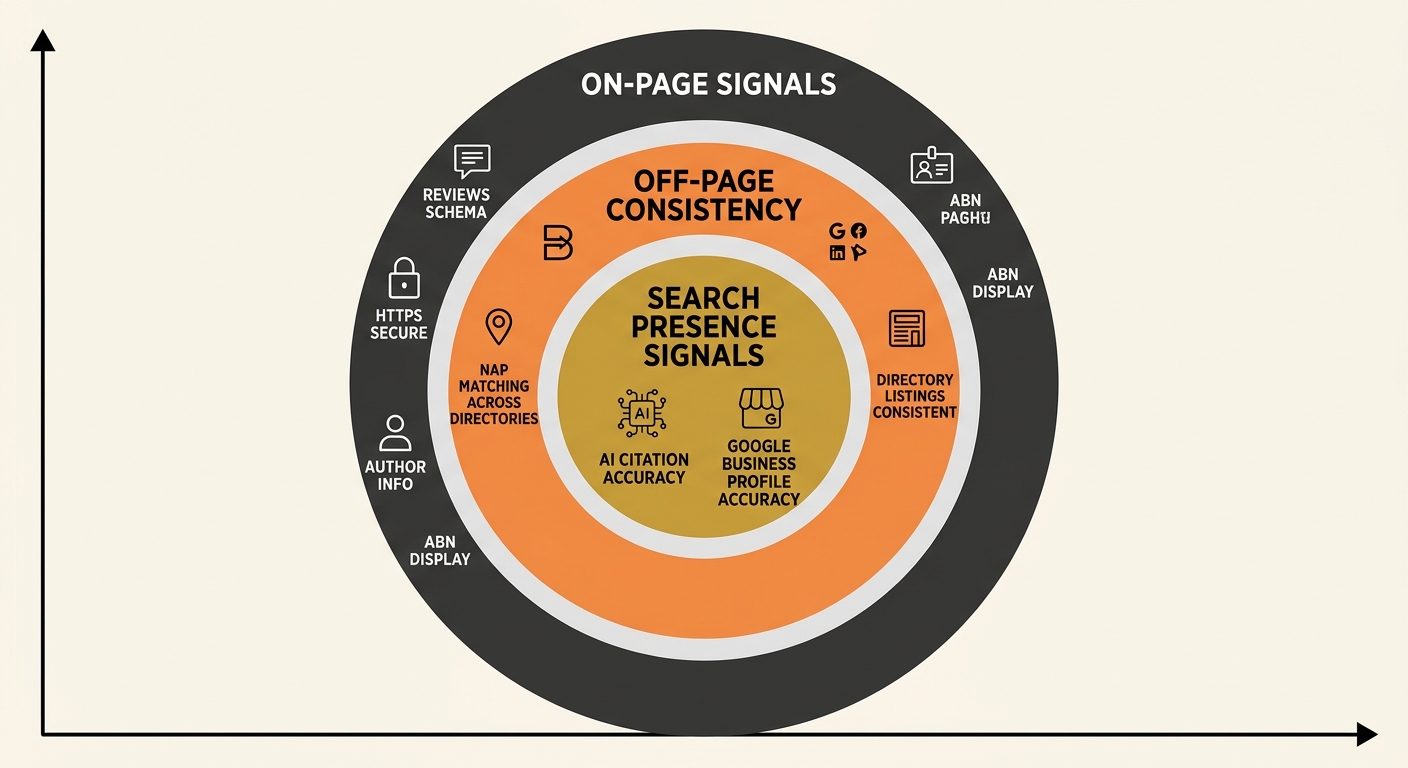
The third layer is emerging and relates to how your business appears in AI-generated search responses. As AI-generated summaries reshape search results, the businesses that get cited tend to be those with consistent, verifiable information across multiple authoritative sources. A business with conflicting details across the web is less likely to be surfaced in an AI overview, and less likely to be trusted by a user who encounters it there. This creates a compounding effect: weak trust signals reduce both traditional conversion rates and your visibility in the AI-driven search layer that’s rapidly growing.
The Compounding Cost for Australian Small Businesses
The Brand Express Company’s 2026 comparison of Australian small business SEO services found that while AI-driven SEO features deliver a 63% positive impact and can generate 77% more backlinks, poor execution fails trust signals entirely. That finding captures the core tension. Australian SMEs are investing in sophisticated ranking strategies, often through agencies, but the credibility layer gets treated as an afterthought. The agency focuses on keyword positions and link building while the business’s Google reviews sit unanswered, the About page features stock photography, and the Privacy Policy was last updated in 2019.
This matters because trust is fragile in ways that rankings are not. Envive’s consumer trust research notes that it takes sustained, consistent effort to build trust, and a single negative experience can destroy it. For a plumber in Parramatta or a physiotherapist in South Brisbane, one unanswered negative Google review can undermine months of SEO investment. The ranking might hold, but the conversion rate quietly erodes because every prospective patient or customer reads that review before booking. If you’re working with professional SEO services and they’re reporting ranking improvements without tracking conversion alongside credibility metrics, you’re seeing only half the picture.
The practical implication is that Australian small business rankings need to be evaluated through a dual lens. Position tracking tells you whether your technical SEO and content strategy are working. Conversion rate relative to traffic quality tells you whether your trust signals are intact. When the two diverge, when rankings climb but conversions stall or decline, the credibility layer deserves investigation before you spend another dollar on link building or content production. An independent SEO consultation that examines both sides of this equation will often reveal that the gap between traffic and revenue has a surprisingly specific cause: a missing reviews widget, an inconsistent address, an expired SSL certificate, or a complete absence of E-E-A-T signals on key landing pages.
Where local SEO services become particularly valuable is in the granular work of aligning every touchable surface of a business’s online presence. This means not just claiming and optimising a Google Business Profile, but ensuring that every directory listing, every social profile, every mention on a local chamber of commerce page reflects accurate, current information. It means responding to reviews systematically, publishing content with identifiable author credentials, and keeping security configurations current. None of this is glamorous work. All of it directly affects whether a ranking translates into a phone call, a form submission, or a sale.
The Uncomfortable Truth About Measuring Trust
The challenge with integrating trust signals into a formal SEO audit process is that some of the most important signals resist clean measurement. You can audit whether review schema is present, but you can’t easily quantify the emotional weight a prospective customer places on a one-star review sitting unanswered at the top of your Google listing. You can check that your ABN is displayed, but measuring how much that specific element influenced a visitor’s decision to stay or leave is genuinely difficult.
Domain Authority, the metric many businesses treat as a proxy for credibility, doesn’t actually help here. As ProRankTracker’s analysis of Domain Authority as a ranking factor points out, while DA can indicate a website’s overall strength, it doesn’t directly influence search engine rankings and it certainly doesn’t measure whether a human visitor trusts what they see. Treating DA as a trust metric is a category error that leads businesses to pursue link quantity over the kind of on-page and off-page credibility signals that actually affect conversion. If you’ve ever looked at your SEO tools and wondered why green ticks don’t match real-world results, this disconnect between tool metrics and human trust is often the explanation.
What we can say with confidence is that the ranking-conversion gap is real, measurable in aggregate, and growing more consequential as search becomes more competitive and AI-mediated. Australian businesses that treat credibility as a separate workstream from technical SEO will keep spending on rankings that underperform. The businesses that pull ahead will be the ones that audit trust with the same rigour they bring to crawl budgets and site architecture, even when the measurement is imperfect and the work feels unglamorous. The full answer to how we quantify trust in search is still being written, and pretending otherwise would be dishonest. But the cost of ignoring it shows up clearly enough in the gap between your traffic report and your bank account.