

Google’s March 2024 Core Update targeted low-quality, unoriginal content for a 40% reduction in search results, according to Search Engine Journal, with particular impact on sites that deployed AI-generated topic clusters and pillar-page architectures between 2021 and 2024. The timing hit brands that had just completed content buildouts designed to establish topical authority through breadth of keyword coverage.
TL;DR: Google’s March 2024 Core Update penalized the exact content cluster strategies brands spent 2021-2024 building, targeting sites with AI-generated topic coverage lacking original value for a 40% reduction in low-quality results.
The update marked a structural shift in how Google evaluates content ecosystems built around pillar pages and supporting clusters. Marketing teams that invested in templated content production to satisfy keyword gaps—rather than genuine reader needs—saw rankings disappear within weeks of the rollout, according to the DM News analysis.
The Content Strategy Under Penalty
The penalized approach followed a widely endorsed playbook: create pillar pages on broad topics, surround them with clusters of supporting articles targeting long-tail keywords, interlink the ecosystem, and publish at volume to demonstrate topical authority. Content teams hired freelance writers or deployed AI tools to fill editorial calendars, aligning every blog post to keyword research that promised organic growth.
The strategy relied on breadth of coverage as a proxy for expertise. Sites built libraries of articles that technically answered queries but offered no proprietary data, expert perspective, or experiential depth beyond what appeared in competing results. Google’s systems grew sophisticated enough to detect content that existed primarily to fill keyword gaps rather than serve reader intent.
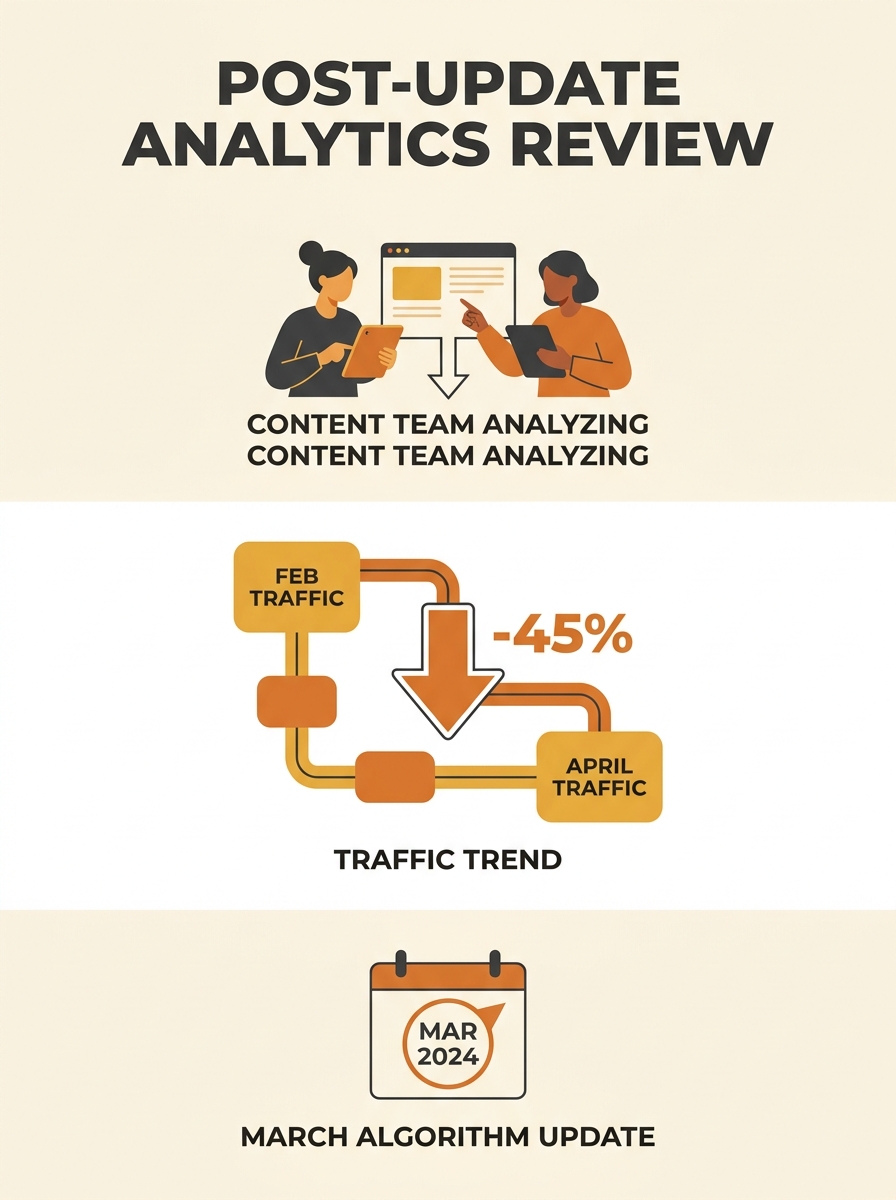
Sarah Perez, reporting for TechCrunch, noted that Google’s policies specifically addressed the need to remove low-quality content from search, including expired websites repurposed as spam repositories by new owners and obituary spam. The March 2024 update automated enforcement at scale.
The Investment Timing Problem
Brands completed their content buildouts between 2021 and 2024, right as Google’s algorithm began penalizing the characteristics that defined them: templated structures, surface-level coverage across dozens of subtopics, and pages that technically answered queries without offering differentiated value. Organizations that believed they had solved organic acquisition faced declining traffic and shrinking keyword rankings.
The scale of investment distinguishes this update from prior algorithm shifts. Brands lost not individual rankings but the return on entire content ecosystems built according to best practices the SEO industry itself championed. Australian SMEs that built topical authority maps around cluster architectures saw months of content work devalued overnight.
The structural tension between satisfying an algorithm and genuinely helping a reader became explicit. When the incentive is to cover every conceivable subtopic in a niche, content teams inevitably produce articles that exist to fill a keyword gap rather than answer a question someone urgently needs answered.
What Google’s Systems Now Reward
The progression from RankBrain to BERT to MUM to AI Overviews traces a consistent arc toward understanding what a searcher actually wants and whether a given page delivers it in a way that justifies the click. The March 2024 update accelerated that trajectory.
Google’s systems now prioritize content satisfying diverse user needs over pages that simply match a query string. “Low-quality” in this context does not mean poorly written—many affected pages were grammatically sound, well-structured, and keyword-optimized. What they lacked was a reason to exist beyond the algorithm.
For brands navigating Google’s AI overhaul of search, the penalty extends beyond traditional organic results. AI Overviews and generative search features preferentially extract from sources demonstrating original analysis, named expert attribution, and specific evidence—the exact characteristics cluster-filling strategies omitted in favor of volume.
The Tactical Response Gap
Post-update commentary from SEO consultants converged on a narrow set of tactical adjustments: add more E-E-A-T signals, improve page speed, tighten internal linking, refresh underperforming content. The recommendations treat the update as an isolated event requiring calibrated response rather than recognizing the cumulative direction of travel.
The deeper problem is strategic. Brands that built content factories optimized for algorithm satisfaction must now rebuild around genuine informational value. That shift requires different production models, different quality thresholds, and different measures of success than keyword coverage and indexation volume.
Australian businesses affected by the update face a choice between incremental fixes to existing content and fundamental rebuilds of their organic visibility strategy—a decision complicated by the AI agents reshaping content production timelines and budget expectations across marketing departments.
Why This Matters Now
The March 2024 Core Update exposed the gulf between what the SEO industry told brands to build and what Google’s evolving systems actually reward. For Australian SMEs that invested in content cluster strategies, the penalty arrives at a moment when organic visibility budgets face scrutiny and AI-driven search threatens to replace traditional SEO as the primary acquisition channel.
The timing forces a strategic reckoning. Brands cannot simply refresh underperforming cluster content with minor E-E-A-T additions and expect recovery. The fundamental mismatch between content shaped by keyword gaps and content shaped by reader needs requires structural change—different production incentives, different quality filters, different content economics.
The brands that recover will be those that stopped optimizing for search engines and started serving genuine informational needs with original analysis, expert perspective, and specific evidence. The March 2024 update made that shift from optional best practice to ranking requirement, eliminating the middle ground where templated topic coverage once delivered reliable organic growth.