

W3era published an AI Overview optimization framework on June 2 that prescribes 40-70 word direct-answer blocks at the start of major content sections, entity-rich semantic structure, and technical SEO foundations as requirements for businesses seeking visibility in Google’s AI-generated search summaries, according to the agency’s published guide. The framework addresses citation readiness for AI Overviews rather than guaranteed inclusion.
TL;DR: W3era’s framework prescribes answer-first formatting, topical depth over keyword density, and technical SEO accessibility as the foundation for AI Overview citation readiness, following Google’s shift toward synthesized search answers.
Framework Emphasizes Answer-Block Structure Over Traditional Keyword Optimization
The framework prescribes opening important content sections with 40-70 word self-contained answers before expanding into supporting detail, a departure from traditional SEO content structure that often buried direct answers several paragraphs into sections. Vikash Bharia, Digital Marketing Head at W3era, said in the published guide that AI systems need “context, entities, relationships, examples, and user-intent coverage” rather than keyword placement alone.
The guide identifies topical depth as a core requirement, arguing that AI systems extract from content that demonstrates comprehensive coverage of a query’s subtopics. Google’s query fan-out mechanism—where the search engine runs multiple related searches across subtopics to generate broader answers—requires pages to address a query’s full scope rather than targeting individual keyword variants, according to W3era’s analysis.
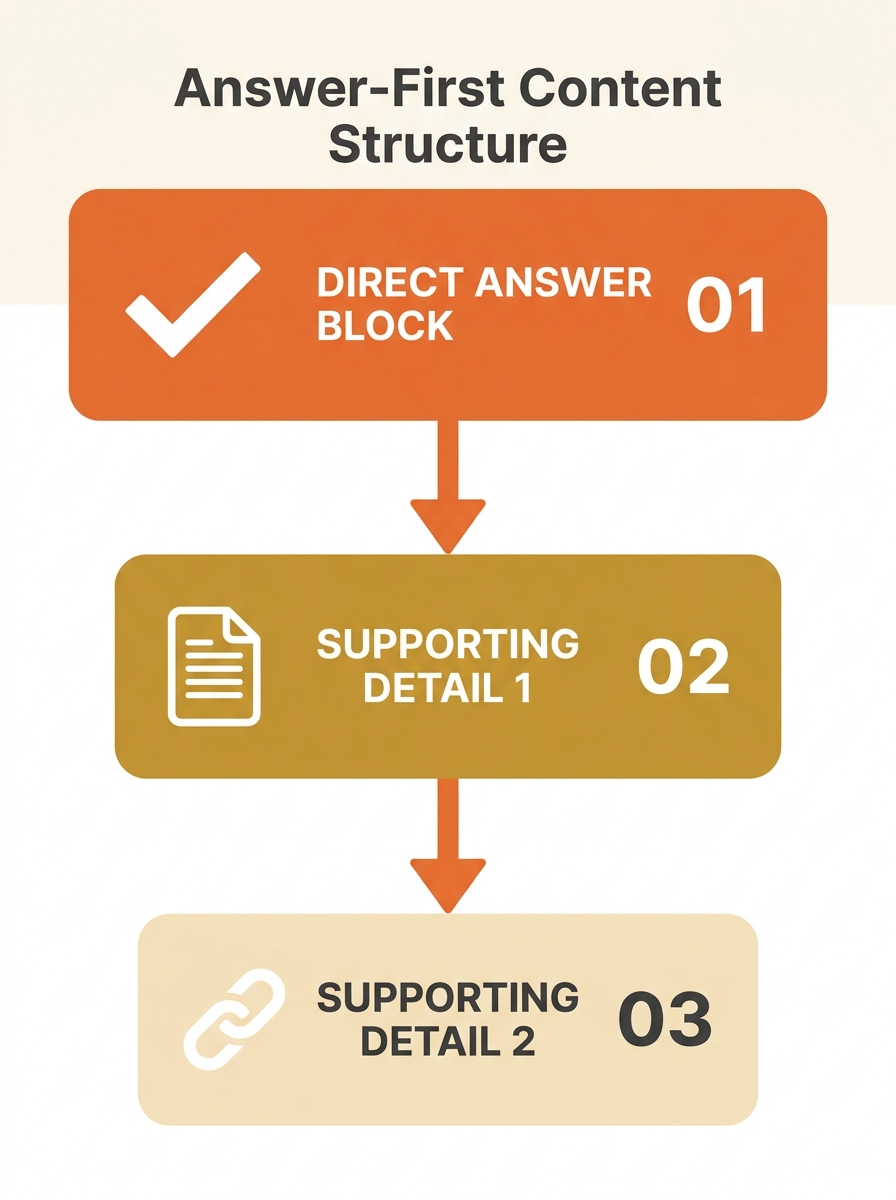
The framework explicitly states that optimization “does not guarantee AI Overview inclusion, but it improves citation readiness,” distinguishing between citation-ready content and guaranteed placement in Google’s AI-generated summaries.
Click-Through Rate Impact Cited as Dual Risk and Opportunity
W3era’s framework cites Pew Research Center data showing users who saw an AI summary clicked a traditional search result in 8% of visits, compared with 15% of visits without an AI summary. Ahrefs data cited in the guide showed AI Overviews correlated with lower click-through rates for top-ranking pages in the platform’s dataset.
The guide frames AI Overview citations as an opportunity for brands to “influence high-intent users earlier in the research journey” despite the overall click-through decline. Businesses that appear as cited sources inside AI-generated answers gain visibility at the query-interpretation stage rather than only competing for clicks in traditional organic listings.
The framework identifies several technical prerequisites: pages must be crawlable, indexable, eligible for snippets, and technically accessible. Schema markup helps search engines understand content structure but carries no AI Overview inclusion guarantee, according to the guide’s structured data section. The approach aligns with existing technical requirements for AI search visibility, which emphasize machine-readable infrastructure.
EEAT Signals and Measurement Frameworks Included
W3era’s framework prescribes adding author details, reviewer notes, sources, publication dates, screenshots, and original examples as trust signals that improve citation likelihood. The guidance follows Google’s emphasis on Experience, Expertise, Authoritativeness, and Trustworthiness (EEAT) as a quality assessment framework, which the search engine uses to evaluate content credibility.
The published guide includes a measurement framework that differs from traditional organic search metrics. W3era recommends tracking AI Overview citations, branded mentions inside AI summaries, zero-click query impact, and assisted conversions rather than relying solely on ranking positions and organic click-through rates.
The framework states that “AI Overview optimisation is still SEO” and that Google’s foundational SEO best practices remain relevant for AI-generated features. Google’s own guidance on AI Overviews confirms the features use core Search ranking and quality systems, including retrieval-augmented generation, as their foundation.
Internal linking structure appears as a distinct optimization component in W3era’s framework, with the guide recommending contextual links that help AI systems understand topical relationships between pages. The approach mirrors topical authority mapping strategies used in traditional organic search optimization but adapted for entity-based content extraction.
Businesses Implications
Australian small and medium businesses depending on organic search traffic face a measurable reduction in click-through rates when AI Overviews appear for their target queries, based on the Pew Research Center data cited in W3era’s framework. The 8% versus 15% click-through comparison means businesses optimizing only for traditional organic rankings may see 47% lower engagement on queries where Google generates AI summaries.
The answer-first formatting structure W3era prescribes requires content teams to restructure existing pages, placing direct answers at section openings rather than building toward conclusions. Businesses with large content libraries face a prioritization decision: which pages address queries likely to trigger AI Overviews and therefore justify the rewrite investment. AI visibility audits can help identify high-priority pages where citation-ready formatting delivers measurable benefit.
The framework’s emphasis on entity-rich semantic structure and comprehensive subtopic coverage aligns with how Australian businesses are pivoting away from zero-click optimization toward citation readiness. Businesses that treat AI Overview optimization as a separate channel—rather than extending existing SEO practices—risk duplicating effort without measurable return. W3era’s guidance positions citation-ready content as an evolution of technical SEO and topical authority work rather than a replacement strategy.