

Search Engine Journal published a multi-location local SEO guide on June 9 prescribing bulk verification workflows for businesses operating ten or more storefronts and warning against programmatic doorway pages, according to the 3,200-word framework. The guide argues that Google now evaluates physical locations as independent entities while simultaneously assessing the broader brand ecosystem, requiring dedicated local landing pages with unique regional content and schema markup rather than templated city pages.
TL;DR: A multi-location SEO guide published June 9 prescribes bulk verification for businesses with 10+ locations and warns that programmatic doorway pages dilute local signals despite the technical ease of generating them at scale.
The framework addresses tactical shifts required since 2020, when AI-powered local search began rewarding entity matching over keyword density and Google Business Profile completeness became a prerequisite for appearing in conversational map queries. For Australian businesses expanding into regional markets—plumbing networks opening Brisbane and Gold Coast branches, physiotherapy groups adding Geelong and Bendigo clinics—the guide’s emphasis on storefront-level independence directly challenges the template-driven approach many franchises still deploy.
Bulk Verification Workflow for Ten-Plus Locations
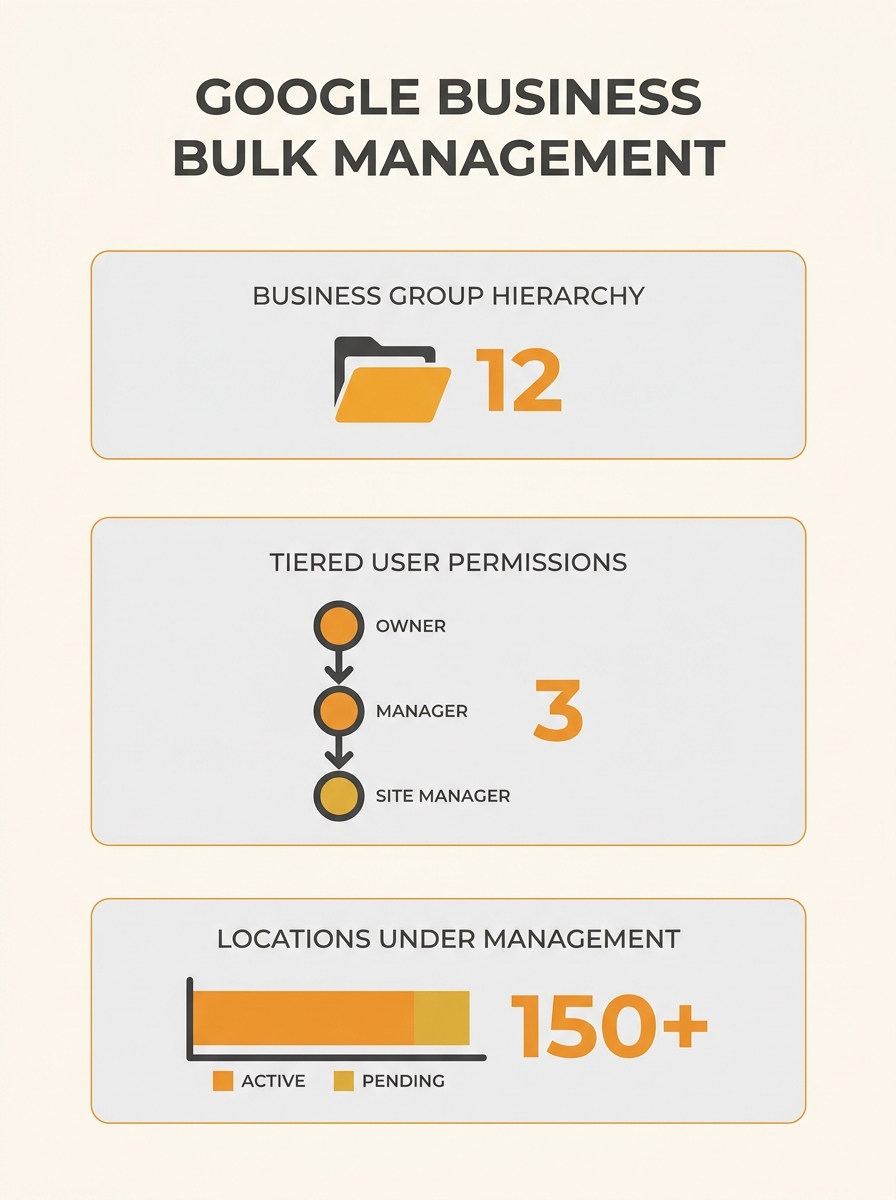
Businesses operating ten or more locations under a single brand name qualify for Google’s bulk verification process, which replaces individual postcard verification with a master spreadsheet submission, the guide states. The spreadsheet requires unique store codes for each location, and Google approves the primary business account after validating the data.
The framework prescribes organizing verified profiles into Business Groups—folders that cluster regional storefronts or sub-brands together—allowing centralized teams to synchronize operating hours, service menus, and attribute data across specific geographic clusters without manually updating each profile. Access permissions split into three tiers: Owners hold full deletion and integration rights, Managers control bulk edits and description updates, and Site Managers restricted to post publishing and basic attribute changes.
This tiered structure matters for Australian businesses where head-office marketing teams need central control while franchisees or regional managers require limited editing capability for location-specific promotions or temporary hour adjustments during public holidays.
Entity Matching Replaces Keyword Density as Relevance Signal
Google’s local algorithms now operate as “entity matching engines” rather than directory lookups, evaluating whether a specific storefront matches query intent through conceptual clustering instead of keyword presence, according to the Search Engine Journal framework. The guide identifies three evolved ranking factors—relevance, distance, and prominence—that differ substantially from their pre-2020 definitions.
Relevance now requires exact primary and secondary category alignment across all Google Business Profiles without over-categorization, which the guide warns “can dilute local signals.” Service offerings must be explicitly defined per location since capabilities vary by storefront—a dental practice’s Sydney CBD location may offer cosmetic procedures its Parramatta branch doesn’t, requiring distinct service schema and GBP attribute tagging.
Distance remains the one factor businesses cannot optimize, the guide notes. Google prioritizes the user’s real-time GPS location or the location modifier in the query (“emergency dentists Grimsby” vs. “emergency dentists”), making granular doorway pages ineffective and penalizable. This constraint particularly affects Australian service-area businesses—electricians, plumbers, arborists—that attempt to rank for every suburb within a 40-kilometer radius through programmatic city pages.
Prominence Evaluated Per Storefront, Not Brand Level
Google assesses prominence individually for each physical location rather than inheriting authority from the parent brand, the framework states. A national franchise with strong domain authority doesn’t automatically confer local pack visibility to a newly opened storefront; that location must independently earn review velocity, local backlinks, and foot-traffic validation.
The guide prescribes four prominence signals: steady review acquisition with active owner responses, backlinks from hyper-local sources such as regional news outlets and suburb business directories, consistent NAP (name, address, phone) data across mapping platforms, and offline reputation signals including foot-traffic patterns and localized brand search volume. The last signal—foot traffic—reflects Google’s use of aggregated mobile location data to validate whether a storefront actually operates at its claimed address, a verification layer that penalized virtual offices following the 2016 Possum update.
For businesses managing multiple location profiles across Australian regions, the independence of prominence scoring means each new branch requires a dedicated local link-building effort and review-generation campaign rather than relying on inherited brand equity.
Dedicated Landing Pages Required, Doorway Pages Penalized
The framework mandates “dedicated local landing pages that feature unique, localized content, schema markup, and regional context” while explicitly warning against programmatic doorway-page generation. Each Google Business Profile must link to a URL containing substantive local information—not templated copy with city names swapped—including suburb-specific service details, regional case studies, and staff bios tied to that location.
This prescription aligns with recent subdomain guidance identifying how generic location pages fragment crawl efficiency. The Search Engine Journal guide doesn’t specify subdomain vs. subfolder architecture but emphasizes that whichever structure a business chooses, each location page must justify its existence with genuinely differentiated content that serves users arriving directly from Google Maps or organic search.
The challenge for Australian franchise networks lies in creating thirty or fifty unique location pages without duplicating service descriptions, a content-volume problem that scales poorly when head-office copywriters attempt manual authoring. The guide offers no prescriptive solution beyond the prohibition against templated pages, leaving businesses to choose between resource-intensive manual creation or strategically limiting the number of location pages to those with sufficient distinct content.
Context and Outlook
Multi-location local SEO sits at the intersection of two competing pressures for Australian businesses: the operational efficiency of centralized marketing systems and Google’s entity-level evaluation requiring per-storefront differentiation. The Search Engine Journal framework’s bulk-verification workflow addresses the first pressure; its landing-page uniqueness requirement and storefront-level prominence scoring create friction against the second.
Businesses expanding into regional Australian markets—where a Brisbane physiotherapy group opening a Gold Coast branch competes against established local clinics with years of accumulated reviews and suburb-specific backlinks—face a prominence deficit that brand authority doesn’t erase. The framework’s emphasis on hyper-local link acquisition and review velocity as independent per-location signals suggests new storefronts require dedicated local campaigns lasting months before achieving map-pack visibility, regardless of parent-brand strength.
The guide’s publication seventeen months after AI Overviews launched in Australian search reflects ongoing recalibration of what local SEO success measures. Map pack rankings remain relevant, but the framework’s focus on entity completeness and conversational query matching acknowledges that users increasingly bypass the ten-blue-links interface entirely, making Google Business Profile data quality the primary visibility determinant rather than a supporting signal.