

Google extended its Preferred Sources feature into AI Overviews and AI Mode on May 27, 2026, turning a Top Stories prioritization tool into an earned-visibility channel that operates independently of search ranking algorithms, according to Digital Applied. The June rollout marks the first time user-selected sources receive visible Preferred badges inside synthesized AI answers.
TL;DR: Google now prioritizes user-selected Preferred Sources in AI Overviews and AI Mode with visible badges, creating an opt-in visibility channel that bypasses traditional ranking competition for publishers who prompt their audiences to add them.
The feature, which launched in August 2025 for Top Stories in the United States and India, expanded globally in December 2025 and added all supported languages on April 30, 2026. Google reports that people are twice as likely to click through to a Preferred Source and that more than 345,000 unique sources have been selected worldwide, though neither metric is independently verifiable in Search Console.
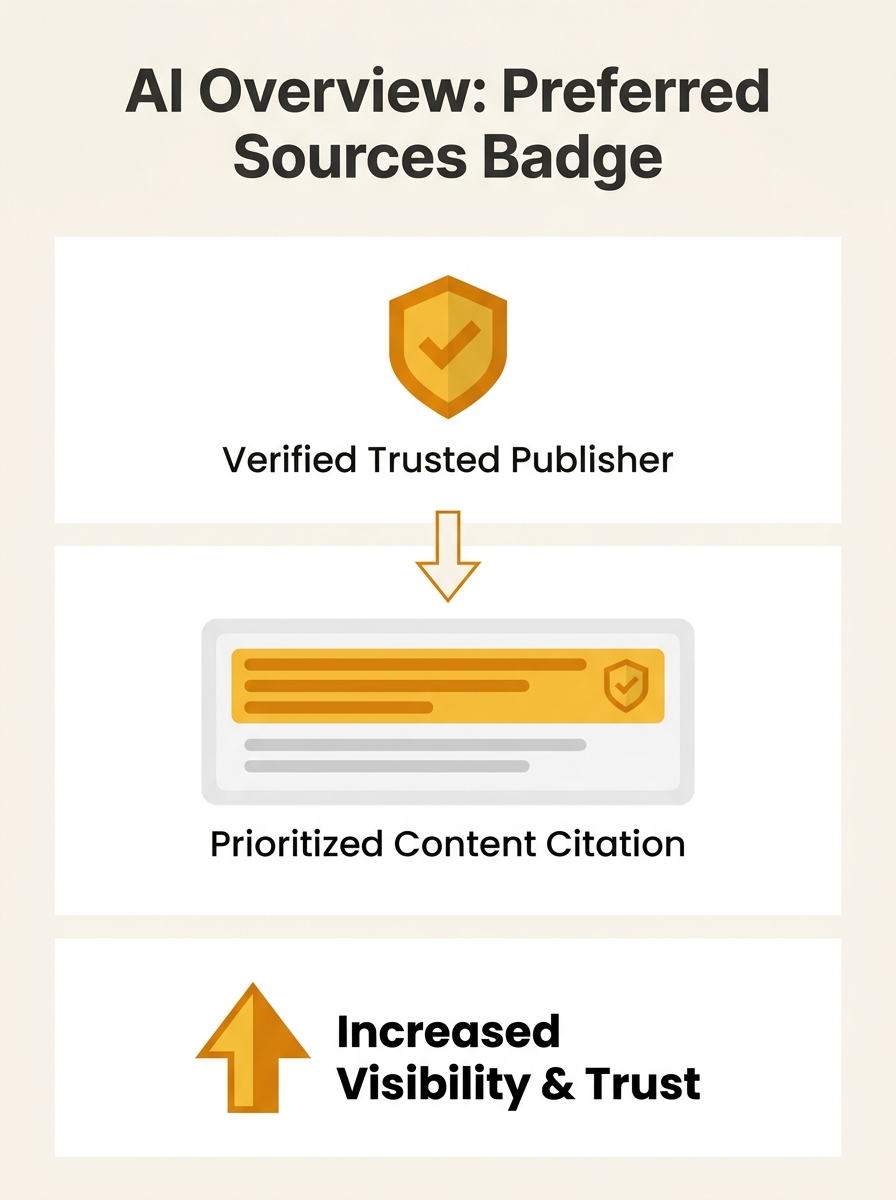
How the Opt-In Mechanic Works
Users manually add preferred sources at google.com/preferences/source, creating a personal allowlist that Google then prioritizes across multiple search surfaces. When a reader has designated a site as preferred and that site is cited within an AI-generated answer, the link displays a visible Preferred badge so readers can identify their chosen outlets inside the response. The same mechanic applies in Top Stories carousels and a new developing-topic article carousel for breaking queries, both announced May 27.
“You’ll be able to easily spot links in AI responses from the sources you’ve already selected,” said Duncan Osborn, Product Manager for Google Search, in the company’s announcement. Google stressed that preferred status does not override relevance requirements, sources must still publish fresh, topically relevant content to surface in results.
The feature inverts traditional SEO dynamics. Unlike ranking factors that publishers optimize toward algorithmically, Preferred Sources is earned through direct audience conversion. There is no on-page signal to improve and no technical audit that unlocks it. The only input is the opt-in itself, which reframes the optimization problem as a marketing and relationship challenge rather than a technical one.
Publisher Implementation Strategies
Google provides a deep-link URL that pre-fills a publisher’s domain on the source-preferences page, reducing the opt-in to one click. The company released official badge assets in 16 languages for publishers to place on high-intent pages. Industry coverage suggests publishers who ran dedicated launch campaigns in August 2025 saw substantially higher sign-up volumes in the first 30 days than those who only added passive footer buttons, though Google has not disclosed sample sizes or exact multiples.
Estimates place U.S. users who have added any preferred source in the low single-digit percentages, creating an uncrowded competitive field for publishers who actively prompt their existing audiences. The adoption gap represents an opportunity window that narrows as awareness spreads and more publishers implement prompts.
Australian businesses with established reader relationships, local news outlets, industry-specific publications, research-backed content operations, can treat the feature as a loyalty-conversion lever. The mechanic favours publishers who already have audience trust and are willing to spend that goodwill requesting a one-click preference setting. Publications without direct reader relationships face structural disadvantage regardless of content quality.
Measurement and Visibility Constraints
Google does not provide a Preferred Sources dashboard in Search Console, leaving publishers to infer performance through indirect signals. The most direct measure is click-through rate uplift on pages cited in AI Overviews for queries where a publisher expects reader overlap, though attribution remains imperfect. Traffic patterns that spike around prompted publication dates may indicate successful opt-in drives, but baseline noise makes isolation difficult.
The feature’s value compounds over time as more readers opt in and Google cites the publisher in more AI-generated answers. Each citation becomes a retention point rather than a fresh ranking competition, shifting the strategic frame from query-by-query optimization toward sustained audience development. Publishers who delay implementation cede early-adopter advantage to competitors who prompt first.
The extension into AI Overviews and AI Mode represents Google’s second major visibility mechanic introduced in 2026 that operates outside traditional ranking. The company launched Highly Cited badges in March 2026, prioritizing frequently referenced sources in synthesized answers. Unlike Highly Cited status, which is algorithmically assigned, Preferred Sources requires explicit user action, giving publishers who cultivate direct audiences a structural edge.
Reading Between the Lines
For Australian SMBs running content operations, Preferred Sources is not a ranking replacement, it is a supplementary channel that rewards existing audience relationships. The strategic shift matters: businesses that have built reader trust through local SEO fundamentals or consistent industry expertise now have a mechanism to convert that trust into sustained visibility in AI search results. The feature penalizes content farms and rewards publishers with genuine followings.
The adoption gap creates a narrow implementation window. Single-digit preference-setting rates mean early movers compete in an uncrowded field, but that advantage erodes as awareness spreads and more publishers add prompts. Businesses with established audiences should implement deep-link calls-to-action in email signatures, post-conversion thank-you pages, and high-traffic evergreen content. Those without direct reader relationships gain nothing from the feature and should focus on AI search optimization fundamentals that drive citations regardless of preference status.
The absence of a Search Console dashboard forces publishers to treat this as a long-term relationship investment rather than a short-term optimization tactic. Unlike ranking improvements that show up in metrics dashboards, Preferred Sources performance compounds invisibly through reader retention and repeat visibility. That makes it a poor fit for businesses chasing quarterly metrics and a strong play for publishers building multi-year audience equity.