

TrySight AI published a seven-strategy framework on June 21 addressing AI search visibility analytics, a measurement practice the company says tracks how brands appear in responses from ChatGPT, Perplexity, Claude, and other generative AI platforms. According to the framework document, the system addresses what TrySight characterizes as a “critical blind spot”, brands ranking well in traditional Google search may be entirely absent from AI-generated answers that now handle millions of daily queries without directing users to search results pages.
TL;DR: TrySight AI released a framework on June 21 for tracking brand mentions across AI platforms like ChatGPT and Perplexity, prescribing prompt libraries, baseline measurement, and quarterly audits to measure visibility in generative search answers.
The publication follows Google’s May 2026 core update, which shifted ranking signals toward content formats AI systems can extract and cite. Australian SMEs relying on organic growth face compounding measurement challenges: traditional SEO metrics don’t capture whether a brand appears when target customers ask conversational queries through AI assistants rather than typing keywords into search engines.
Framework Prescribes Structured Prompt Libraries Over Ad-Hoc Testing
The first strategy in TrySight’s framework mandates building what the company calls a “prompt tracking framework”, a curated library of conversational queries organized by customer intent, persona, and funnel stage. The framework recommends a minimum library of 30 to 50 prompts, reframed from existing keyword research into natural-language questions AI users would type.
TrySight instructs businesses to organize prompts across three dimensions: intent (informational, comparison, purchase), persona (marketer, founder, agency), and funnel stage (awareness, consideration, decision). A consideration-stage marketer might query, “What are the best tools for tracking brand mentions in ChatGPT?” while an awareness-stage founder asks, “How do AI search engines decide which brands to mention?”
The framework positions this prompt library as “the backbone of everything else in your AI visibility analytics practice,” warning that measurement without it produces inconsistent results and conclusions disconnected from actual customer behavior. TrySight recommends quarterly refreshes to the prompt library, noting that AI models evolve and user behavior shifts.
Baseline Measurement Before Content Changes Required
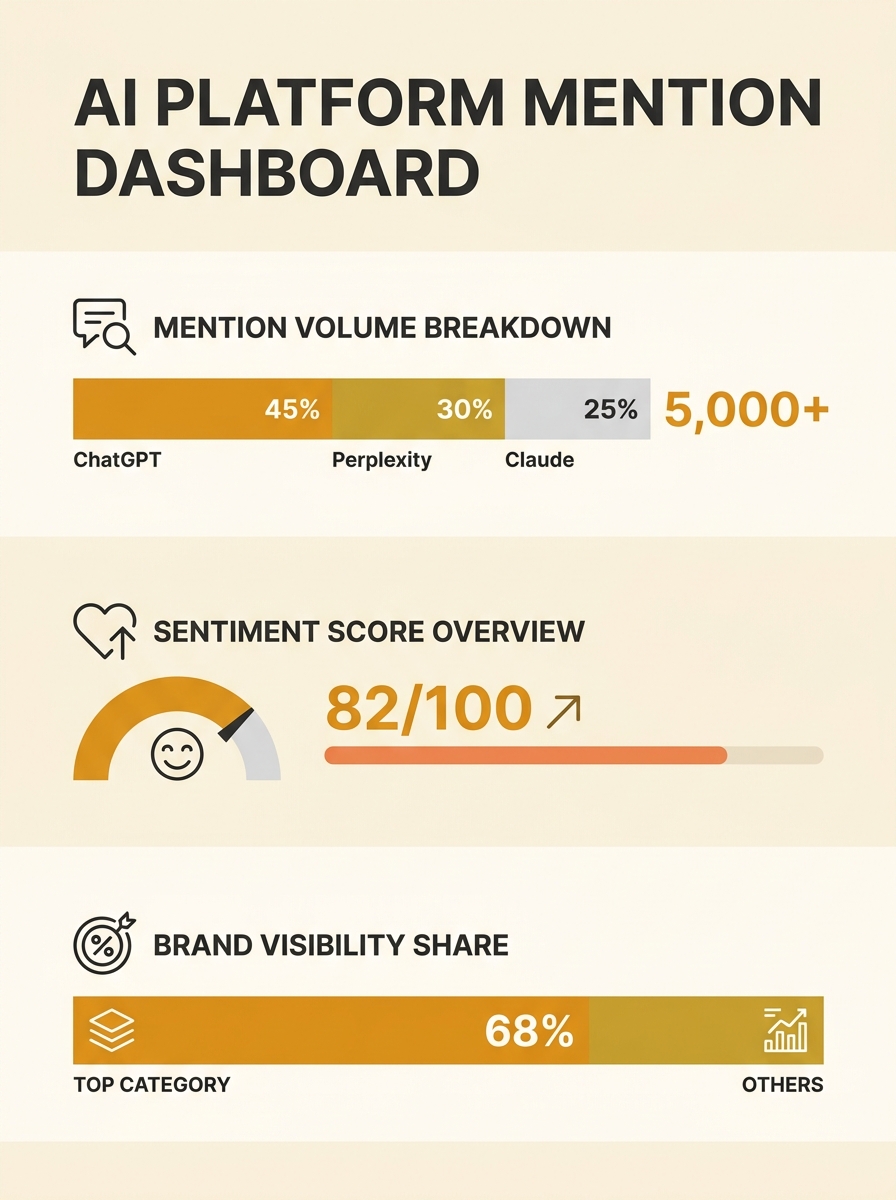
TrySight’s second strategy prescribes establishing an AI visibility baseline before making any content optimizations. The framework identifies four baseline dimensions: mention frequency (how often a brand appears across tracked prompts), sentiment classification (positive, neutral, or negative framing), context accuracy (whether AI descriptions match the actual product), and competitive co-mentions (which competitors appear alongside the brand and in what order).
The company recommends running all prompts across target AI platforms within the same week to minimize variance from model updates, then calculating an “AI Visibility Score”, the percentage of tracked prompts where the brand appears at least once across all platforms. TrySight positions this baseline as a control group against which all subsequent GEO (Generative Engine Optimization) work can be measured.
“Optimization without measurement is guesswork,” the framework states, warning that brands jumping directly into creating GEO-optimized content “can’t tell whether their efforts are working” and often duplicate content that already performs well while ignoring genuine gaps.
The company’s own platform is positioned as tooling for this baseline capture, tracking brand mentions across ChatGPT, Claude, Perplexity, and other AI platforms with sentiment scoring and prompt-level granularity. TrySight recommends re-running baselines monthly at minimum, arguing that AI model updates make static baselines “quickly obsolete.”
Remaining Strategies Target Content Gaps and Citation Patterns
The framework’s remaining five strategies were not detailed in full in the published excerpt, but TrySight positions the seven-strategy system as building toward “a compounding system that improves your brand’s presence across the AI search landscape.”
The framework distinguishes AI search visibility analytics from traditional SEO metrics, noting that AI visibility “requires an entirely new measurement framework” because AI models may answer queries without sending users to search results pages. TrySight characterizes the current brand measurement gap as leaving businesses “reactive” and working from “guesswork to proactive, data-driven decision-making.”
The company references GEO (Generative Engine Optimization) as the optimization discipline corresponding to AI visibility analytics, positioning the framework as supporting systematic GEO efforts rather than one-off content experiments.
Context and Outlook
Australian SMEs evaluating AI search optimisation strategies face a practical constraint: measurement tools for traditional organic search (Google Search Console, ranking trackers) don’t capture brand presence in conversational AI platforms. TrySight’s framework addresses this gap but introduces a manual overhead, running 30-50 prompts monthly across multiple platforms, documenting sentiment, and tracking competitive co-mentions requires dedicated resourcing.
The June 21 publication coincides with broader shifts in how AI systems select brands for citation, creating an earned-visibility channel outside traditional ranking. Businesses absent from ChatGPT and Perplexity citations face organic discovery risk even when Google rankings remain stable.
The quarterly prompt refresh cadence TrySight prescribes aligns with typical content strategy review cycles but adds a new audit layer. Whether SMEs adopt the full seven-strategy framework or cherry-pick baseline measurement and prompt tracking, the underlying shift is clear: organic growth measurement now requires tracking two parallel visibility streams, traditional search engine rankings and AI platform mentions, with different content signals driving each.