

Buying backlinks is the single worst investment an Australian small business can make in SEO right now. At an average cost of $361 per link and rising penalty risk from Google’s recent core updates, purchased links produce weaker long-term results than three free tactics any SME can run on 5 hours a week.
TL;DR: 93.8% of link builders now prioritise quality over volume. Three zero-cost methods (local citation building, quarterly linkable assets, and direct journalist outreach) consistently outperform purchased backlinks for Australian SMEs when measured by referral traffic and ranking stability rather than Domain Rating.
The argument against spending money on links isn’t philosophical. It’s mathematical. The numbers break down into three evidence categories, each pointing at the same conclusion: a backlink strategy with no budget works better for Australian small businesses than a paid one.
Free Local Citation Building Does What Agencies Charge Thousands For
Why do SMEs pay $2,000-$5,000 per month for link building retainers when 30+ free Australian local citation sites exist and are openly documented? White Chalk Road maintains an updated list of 30 free Australian local citation sites that includes Yellow Pages Australia, TrueLocal, Yelp Australia, Hotfrog, StartLocal, and over two dozen more. BrightLocal reports delivering over 100,000 citations through its builder tool, confirming the scale at which these directories operate.
Local citation building is the most time-efficient link tactic available to Australian SMEs. Each listing takes between 5 and 15 minutes to create. Completing the top 30 sites costs roughly 7-8 hours of total effort, spread across a week or two. The result is 30+ consistent backlinks from high-domain-authority directories, accurate NAP (name, address, phone) data across the web, and improved eligibility for Google’s local map pack.
This foundation matters because Google’s local algorithm weighs citation consistency heavily. If your business name, address, and phone number appear differently across 4 or 5 directory profiles, the conflicting signals dilute your local ranking potential. Getting the basics right here connects directly to the kind of local SEO fundamentals that drive real lead growth without ad spend.
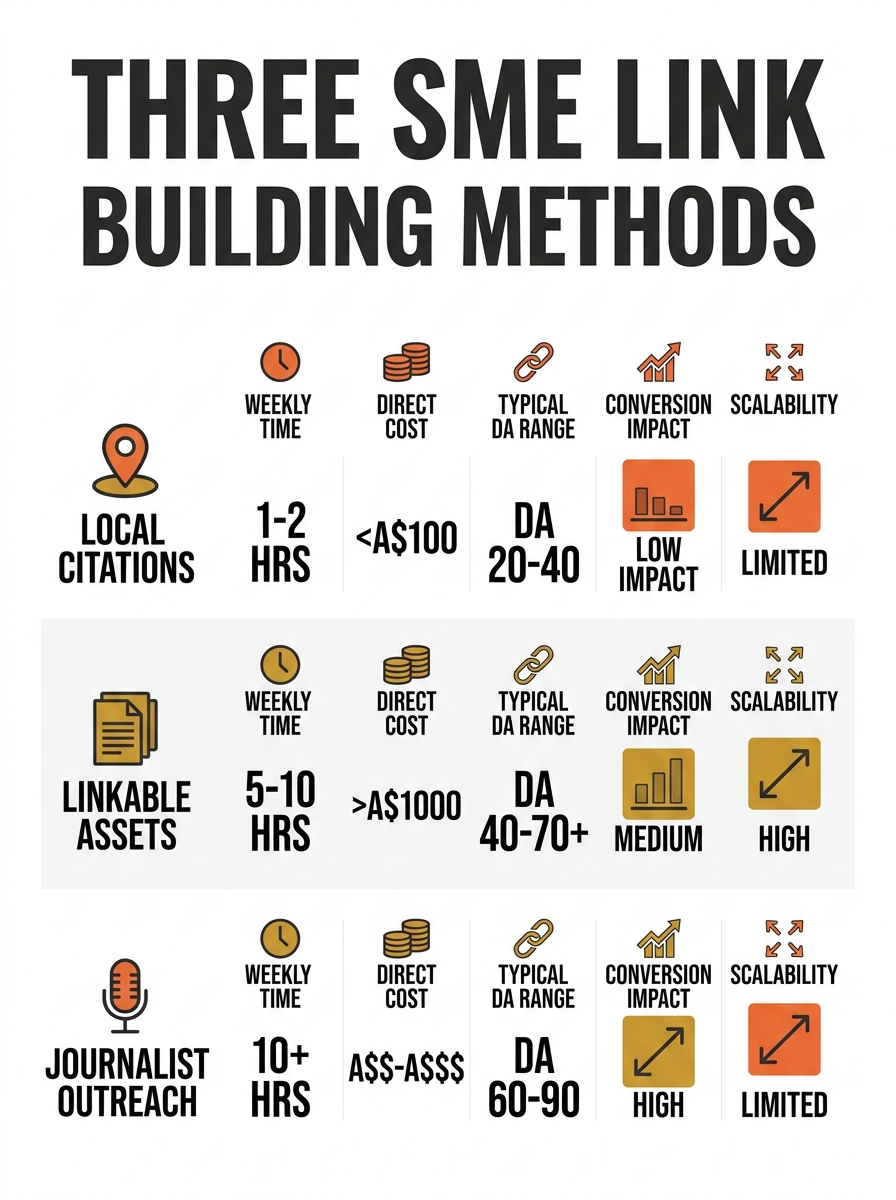
| Method | Weekly Time | Direct Cost | Typical DA Range | Conversion Impact | Scalability |
|---|---|---|---|---|---|
| Local Citations | 1-2 hrs (setup), then minimal | $0 | DA 30-80 | Moderate (local traffic) | Limited (finite sites) |
| Linkable Assets | 3-5 hrs creation, 1-2 hrs promotion | $0 | DA 20-70+ | High (qualified referral traffic) | High (compounds over time) |
| Journalist Outreach | 2-3 hrs per week | $0 | DA 50-90 | High (brand awareness + traffic) | Moderate (relationship-dependent) |
Ven Agency’s link building guide puts it plainly: “Like many SMEs, we don’t have an unlimited budget for SEO, so we’ve invested time in developing smart, cost-effective tactics that actually work.” The citation layer is where that investment starts paying returns fastest.
One Data Asset Per Quarter Beats Monthly Retainer Output
The shift toward quality over volume in link building is measurable. According to industry survey data, 93.8% of link builders now prioritise link quality over quantity, up from roughly 65% five years ago. For Australian SMEs, this means the old playbook of churning out 10-15 low-quality guest posts per month is dead. The new approach is creating one substantial linkable asset per quarter and promoting it well.
A linkable asset is any piece of content that earns backlinks because other publishers want to reference it. Think: an original salary benchmarking survey for your industry in Australia, an ROI calculator specific to your trade, a data visualisation of publicly available ABS statistics relevant to your niche, or an industry playbook with original methodology. These take real effort. Quality guest posts alone require 20+ hours of research and writing to meet editorial standards at worthwhile publications. One agency documented a quadrupled acceptance rate after shifting from pitching 200 mediocre sites to targeting 20 exceptional ones with deeply researched content.
A backlink strategy with no budget works better for Australian small businesses than a paid one when measured by the metrics that actually determine revenue.
The maths here favours the DIY approach. At $361 per purchased link, a modest campaign of 10 links per month costs $3,610. Over a quarter, that’s $10,830 for 30 links of uncertain quality that may get devalued in the next core update. One well-built data asset, costing nothing but your time and expertise, can attract 15-40 organic backlinks over 12 months as publishers discover and cite it. And those links carry genuine editorial intent, which is exactly what Google’s algorithms are now calibrated to reward.
If your site already has strong E-E-A-T signals through credible authorship and demonstrated expertise, each linkable asset compounds on that foundation. The referring domains see an author with visible credentials, a site with topical depth, and content worth linking to. That combination is what makes people earn backlinks in Australia without spending a cent on outreach tools.

Journalist Relationships Without the Agency Fee
Digital PR for an Australia SME sounds expensive. It doesn’t have to be. First Page Australia’s digital PR guide describes the core tactics as “online media placements, influencer partnerships, thought leadership content, and data-driven campaigns” working together to build brand authority. Every one of those is executable without an agency.
Taurus Marketing’s startup guide recommends a focused approach: “Identify local Australian media outlets or industry publications, craft compelling press releases for significant milestones, and build relationships with relevant journalists or bloggers.” The keyword is “relationships.” You don’t need 500 media contacts. You need 5-10 journalists who cover your niche and who recognise your name when it appears in their inbox.
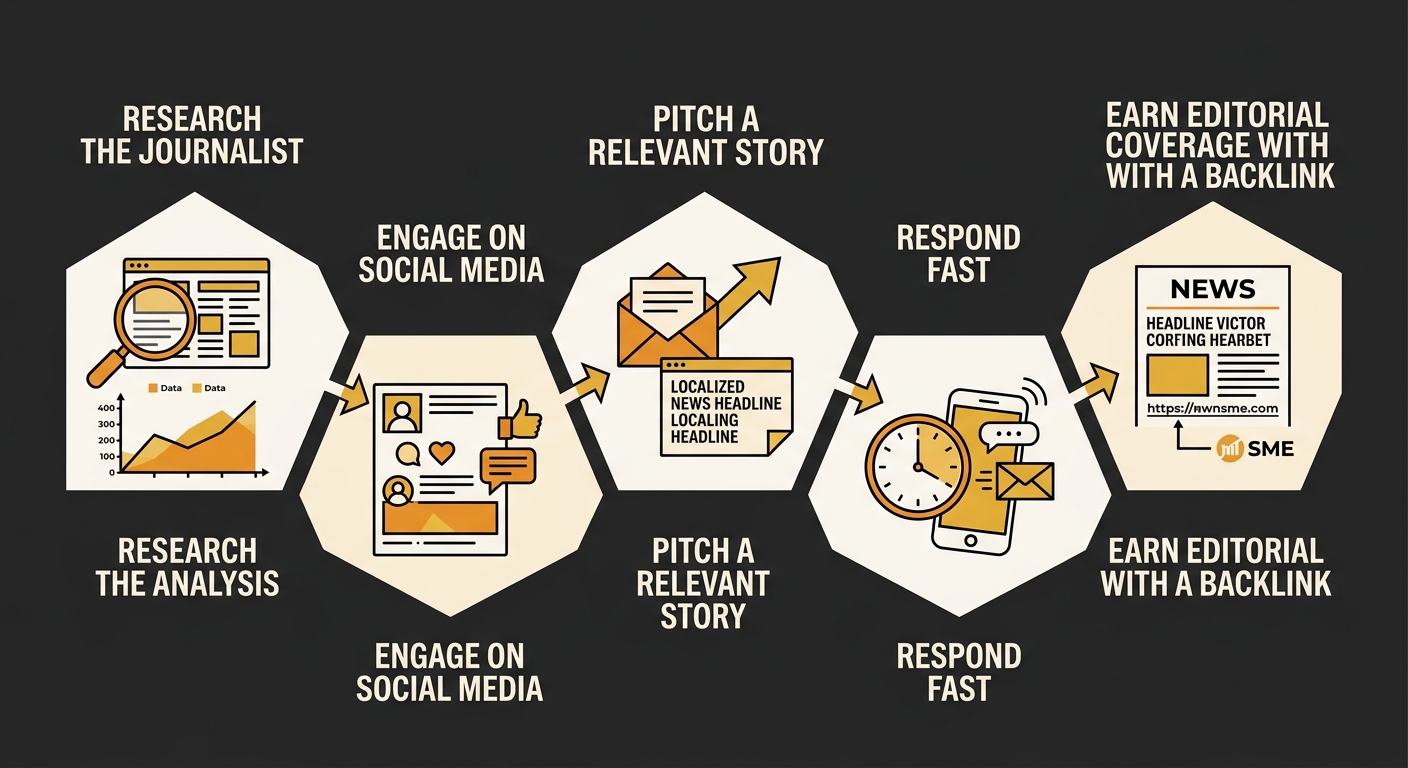
Here’s a practical sequence that costs nothing but time:
- Identify 8-10 journalists at outlets like SmartCompany, Business News Australia, the AFR’s small business section, and relevant trade publications for your industry.
- Follow them on LinkedIn and Twitter/X. Read their recent articles. Understand what they actually cover versus what their masthead suggests.
- When you have a genuine data point, milestone, or contrarian take relevant to their beat, pitch it in under 150 words. No attachments, no PR jargon.
- Respond within 30 minutes if they reply. Journalists work on tight deadlines, and a source who’s available at 4pm on a Tuesday earns repeat coverage.
The reason this works so well for link building for small business in Australia is that Australian media is comparatively small. The pool of business journalists covering SME topics across the country numbers in the low hundreds, not thousands. Getting recognised by 8-10 of them is achievable within 3-4 months of consistent, respectful engagement. Each piece of earned media coverage typically delivers a DA 50-90 backlink from a genuine news domain, the exact kind of link that agencies charge $500-$1,500 each to place.
This also happens to be where most businesses fail through common outreach mistakes: they send templated pitches, forget to personalise, and treat journalists like link-dispensing machines. The fix is treating outreach like a professional relationship, because that’s what it is.
Tip: Before spending anything on link building, audit your unlinked brand mentions. Tools like Ahrefs and Google Alerts can surface instances where publications mention your business without linking to you. A polite email asking for the link converts at a higher rate than any cold outreach, and these are the easiest backlinks you’ll ever earn.
The Earn-Cost-Risk Scorecard
To make this framework repeatable, evaluate every potential link building tactic against three axes before committing time to it:
- Earned Authority Value: Will this link send qualified referral traffic, or does it exist purely for a crawl signal? Links from real publications read by real people score highest.
- Direct and Indirect Cost: Factor your hourly rate into “free” tactics. Creating a linkable asset at 20 hours of founder time has a cost, but that cost is still 4-6x lower than the equivalent purchased links at $361 each.
- Penalty and Devaluation Risk: Google’s core updates continue to target manipulative link patterns. The difference between paid link services and organic outreach is the difference between a depreciating asset and an appreciating one.
Any tactic scoring low on earned authority and high on penalty risk should be eliminated immediately, regardless of how cheap it appears per link.
Where This Leaves the Budget Argument
The conventional wisdom that quality link building requires a PR budget or agency retainer was true in 2018. The ecosystem has shifted. Citation directories are free and plentiful, with 30+ quality Australian sites waiting for your listing. Linkable assets built from original data outperform agency-placed guest posts because 93.8% of the industry now optimises for quality, making editorial gatekeepers pickier about what they’ll publish and link to. And the Australian media landscape is small enough that 5 hours per week of genuine journalist engagement produces results that agencies charge $3,000-$8,000 monthly to replicate.
The measurement framework needs to shift too. Stop tracking Domain Rating as your primary backlink metric. Track referral traffic that matches your ideal customer profile, assisted conversions from organic landing pages, and opportunities influenced by sessions from referring domains. These are the numbers that tie link building to revenue, and they consistently favour earned links over purchased ones. Australian SMEs operating without a budget aren’t at a disadvantage in this environment. The businesses still writing cheques for bulk link placements are the ones falling behind.