
Nav43’s analysis of content restructuring projects found that sites organised around topic clusters recorded a 74% average increase in organic traffic within six months. The sites in question didn’t publish more content, buy more backlinks, or overhaul their on-page copy. They reorganised what already existed, connecting pillar pages to subtopic pages through deliberate internal links and cleaning up navigation that had grown messy over years of ad hoc publishing.
That figure deserves scrutiny, because it tells us something specific about how search engines interpret site structure for SEO. Google’s crawlers don’t read your site the way a human does. They follow links, measure depth, assess relationships between pages, and assign importance based on where a page sits in your internal linking hierarchy. A page buried five clicks deep with a single inbound internal link is, in Google’s estimation, less important than a page sitting two clicks from the homepage with twenty contextual links pointing to it.
The architecture of your content — how pages relate, how they’re grouped, and how links flow between them — shapes what gets indexed, what ranks, and what gets ignored.
What a Crawlable Site Structure Actually Looks Like
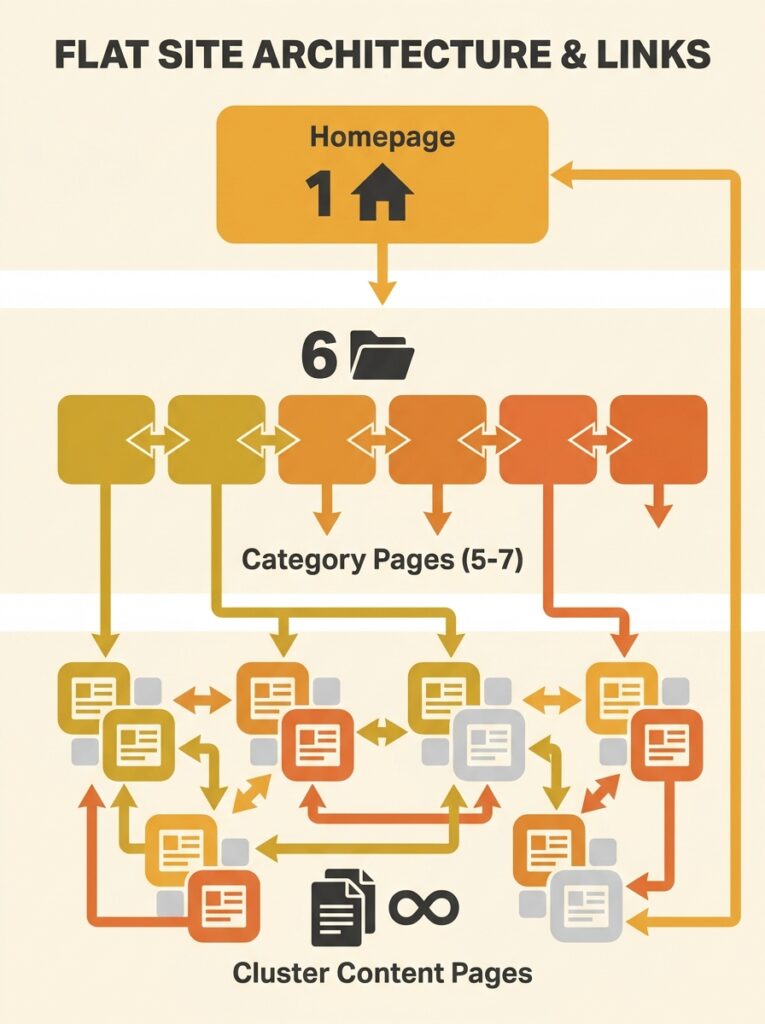
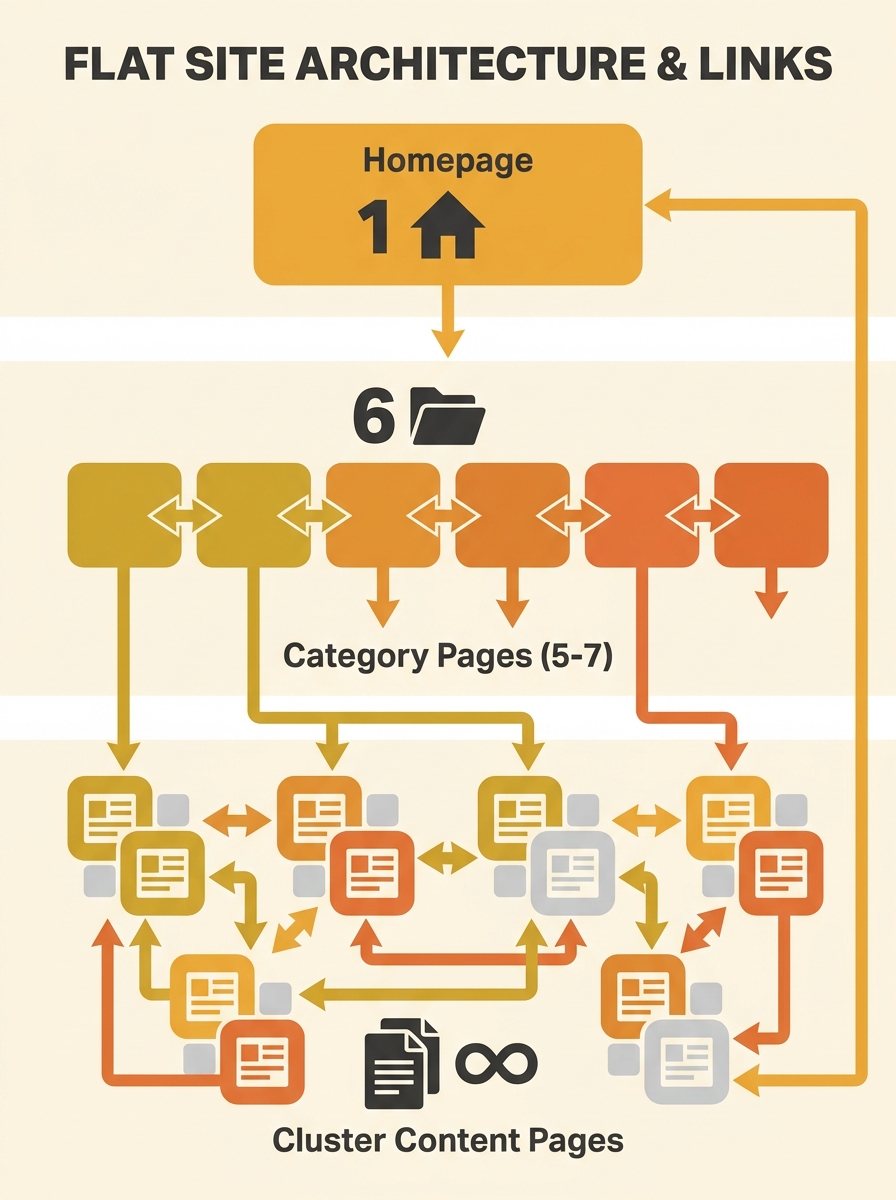
The principle is straightforward: every important page on your site should be reachable within two to three clicks from the homepage. SEMrush and multiple crawl-analysis platforms have confirmed that flat architectures reduce user effort, improve crawl efficiency, and distribute PageRank more evenly across a site. Pages buried beyond five clicks face real indexing risk.
As Spicy Web’s analysis puts it, “a clean, logical structure allows crawlers to efficiently access and index all your pages, increasing the likelihood they’ll appear in search results.” That sounds obvious. In practice, most Australian business sites fail this test, particularly those that have been publishing blog content for three or more years without a structural plan. Pages accumulate. Categories multiply. The navigation grows sideways instead of deepening around core topics.
A crawlable site structure has three characteristics:
- Shallow depth: important pages sit close to the homepage
- Consistent internal linking: every page receives and gives contextual links
- Logical grouping: related content lives together in defined topic areas, rather than scattered across arbitrary categories
If you’ve been accumulating technical SEO debt without realising it, your site structure is likely the first place that debt is compounding.
How Internal Links Drive Rankings (and How Most Sites Get Them Wrong)
Search Engine Journal’s research is blunt on this: “search engines give greater value to internal links regarding ranking on search engine results pages.” Internal links do three things simultaneously. They help crawlers discover pages. They distribute authority (PageRank) across your site. And they signal topical relationships between pieces of content.
Google’s own link best practices documentation specifies that anchor text should be descriptive, concise, and relevant, helping both users and Google understand the linked content. Generic text like “click here” or “read more” wastes an opportunity to reinforce topical signals. When you’re building internal links, the anchor text you choose carries real weight in how search engines interpret the target page.
The most common internal linking hierarchy failures we see on Australian sites:
- Orphan pages: content that exists on the site but receives zero internal links. Crawlers can’t find these pages unless they’re in the sitemap, and even then, Google treats them as low priority. Netwave Interactive’s research recommends regular audits using Screaming Frog to identify and fix orphan pages.
- Top-heavy linking: every internal link points to the homepage or main category pages, leaving deeper content starved of authority.
- Random linking: links placed without topical logic, connecting a page about dental SEO to a page about e-commerce shipping for no reason other than “we need more internal links.”
As Yoast’s guide to internal linking explains, internal linking “quietly does the heavy lifting for your website” when done with intention. The key word is intention. Each link should answer the question: would a reader on this page genuinely benefit from visiting that page?
A content architecture strategy works when every internal link answers one question: would a reader on this page genuinely benefit from visiting that page?
Building Topic Clusters That Search Engines Understand
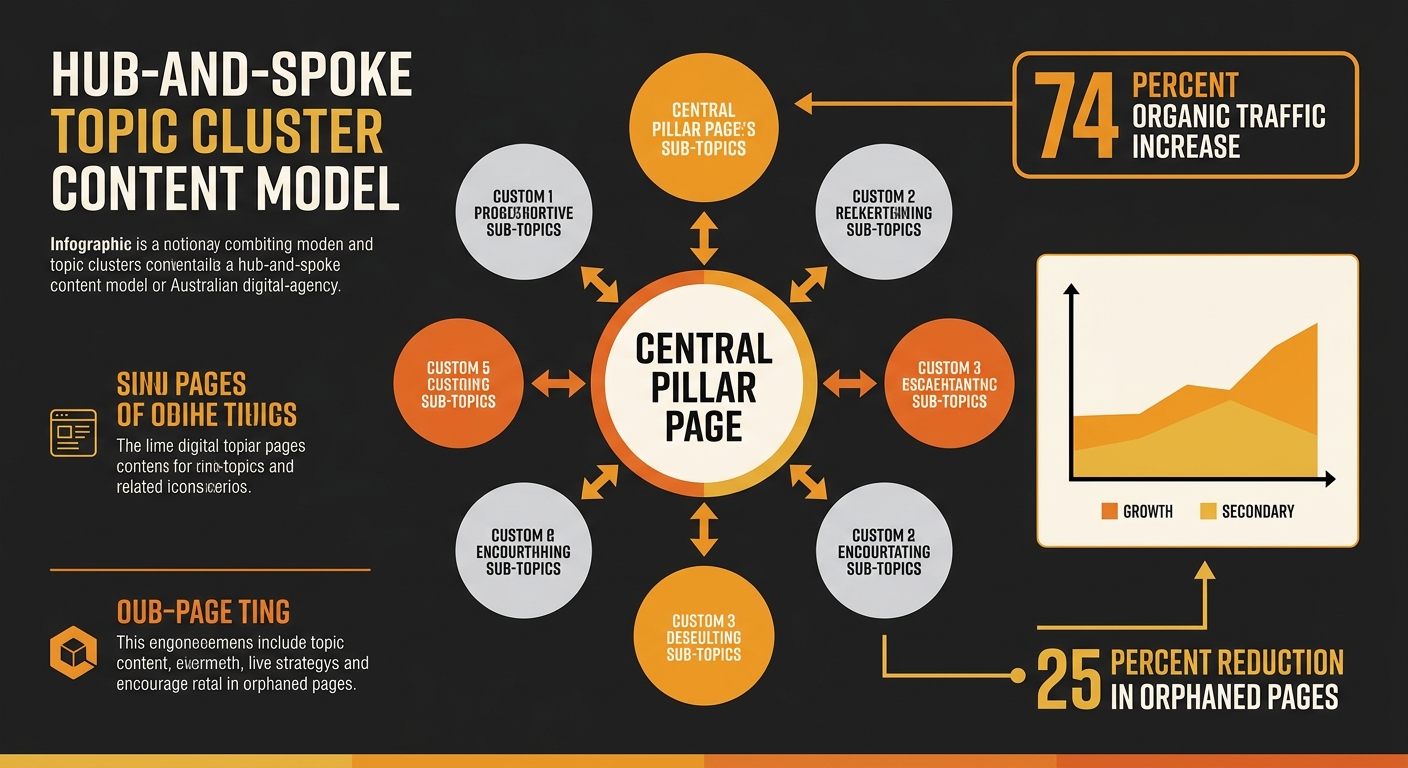
The hub-and-spoke model gives your content architecture strategy a concrete shape. A pillar page covers a broad topic in depth. Cluster pages explore specific subtopics and link back to the pillar. The pillar links out to each cluster page. This creates a closed loop of topical relevance that search engines can follow and interpret.
The 74% organic traffic increase mentioned earlier came specifically from sites that adopted this model. And the data shows a secondary benefit: a 25% reduction in orphaned pages, because the cluster structure forces every piece of content to have at least one logical home and at least one inbound link.
For an Australian service business, this might look like:
- Pillar page: “Complete Guide to SEO for Tradies”
- Cluster pages: “How to rank for ‘[trade] near me’ searches”, “Google Business Profile setup for trade businesses”, “Getting reviews that improve local rankings”, “Website speed optimisation for trade sites”
Each cluster page links back to the pillar. The pillar links to each cluster. And where relevant, cluster pages link to each other. This creates a dense web of topical signals that reinforces your authority on the subject. We’ve covered how to structure sites for better rankings in earlier work, and the hub-and-spoke model remains the most reliable framework for achieving this.
Information Architecture as a Ranking Signal
The University of Arkansas WEBFirst framework recommends presenting “information in layers — show the information progressively, limit information to allow people to better absorb it.” This principle applies directly to how you structure content for both users and search engines.
Information architecture rankings depend on how well your site’s hierarchy matches the way people actually search for and consume information. Google has been explicit that user experience factors influence rankings. Search Engine Journal’s analysis found that “thinking in terms of user experience can help with SEO because resultant strategies tend to align with how Google ranks websites.”
Breadcrumbs illustrate this overlap between UX and SEO well. They show users where they are in your site’s hierarchy, reduce bounce rates, and appear as rich snippets in search results. One documented case study found that removing breadcrumb schema led to approximately a 40% drop in organic click-through rates. That’s a significant number for a structural element that takes minimal effort to implement.
Consistent URL structures matter here too. A URL like yoursite.com.au/services/seo/technical-audit tells both users and crawlers exactly where a page sits in the hierarchy. A URL like yoursite.com.au/page?id=347 tells nobody anything.
Auditing Your Architecture Regularly
Automated SEO tools will tell you your site is fine when it isn’t. We’ve written about why green ticks from audit tools miss what actually matters, and site structure is one of the areas where false confidence does the most damage. A tool might confirm that all your pages return 200 status codes and have meta titles, while completely ignoring that 30% of your blog posts are orphaned or that your internal linking hierarchy funnels all authority into three pages.
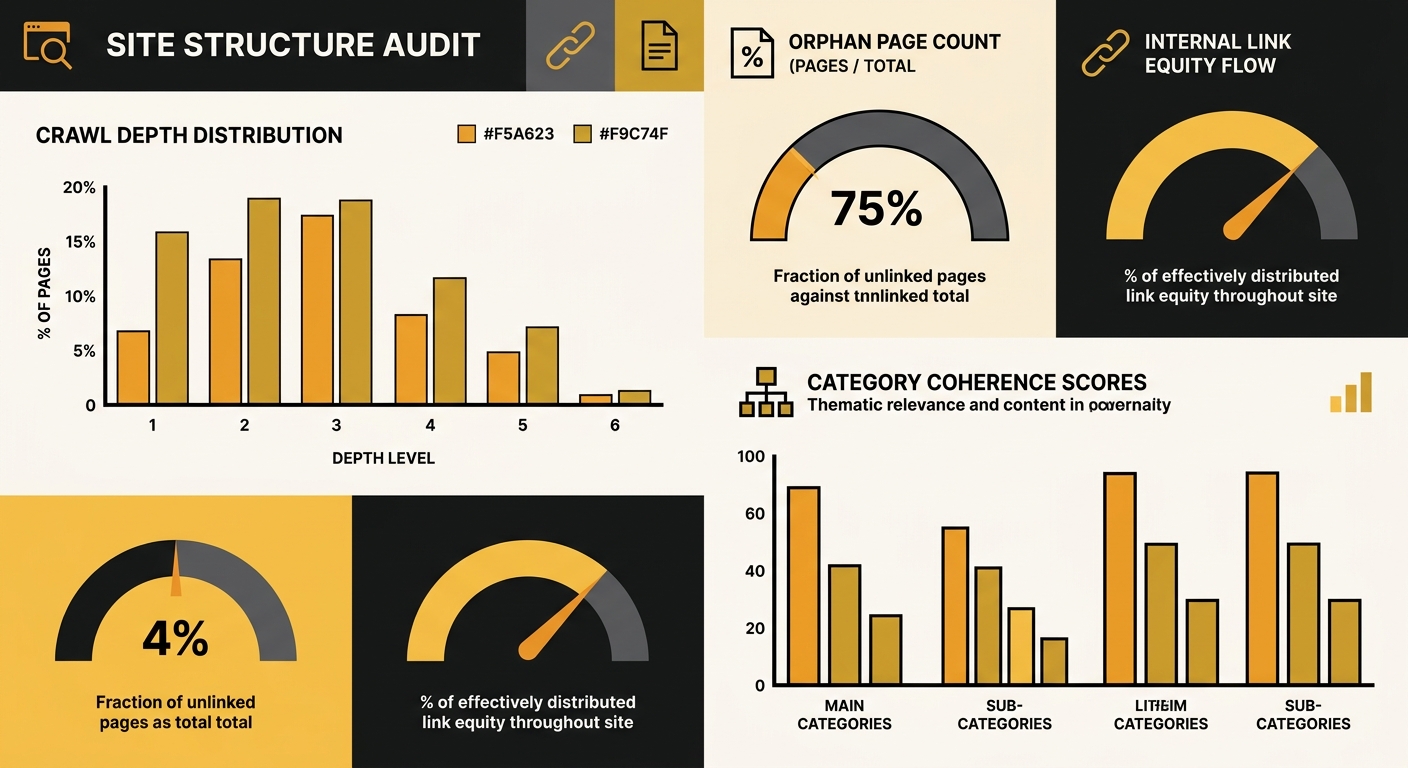
A proper structure audit examines:
- Crawl depth distribution: what percentage of pages sit beyond three clicks from the homepage?
- Internal link equity flow: which pages receive the most internal links, and does that match your commercial priorities?
- Orphan page count: how many published pages have zero internal links pointing to them?
- Category coherence: do your content groupings reflect actual topics, or have they become catch-all containers?
For sites with fewer than 500 pages, a quarterly audit is manageable. Larger sites with active publishing schedules should review structure monthly, because every new page you publish without connecting it to your existing architecture creates potential orphan content.
Tip: Run a crawl in Screaming Frog and sort pages by crawl depth. Any commercially important page sitting beyond three clicks from your homepage needs additional internal links or a restructured navigation path.
When the design, linking, and information hierarchy are aligned, Big Orange Planet’s research confirms what practitioners already know: “rankings stabilise, engagement improves, and the site begins to function as a cohesive system rather than a collection of pages.”
What The Numbers Don’t Capture
The 74% traffic increase and the 40% CTR drop from removed breadcrumbs both point in the same direction: structure matters enormously. But these figures come from sites that had clear structural problems to begin with. A site that’s already well-organised won’t see the same dramatic gains from restructuring.
The data also can’t tell you which specific architectural decisions drove the improvement. Was it the reduction in orphan pages? The shortened crawl depth? The topical clustering? The improved internal link equity distribution? In most real restructuring projects, all of these change simultaneously, making it difficult to isolate the contribution of any single factor.
And there’s a measurement gap around information architecture rankings specifically. Google doesn’t publish a “structure quality score.” We infer its importance from the aggregate effect of structural changes on crawl behaviour, indexation rates, and ranking movements. The evidence is strong, but it’s circumstantial rather than causal.
What we can say with confidence is that Australian businesses publishing content without a defined content architecture strategy are building on unstable ground. Every page added without structural intent makes the next restructure harder and more expensive. The sites that perform consistently over years are the ones that treated architecture as a planning exercise before they started publishing, and kept maintaining it as the site grew.