

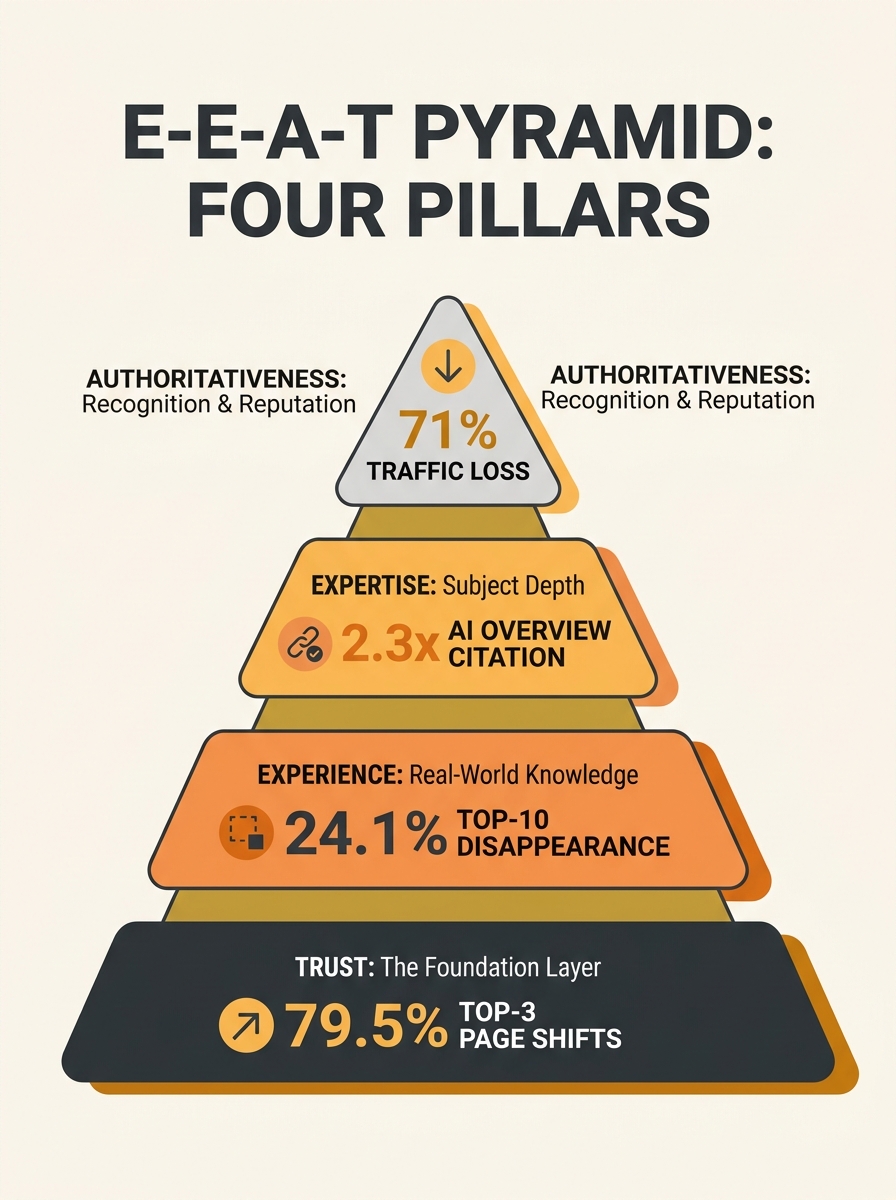
Of all pages ranked in Google’s top three before the March 2026 Core Update, 79.5% shifted positions, and sites lacking demonstrable E-E-A-T signals bore the brunt. Google’s quality framework evaluating experience, expertise, authoritativeness, and trustworthiness now determines which Australian business websites hold rankings and which lose them entirely.
TL;DR: Google’s March 2026 update displaced 79.5% of top-3 pages, hitting sites without genuine experience and trust evidence hardest. Pages with strong E-E-A-T signals are 2.3 times more likely to appear in AI Overviews. Australian YMYL sites in health, finance, and legal face the steepest requirements: named expert authors, primary-source citations, and transparent editorial processes.
What the March 2026 Core Update Exposed
The March 2026 Core Update was the most volatile in recent memory, producing a 24.1% disappearance rate for pages previously sitting in the top 10. Sites that had relied on AI-paraphrased content restating widely available information lost 71% of their organic traffic. The pattern was consistent: Google penalised content that lacked identifiable human expertise and first-hand knowledge.
This update reinforced what Google’s Search Quality Evaluator Guidelines have stated for years. As Search Engine Land’s analysis documents, behind the public-facing narrative is a sophisticated web of signals that Google uses to evaluate quality, trust, and authority. E-E-A-T is the lens through which both quality raters and algorithms assess whether content deserves to rank.
For Australian businesses that had invested in building topical authority through content clusters, the update hit hard when those clusters lacked genuine expertise markers. Sites that built topical authority maps with real author credentials fared measurably better than those that published volume without demonstrated knowledge. Google’s March 2024 update had already penalised shallow cluster strategies, and the 2026 update deepened that trend by 34% according to early volatility tracking data.
Trust Anchors the Entire Framework
Google’s own documentation identifies trust as the most critical E-E-A-T pillar. A page with weak trust signals cannot rank well regardless of how expert its content appears. For Australian business websites, trust signals break down into verifiable, crawlable elements that Google can assess programmatically.
Transparent contact information forms the baseline. Google expects real, multi-method contact details: a physical address (critical for Australian businesses targeting local search), a phone number, and an email address. Sites missing these basics signal risk to both algorithms and quality raters. This connects directly to how Google evaluates local business profiles, where the same trust markers matter across organic and map pack results.
Beyond contact details, trust signals include HTTPS implementation, clearly published editorial policies, visible correction or update processes, and real business registration details. For Australian businesses, displaying an ABN and relevant industry registrations (AFSL for financial services, AHPRA registration for health practitioners) provides verifiable trust evidence that generic international competitors simply can’t replicate.
Danny Sullivan stated in January 2026 that “SEO for AI is still SEO,” confirming that the trust and authority signals driving organic rankings also determine AI Overview citation priority. Pages with strong E-E-A-T signals are 2.3 times more likely to be cited in AI Overviews, making these trust foundations essential for visibility in both traditional and generative search.
Experience Signals Separate Real Expertise from Restated Information
Why has experience become the pivotal differentiator? Because every competitor can now produce competent-sounding text on any topic. ClickPoint Software’s analysis of E-E-A-T in AI-powered search identifies experience as having “emerged as a valuable differentiator with saturated content.” When AI can write a passable article on superannuation rules in 30 seconds, first-hand knowledge becomes the ranking tiebreaker.
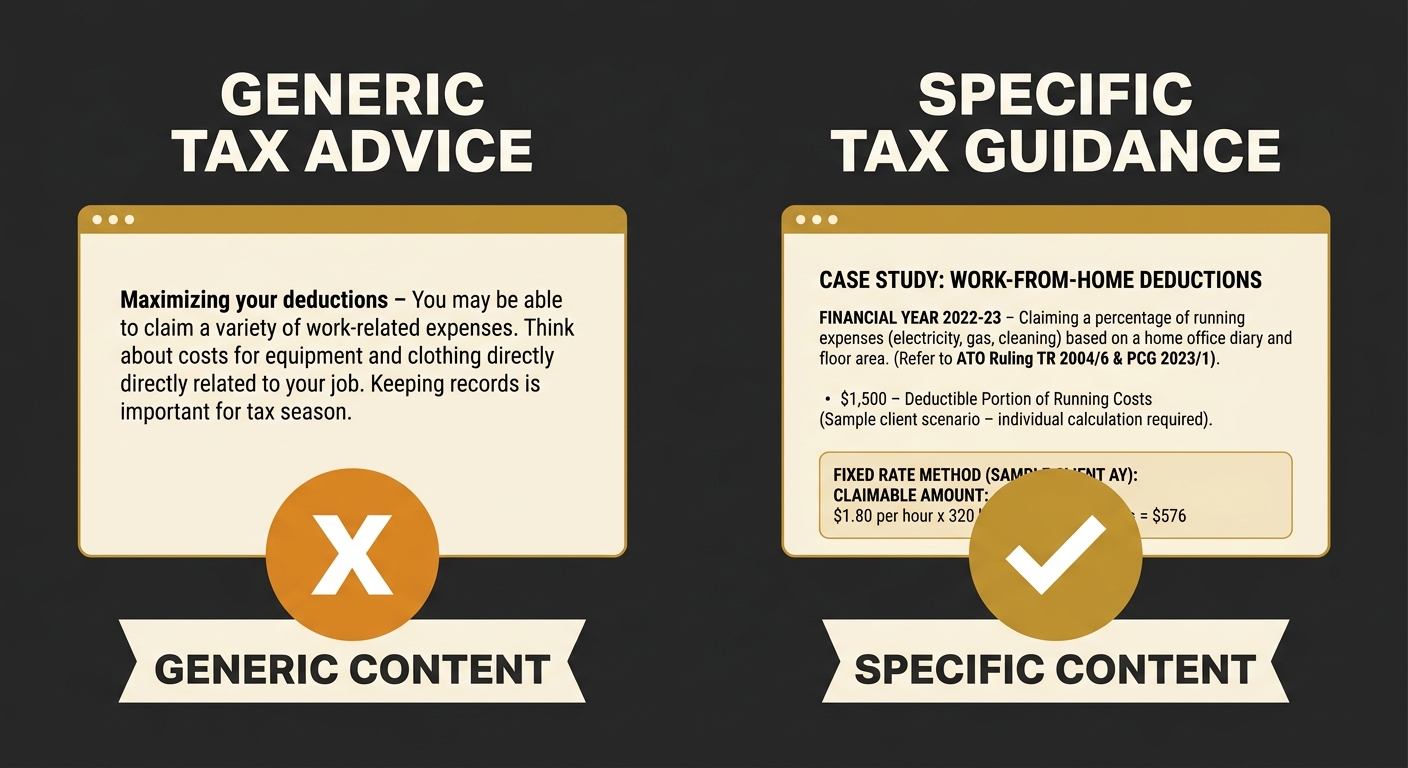
Google’s quality raters look for evidence that the content creator has actually performed the work they’re writing about. For an Australian accounting firm covering small business tax deductions, this means specific examples drawn from real client scenarios (anonymised, naturally), original calculations referencing particular ATO rulings, and concrete dollar figures. For a tradesperson’s website, it means documented project photos with visible Australian settings, specific material choices explained in context, and named local suppliers.
Concrete experience signals that Google’s systems can identify include:
- Original photographs and screenshots with verifiable metadata
- Specific numerical results from real implementations (e.g., “reduced bounce rate from 68% to 41% across 14 weeks”)
- Named tools, products, or methods used in documented practice
- Dated references to completed projects or engagements
- First-person accounts with details a non-practitioner wouldn’t know
Sites demonstrating experience through these markers gained ground after the March 2026 update. Sites publishing content that reads like a Wikipedia summary lost it.
Author-Level Signals Google Tracks
Author authority SEO has moved from a nice-to-have to a measurable ranking input. Google tracks author identity through a combination of structured data, consistent publishing history, and external validation.
At the page level, this means named author bios with relevant credentials, links to professional profiles (LinkedIn, industry association memberships), and a consistent publishing footprint across the site. At the site level, it means an About page with named team members, their qualifications, and their areas of expertise.
External author authority signals carry significant weight:
- Published bylines on recognised Australian industry sites (SmartCompany, AFR, InDaily)
- Speaking engagements at conferences or industry events
- Citations in academic or professional publications
- Active, verified social profiles with topical consistency
- LinkedIn profiles showing relevant 5+ year career history in the subject area
When every competitor can generate competent-sounding text on a topic, demonstrable first-hand experience becomes the ranking tiebreaker.
For Australian businesses, building author authority often means ensuring your subject matter experts are visible online. If your senior financial adviser has 20 years of experience but no digital footprint, that expertise is invisible to Google’s systems. Getting them published in recognised Australian outlets, building a LinkedIn presence with 500+ connections in their field, and linking their author profiles to structured data on your site creates the external validation Google looks for. Semrush updates Authority Scores for all domains every two weeks, and the higher a referring domain’s score, the more weight a backlink from that site carries for your authority signals.
YMYL Content in Australia Carries a Higher Bar
YMYL content covers topics where inaccurate information could cause real harm: health advice, financial guidance, legal information, personal safety. Google applies heightened E-E-A-T scrutiny to these categories because the consequences of poor content are severe. Australian businesses in these sectors face particular requirements shaped by local regulatory frameworks.
ID Digital’s analysis of Australian YMYL requirements notes that “good SEO practices also keep you on the right side of regulation,” highlighting the overlap between Google’s quality expectations and Australian compliance obligations. This double standard works in favour of Australian businesses willing to do the compliance work.
Australian YMYL content requires:
- Professional credentials displayed prominently (AHPRA registration for health content, AFSL number for financial advice, law society membership for legal content)
- Citations to primary sources linking to the ATO, ASIC, TGA, or relevant Australian regulatory bodies rather than secondary summaries
- Documented expert review processes stating who reviewed the content, their qualifications, and when it was last updated
- Compliance alignment ensuring content meets AHPRA advertising guidelines for health, ASIC’s regulatory requirements for financial services, or relevant state-based regulations
YMYL pages showed the steepest ranking drops among content lacking verified expert authorship during the March 2026 update. Where your site covers topics that border YMYL territory (fitness advice, dietary recommendations, small business financial tips), applying YMYL-grade E-E-A-T signals provides a competitive buffer. The same principle applies when preparing for AI-driven search shifts: the content that survives algorithmic volatility is the content backed by genuine, verifiable expertise.
The Three-Layer E-E-A-T Audit
Evaluating your site’s E-E-A-T readiness works best when you separate signals into three distinct layers: page-level, author-level, and site-level. Each layer contributes different evidence to Google’s quality assessment, and weaknesses at any layer undermine the others.
| Layer | Key Signals | Common Australian Gaps |
|---|---|---|
| Page-level | Original data, first-hand experience markers, primary-source citations, publication and update dates | Generic advice without Australian-specific detail; no dates; no cited regulatory sources |
| Author-level | Named author with bio, credentials displayed, external bylines, LinkedIn profile, 80%+ topical focus | Anonymous content; author bios without qualifications; no external publishing history |
| Site-level | About page with team details, ABN displayed, editorial policy, HTTPS, consistent topical concentration | Missing ABN; no editorial standards page; thin About page; content scattered across 6+ unrelated topics |
Sites with consistent topical concentration (80% or more of content focused on their core subject area) send stronger authoritativeness signals than sites publishing broadly across unrelated topics. This aligns with how content architecture functions as a technical SEO foundation: the structure of your site communicates your expertise boundaries to Google before a single word of content is evaluated.
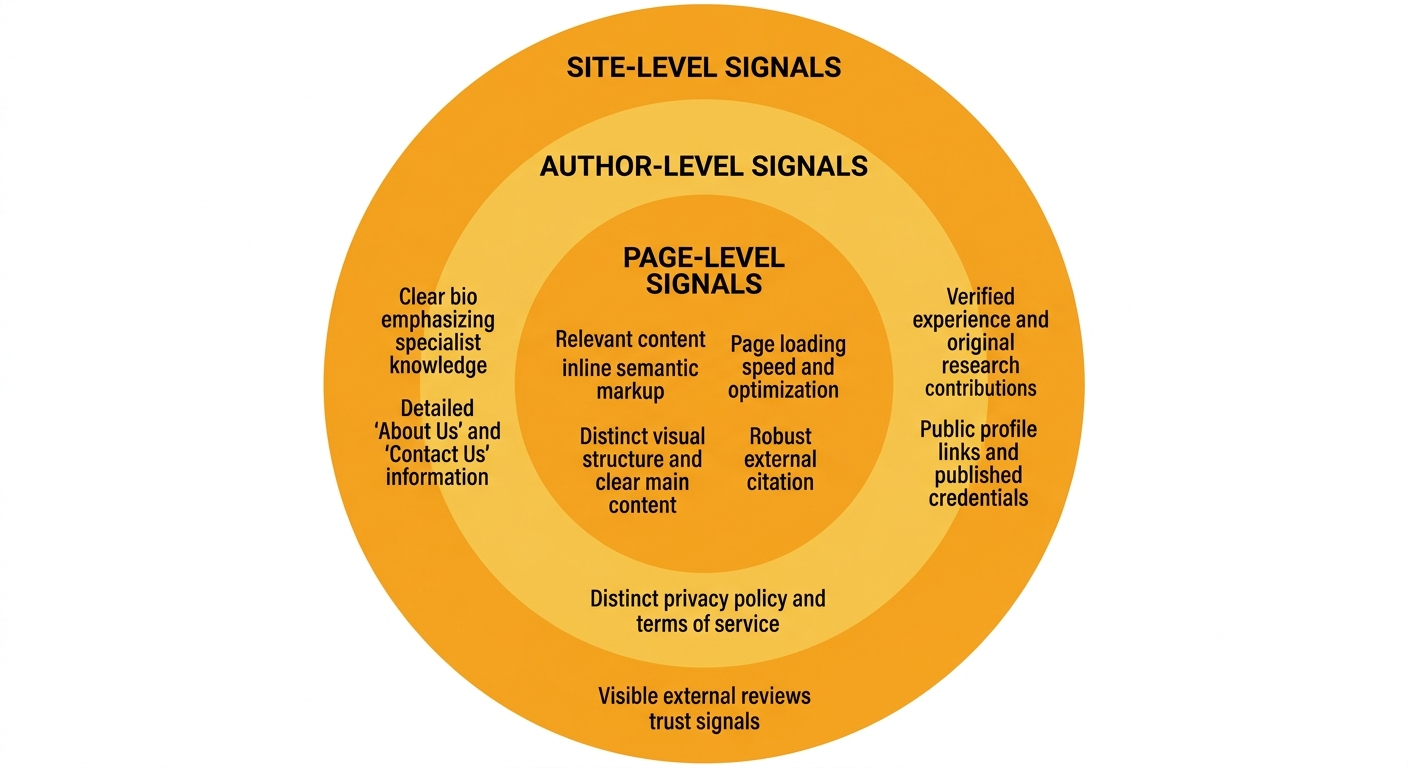
Tip: Run the three-layer audit quarterly. Start at the site level (About page, contact details, editorial policy), then check author profiles for your top 10 pages by traffic, then audit the page-level signals on those same 10 pages. Fixing gaps at higher layers cascades trust benefits downward.
What These Signals Still Can’t Measure
The data makes a strong case for investing in E-E-A-T signals, but the framework has genuine blind spots. Google’s systems struggle to verify offline expertise. A surgeon with 30 years of clinical experience but no digital footprint scores poorly on author authority signals. A small-town solicitor who’s handled hundreds of property settlements ranks behind a content marketing agency with better on-page markup and more external bylines.
E-E-A-T also doesn’t account well for emerging expertise. New practitioners, early-stage businesses, and professionals entering digital channels for the first time face a cold-start problem: they have real experience but no indexed evidence of it. Building that evidence takes 6 to 12 months of consistent effort, and there’s no shortcut that doesn’t compromise the authenticity Google’s systems are designed to detect.
The 2.3x AI Overview citation advantage for high-E-E-A-T pages suggests this framework’s influence will grow. But whether Google can reliably distinguish genuine expertise from well-constructed signals remains an open question. The numbers tell us what correlates with rankings and citations. They don’t tell us how precisely Google’s systems distinguish a credentialed expert from someone who has assembled a convincing-looking author profile with the right structured data. That gap between signal and substance is the space to watch as both traditional and generative search continue to raise the bar on what counts as trustworthy content.