

Passage ranking broke the assumption that a single page earns a single ranking position. Google’s system, which the company says affects roughly 7% of all search queries, can surface a buried paragraph from a 3,000-word guide as the top result for a specific query, even when the page as a whole targets something broader. For Australian businesses publishing long-form guides, the internal structure of each section now carries independent ranking weight.
TL;DR: Google passage indexing doesn’t change how pages are crawled or stored. It changes ranking: Google evaluates and surfaces individual sections of a page independently for specific queries. Australian sites need to treat every H2 section as a self-contained answer, because each one competes separately in search results.
The Name Is Wrong, and That Confusion Costs Rankings
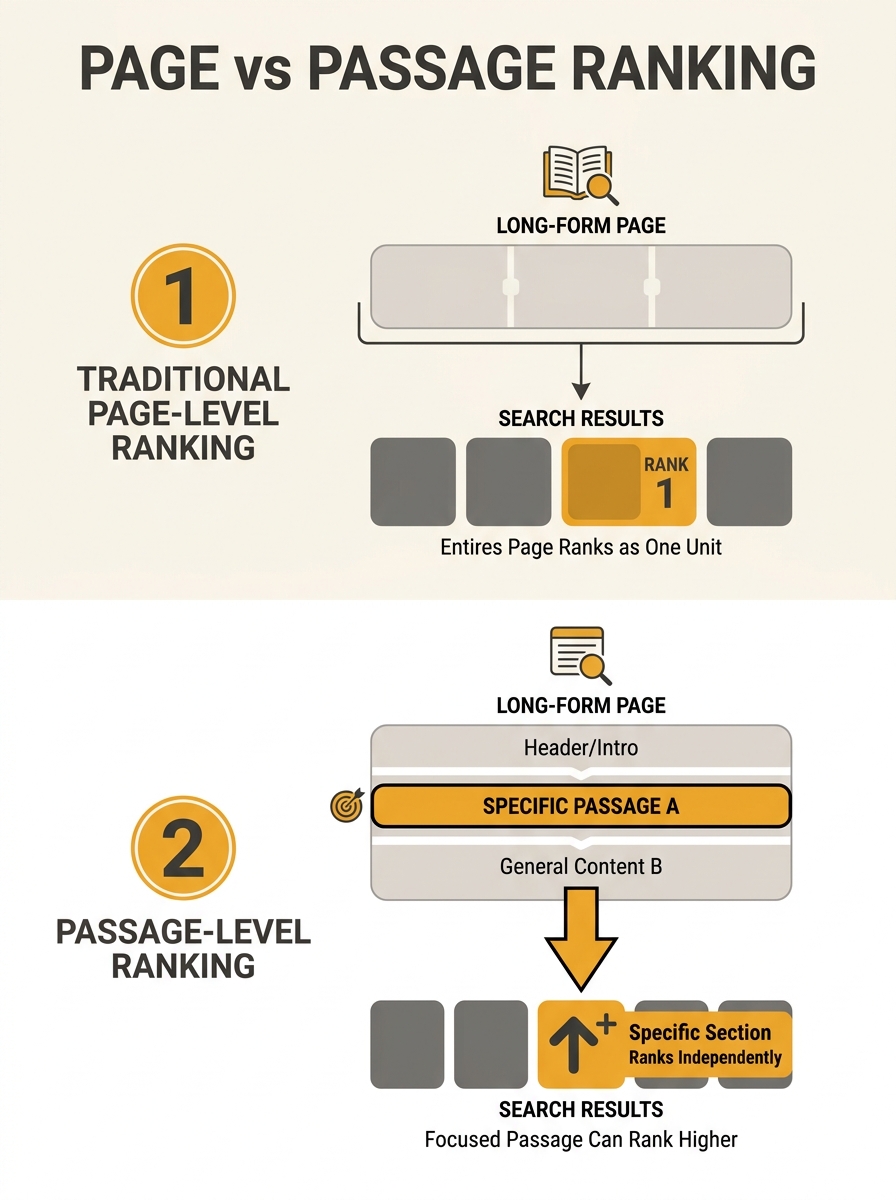
Google announced “passage indexing” in October 2020 and rolled it out in February 2021, but the name created immediate problems. As Search Engine Land reported, a Google spokesperson clarified that “Google is still indexing full pages, but Google’s systems will consider the content and meaning of passages when determining what is most relevant, versus previously we were largely looking at the page overall.” Indexing didn’t change. Ranking did.
This distinction determines what you actually optimise. If you believed Google was separately indexing passages (creating independent index entries for each section), you might conclude that each section needs its own backlink profile or its own entity signals. That’s wrong. Google still crawls and indexes the full page as one document. What changed is how the ranking algorithm evaluates relevance: it can now score a specific passage within that document against a query, independent of the page’s overall topic focus.
Danny Sullivan, Google’s Search Liaison, confirmed that passage indexing “works in tandem” with existing algorithms like BERT and link analysis. It’s an additional ranking signal layered on top of existing on-page SEO signals. Martin Splitt, Google’s developer advocate, described it as “a refinement to help content that isn’t perfectly optimised still rank for specific queries, rewarding genuinely helpful, in-depth content.”
Long-Form Pages Now Compete at the Section Level
The practical effect of passage ranking Australia site owners should understand is this: a 2,500-word guide about “renovating a Queenslander” can rank for “how to insulate a Queenslander roof” based solely on the quality of one 150-word section buried under the fourth H2. The page doesn’t need to be about insulation specifically. It needs one section that answers the insulation query clearly and completely.
This changes long-form content structure in a measurable way. Before passage ranking, long-form pages earned traffic primarily through their aggregate relevance score and domain authority. A page covering 12 subtopics would rank for its primary keyword, and perhaps a handful of related terms. After passage ranking, that same page can theoretically rank for 12 distinct queries, one per section, provided each section is structured as a standalone answer.
Content section optimisation requires that “each section should address a unique topic or subtopic that aligns with common search intents,” with headings and subheadings giving structure that makes it “easy for both users and search engines to understand the flow of information.” This aligns with the content architecture principles that strong Australian sites already follow, but passage ranking raises the stakes for each individual section.
The 7% of queries affected by passage ranking skew heavily toward long-tail, informational searches. These are exactly the queries Australian service businesses and e-commerce sites target with their guides, FAQs, and educational content. A law firm’s 4,000-word family law guide, a tradie’s renovation FAQ, an accountant’s tax explainer: these page types create the most opportunity and the most risk under passage ranking.
A page covering 12 subtopics can theoretically rank for 12 distinct queries, one per section, if each section is structured as a standalone answer.
Heading Structure Became a Ranking Input
Before passage ranking, heading tags (H1, H2, H3) served primarily as accessibility aids and light relevance signals. You could get away with vague headings like “More Information” or “What You Need to Know” because Google evaluated the page holistically. Passage ranking changed that equation. Google’s system now uses heading hierarchy to identify passage boundaries and determine what each section covers.
As Gracker’s technical SEO guide puts it: “Use heading tags (H1, H2, H3, etc.) to create a clear and logical structure. H1 should be your primary topic, with H2s as major subtopics, and H3s for more granular sections.” This guidance existed before passage ranking, but it was a recommendation. Now it functions as a requirement for visibility.
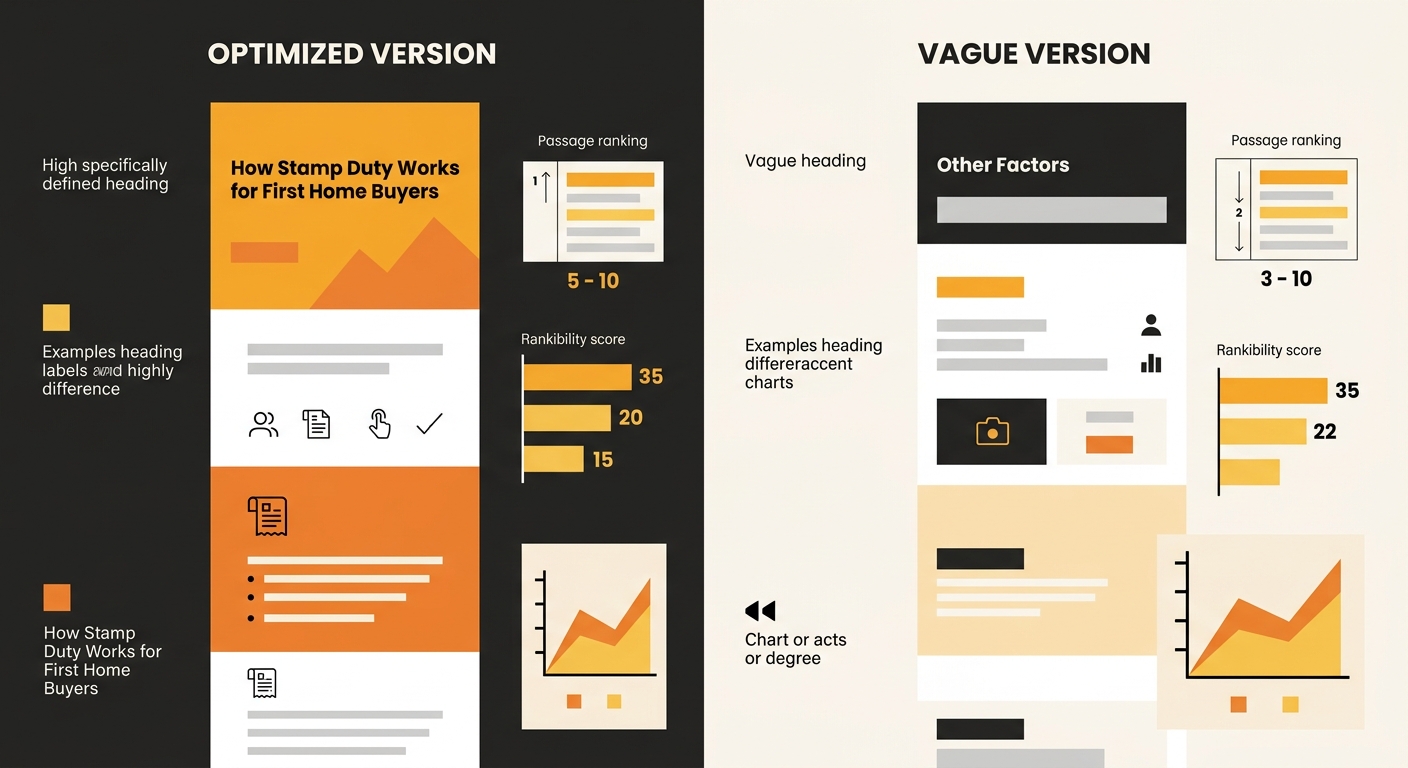
The heading acts as a label that tells Google what query the following passage should be evaluated against. An H2 that reads “Our Approach” tells Google nothing. An H2 that reads “How Stamp Duty Works for First Home Buyers in NSW” tells Google exactly which queries that passage should compete for. The heading is the passage’s primary on-page SEO signal.
Tip: Audit your existing long-form content by reading only the headings in sequence. If a reader can’t understand what each section covers from the heading alone, Google’s passage ranking system has the same problem. Every H2 and H3 should function as a self-contained descriptor.
This is where many Australian sites fall down. We’ve reviewed hundreds of long-form pages from Australian professional services firms, and the pattern is consistent: strong opening sections with specific headings, followed by a gradual descent into generic labels. The first two H2s might be clear (“What Is Capital Gains Tax on Investment Properties?” and “CGT Discount for Assets Held Over 12 Months”), but by the fifth section, the heading has degraded to “Important Considerations” or “Other Factors.” Those later sections, which often contain the most specific and valuable information, become invisible to passage ranking because Google can’t determine what they answer.
Passage Ranking and AI Overviews Share Extraction Logic
Since Google launched AI Overviews in Australia, the connection between passage ranking and generative search has become direct. AI Overviews pull content from pages at the passage level, using the same NLP understanding (BERT and SMITH models) that powers passage ranking. A page well-structured for passage ranking is, by default, well-structured for AI Overview citation.
This creates a compound return on content section optimisation. When you structure a section to rank independently via passage ranking, you simultaneously increase the probability of that section being extracted and cited in an AI Overview. Sites that have already audited their content for AI visibility will recognise this overlap. The passage is the unit of extraction for both traditional ranking and generative search.
Passage ranking is now fully integrated into Google’s Helpful Content system and E-E-A-T framework. Individual passages still contribute to the page’s total relevance score, meaning a weak section can drag down a strong one. You can’t hide thin content inside a long page and expect the algorithm to simply skip over it. Google evaluates the passage and its context within the broader document.
The Passage Independence Score
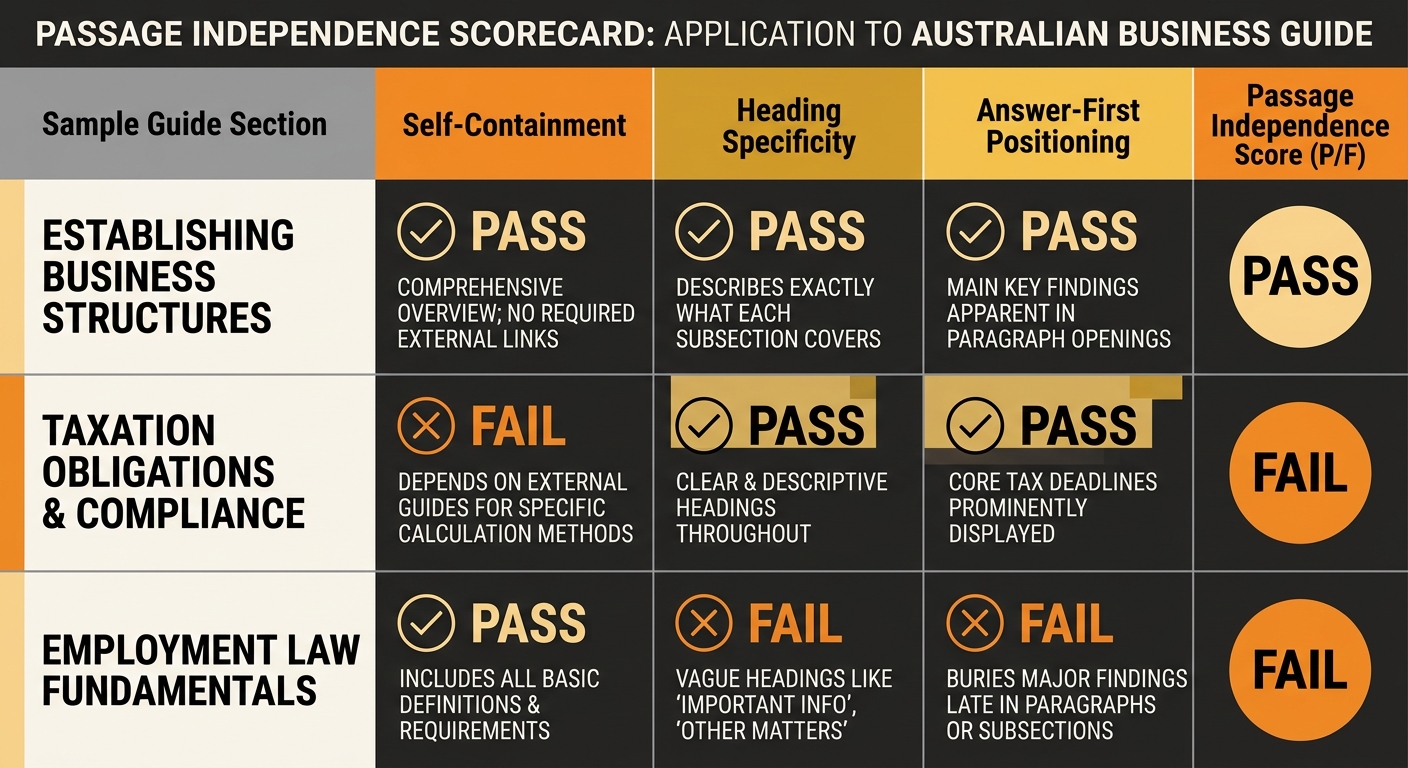
To make Google passage indexing actionable for Australian sites, we propose evaluating each section of your long-form content against three criteria we call the Passage Independence Score:
| Criterion | What It Measures | Pass Condition |
|---|---|---|
| Self-containment | Can the section answer a specific query without requiring context from surrounding sections? | A reader dropped into this section cold can extract a complete answer |
| Heading specificity | Does the H2 or H3 map to a real search query your audience types? | The heading contains the same language a searcher would use |
| Answer-first positioning | Is the key fact or answer in the first 40 to 75 words of the section? | The opening sentence directly addresses the heading’s implied question |
Score each section 0 or 1 on each criterion. A section scoring 3/3 is fully optimised for passage ranking. A section scoring 0/3 or 1/3 is invisible to it. On a typical 3,000-word Australian guide with 8 to 10 sections, we consistently see 2 to 3 sections scoring 3/3 and the remaining 5 to 7 scoring 1/3 or below. Each low-scoring section represents a lost ranking opportunity for long-tail queries.
This framework connects directly to the topical authority mapping process. Each section of a long-form page should align with a specific subtopic in your authority map. If a section doesn’t correspond to an identifiable query cluster, it either needs restructuring or it belongs in a different piece of content entirely.
The Claim, Revisited
Passage ranking didn’t introduce a new type of SEO. It changed the unit of competition from the page to the section. Every long-form page on your Australian site is now a collection of independently evaluated passages, each capable of ranking for its own set of queries, each capable of being extracted into an AI Overview, and each capable of being ignored entirely if its heading is vague and its answer is buried in the third paragraph.
The sites that benefit from passage ranking Australia-wide aren’t doing anything exotic. They write specific headings, put answers first, and ensure each section can stand alone. The sites that miss out are the ones still treating long-form content as a single document with a single target keyword. That mental model was reasonable before February 2021. It’s been wrong for five years, and rebuilding your strategy around how Google actually processes content is the adjustment most Australian businesses still haven’t made.