

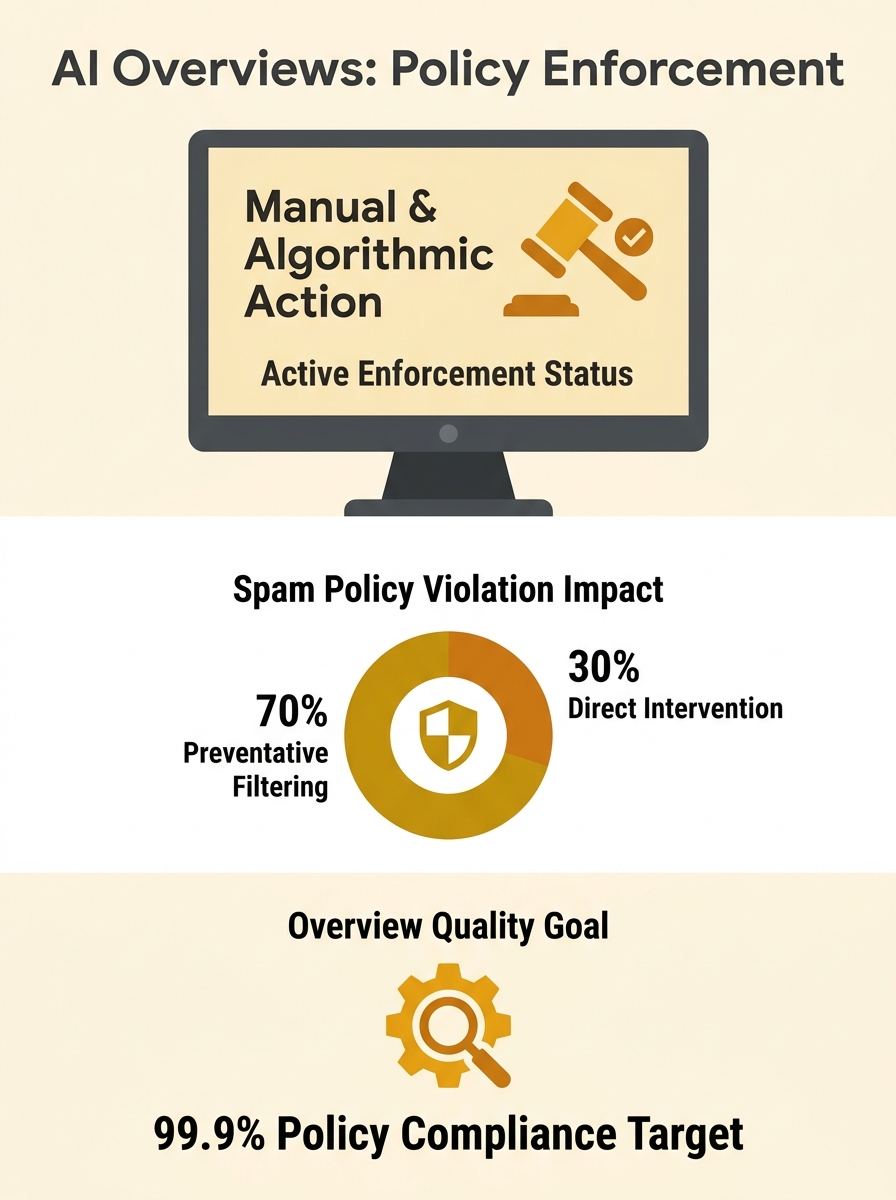
Google updated its spam policy documentation on May 15, 2026, to clarify that attempts to manipulate AI Overviews and AI Mode will be treated under the same enforcement framework as traditional search manipulation, according to Business 2 Community. Penalties for violations include ranking demotion or removal from Google Search entirely.
TL;DR: Google’s May 2026 policy update extends spam enforcement to AI Overviews and AI Mode, treating manipulation of generative search surfaces the same as traditional search abuse, with penalties including removal from Google Search.
The update extends an enforcement campaign that began with a major March 2024 policy overhaul. That earlier change introduced three new abuse categories, scaled content abuse, site reputation abuse, and expired domain abuse, and set a stated goal of reducing low-quality, unhelpful content in search results by approximately 40 percent.
The latest policy language does not classify AI-authored content as automatically spam. Instead, it brings Google’s generative search surfaces under the same policy logic already applied to web results, according to the company’s Search Central documentation. For Australian small business operators, the question shifts from whether pages rank to whether content is trusted enough to appear in AI-driven search features.
Policy Targets Intent, Not Authorship
Google’s public position on AI-generated content has remained broadly consistent since February 2023. The company evaluates content based on quality and usefulness, not the tool used to produce it, according to statements in its Search Central documentation. Violations occur when automation, including AI, is used primarily to manipulate rankings rather than serve users.
“Appropriate use of AI or automation is not against our guidelines. What is against our guidelines is using AI or automation to generate content primarily to manipulate search rankings,” Google stated in its February 2023 documentation.
The March 2024 update renamed the category of spammy auto-generated content as scaled content abuse. That classification covers mass production of pages, whether written by AI or human content farms, when the primary purpose is ranking rather than helping users.
Google also added two other categories. Site reputation abuse applies when a trusted domain hosts low-quality third-party or sponsored content to exploit its authority. Expired domain abuse targets the purchase of previously authoritative domains mainly to rank low-quality content under inherited trust.
The policy defines the issue as intent and primary purpose, not authorship. It does not explain how Google’s systems determine intent at scale or how accurately those systems separate thin automated content from useful AI-assisted work.
Enforcement Evidence Visible, 40 Percent Reduction Unverified
Google’s claim that the March 2024 changes were designed to reduce unhelpful content by about 40 percent was a company-stated goal, not an independently audited result. No peer-reviewed or third-party audited public measurement shows exactly how much low-quality content was removed.
Clear evidence that enforcement occurred exists. SEO practitioners and outlets tracking the update reported de-indexing and visibility losses for sites described as spammy, thin, or heavily dependent on scaled publishing workflows. Much of the available data comes from the SEO community rather than from Google’s own enforcement disclosures.
Lily Ray of Amsive and Michael King of iPullRank have argued that the practical target is not AI-assisted production as a category, according to industry analysis. The bigger risk is thin, scaled, low-value text that provides little beyond what a user could get from a generic AI prompt.
King has noted that even compliant sites can experience short-term ranking volatility after major updates while Google tunes its detection systems, according to his public commentary on the policy changes. That caveat reflects real uncertainty around automated classifiers and edge cases.
Small Businesses Face Greater Risk with Thin, Repetitive AI Content
The policy burden does not fall evenly. Large companies often have SEO teams, content strategists, legal reviewers, and compliance processes that can audit content portfolios and adjust quickly. Small businesses, especially sole proprietors and teams without in-house marketing staff, usually do not.
That resource gap matters because many small operators now rely on general-purpose AI writing tools such as ChatGPT, Jasper, and Google Gemini to create content at a volume they could not produce manually. Survey data shows small business owners are increasingly using AI tools to manage content production, marketing copy, and customer communication across multiple parts of the business.
That approach can improve efficiency, but it can also create the exact pattern scaled content abuse is meant to catch when content is thin, repetitive, or lightly reviewed. The distinction between useful AI-assisted content and low-quality scaled content is procedural, a local contractor using AI to draft and refine a detailed FAQ about its services operates very differently from a publisher pushing out hundreds of near-identical pages to capture long-tail searches.
Google’s policy recognizes that difference in principle, but the company has not published false-positive rates or accuracy benchmarks for the systems that enforce it. Australian small businesses using AI tools for content strategies face more risk when content lacks substantive value, clear expertise signals, or meaningful differentiation from what AI tools produce by default.
The May 2026 extension to AI Overviews and AI Mode raises the stakes because visibility in generative search surfaces now carries the same enforcement risk as traditional search manipulation. Sites that rank in web results but not in AI-driven answers may face audit scrutiny if Google’s systems flag their content as low-value or scaled.
What This Means for Australian Small
Australian small businesses using AI tools for content creation need to focus on substantive value and clear expertise signals rather than volume. The May 2026 policy update does not ban AI use, it penalizes thin, scaled content produced primarily to manipulate rankings, whether that content comes from AI or other automation.
The enforcement framework treats AI Overviews and AI Mode the same as traditional search results. That means small businesses relying on generative search visibility for leads and brand discovery now face the same spam penalties as those manipulating web rankings. The practical risk increases for businesses publishing large volumes of lightly reviewed AI content without clear differentiation or expertise.
Resource-constrained operators should prioritize quality over quantity, substantive answers over keyword coverage, and human review over unedited AI output. The policy documentation makes intent the deciding factor, but Google’s automated classifiers determine intent at scale, and those systems do not publish accuracy benchmarks or false-positive rates. The safest approach remains content that serves users first and search visibility second.