

Google deprecated seven schema types in June 2025 and ended rich result support for them in January 2026. For any Australian local business still running outdated structured data, those markup blocks do nothing. The schema markup checklist Australia businesses need today has narrowed to a specific set of types, and getting them right lifts click-through rates by 20% to 30%.
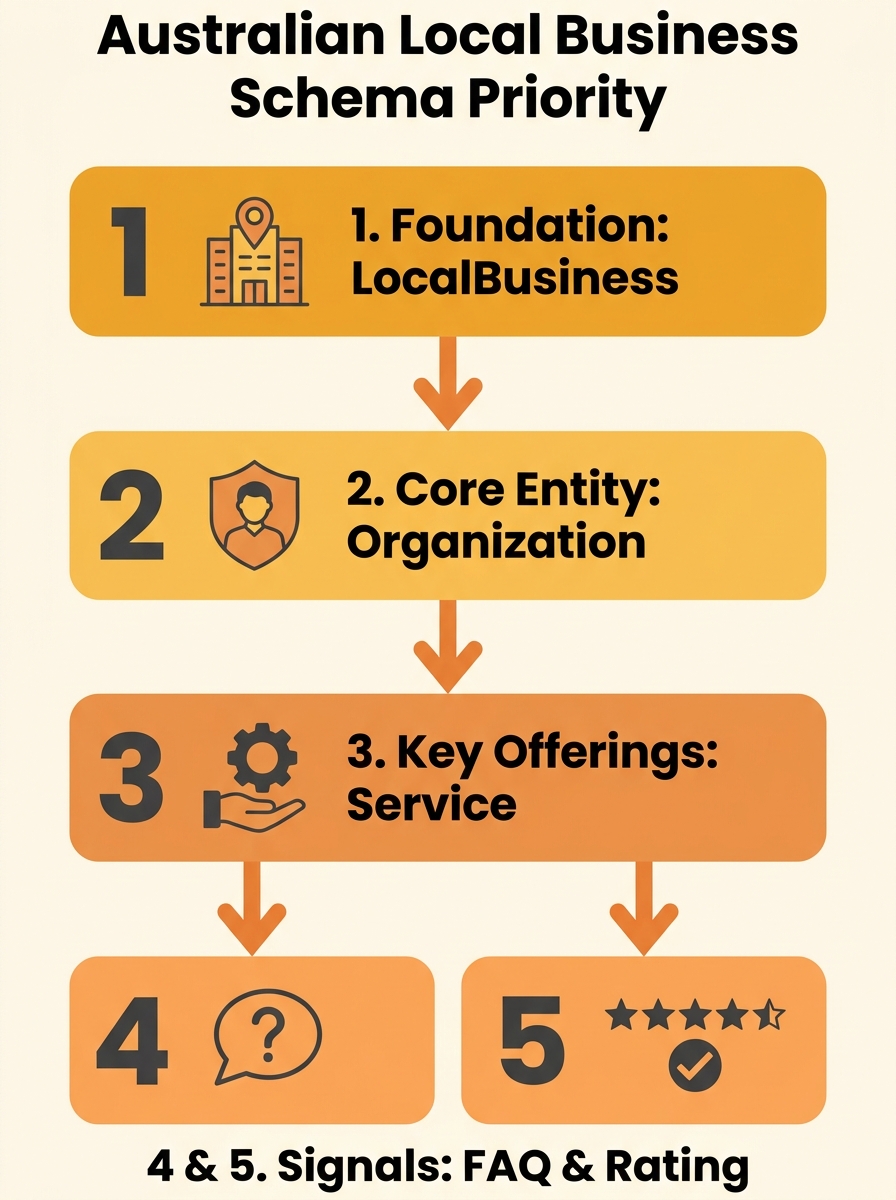
TL;DR: Five schema types matter most for Australian local businesses: LocalBusiness (with the correct subtype), Organization, Service, FAQPage, and AggregateRating. JSON-LD is Google’s only recommended format. Australian-specific fields like ABN, areaServed suburbs, and consistent NAP details separate functional markup from dead code.
Why Seven Fewer Schema Types Changes Your Priority List
Google’s June 2025 deprecation removed Book Actions, Course Info, and five other types from rich result eligibility. Businesses that built pages around those types lost their enhanced search listings when support ended in January 2026. The remaining types carry more weight now because Google has fewer categories to distribute rich results across.
For local businesses, the practical impact is clear. Pages with valid structured data that qualifies for rich results can increase click-through rates by up to 82%, according to SEO Services Australia’s markup guide. Even conservative estimates put the CTR gain at 20% to 30% for local business listings with star ratings, opening hours, or service areas displayed directly in search results.
This is where structured data implementation pays off. Google’s crawlers read your schema to decide whether your page qualifies for enhanced display. Without it, you’re competing for plain blue links against businesses showing ratings, price ranges, and hours right in the search results.
LocalBusiness Schema Needs the Right Subtype
The generic LocalBusiness type works, but it misses category-specific features. Google’s structured data documentation lists dozens of subtypes: Dentist, Plumber, Restaurant, Store, LegalService, FinancialService, and more. Each subtype unlocks fields that the generic type doesn’t support.
A plumbing business in Brisbane using the Plumber subtype can specify service areas at the suburb level. A dentist in Melbourne using the Dentist subtype gets fields for accepted insurance and medical specialties. The generic LocalBusiness type has none of these.
Temerity Digital’s local schema guide describes the value directly: “For local businesses, think trades, professional services, retail stores, medical and dental practices, this is enormously valuable,” according to their published implementation guide. Adding local schema to your homepage and contact page strengthens the signals Google’s local ranking algorithm uses for suburb-level searches. If you’ve already been fixing your local SEO fundamentals, the right schema subtype reinforces all that effort at the code level.
Required fields for any LocalBusiness subtype:
- name (exact registered business name)
- address (full street address with state and postcode)
- telephone (with +61 country code format)
- openingHoursSpecification (day-by-day hours, including public holidays)
- geo (latitude and longitude coordinates to 6 decimal places)
The Australia-Specific Fields That Generic Guides Miss
Why do most Australian business schema types underperform? Because site owners follow international guides that skip locally relevant fields. Defyn Digital’s schema implementation guide highlights one detail that matters here: “Adding your Australian Business Number (ABN) to schema markup can boost trust,” according to their published SEO strategy guide. Google doesn’t officially list ABN as a ranking factor, but it adds a verifiable 11-digit data point that crawlers and AI systems can cross-reference against the Australian Business Register.
Here’s the schema markup checklist Australia businesses should follow for local details:
- ABN field: Use the taxID property with your 11-digit ABN
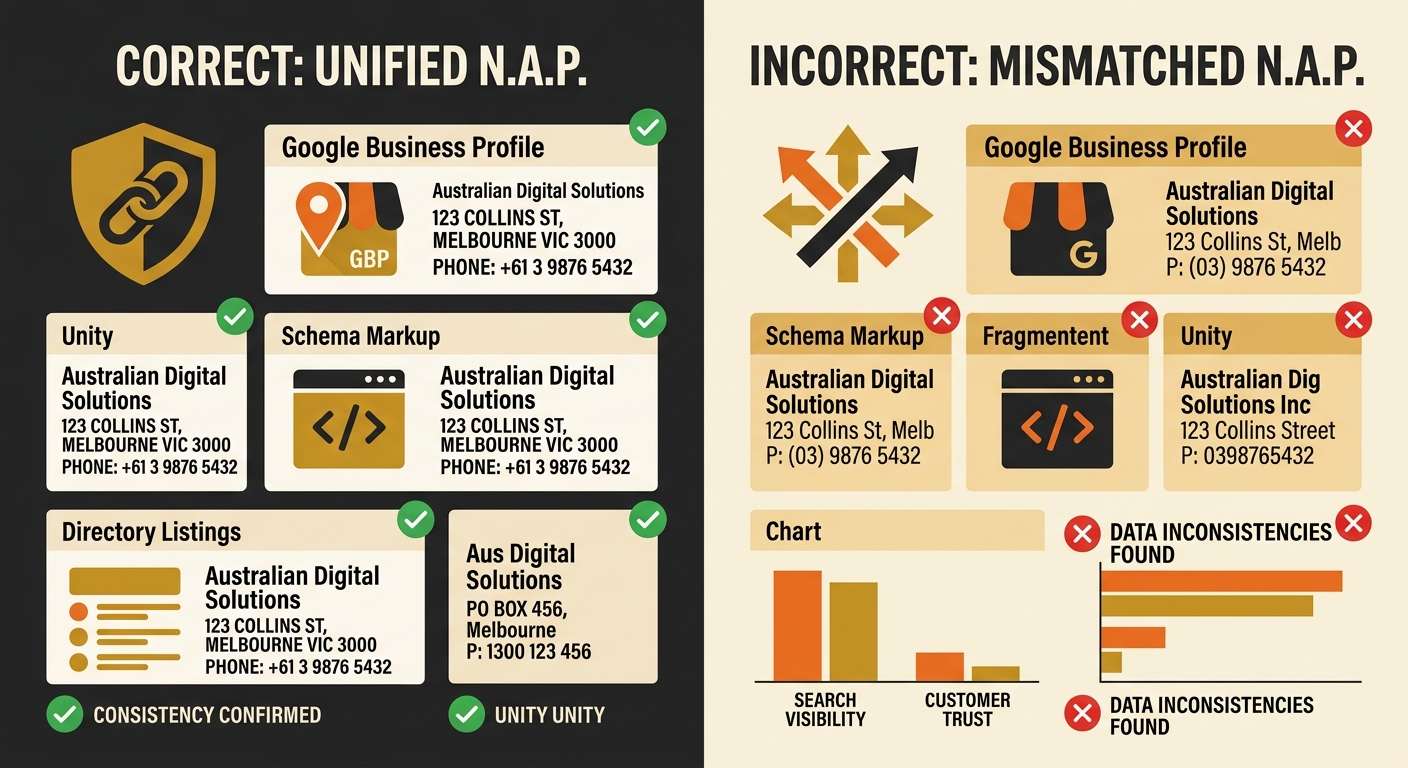
- NAP consistency: Your name, address, and phone number must be identical across your schema, your Google Business Profile, and every directory listing. One different digit in your phone number creates a conflicting signal
- areaServed: List specific suburbs and regions, not just your city. A builder in Sydney’s Northern Beaches should list Dee Why, Manly, Brookvale, and Freshwater individually
- currenciesAccepted: Set to AUD
- paymentAccepted: List actual payment methods (EFTPOS, credit card, bank transfer)
The NAP consistency point deserves extra attention. Defyn Digital’s guide stresses that Australian businesses need “accurate and consistent name, address, and phone number details” matched across the web. If your schema says one address and your Google Business Profile says another, both signals weaken each other rather than reinforcing your location.
Organization and Service Schema Work as a Pair
Organization schema sits above your LocalBusiness markup. It defines your brand identity: logo URL, social profile links, founding date, and legal name. For businesses operating across multiple locations, Organization schema acts as the parent entity that ties individual LocalBusiness entries together into a single brand.
Service schema fills the gap that LocalBusiness leaves open. Your LocalBusiness markup says who you are and where you are. Service schema says what you do. Each service gets its own block:
- serviceType: “Blocked Drain Repair” or “Tax Return Preparation,” not “Services”
- provider: Links back to your LocalBusiness entity
- areaServed: Can differ per service (you might do emergency plumbing across all of Sydney but kitchen renovations only in the Inner West)
- offers: Starting price or price range with AUD currency code
The Schema.org LocalBusiness specification shows how Service and LocalBusiness types nest together. The provider field in your Service schema should reference the same entity as your LocalBusiness block. This tells Google these are connected data points about one business, not unrelated entries on the same page.
FAQPage and AggregateRating Still Deliver Value
Google restricted FAQPage rich results in 2023, limiting the visual dropdown display to authoritative government and health sites. But the schema type still functions for entity understanding. Google reads your FAQ markup to build its knowledge graph about your business, even when it doesn’t render the FAQ snippets in search.
AggregateRating schema displays star ratings in search results. Google prefers ratings sourced from third-party review platforms over self-hosted reviews, so the best approach is marking up ratings from Google Reviews, ProductReview.com.au, or industry-specific platforms. A café with 247 Google Reviews averaging 4.6 stars gets that data shown directly in the search listing when AggregateRating schema matches Google Business Profile data.
Warning: Don’t mark up self-hosted testimonials as AggregateRating. Google’s guidelines discourage this practice, and it can trigger a manual action. Use ratings from third-party platforms that Google can independently verify.
JSON-LD Best Practices for Clean Implementation
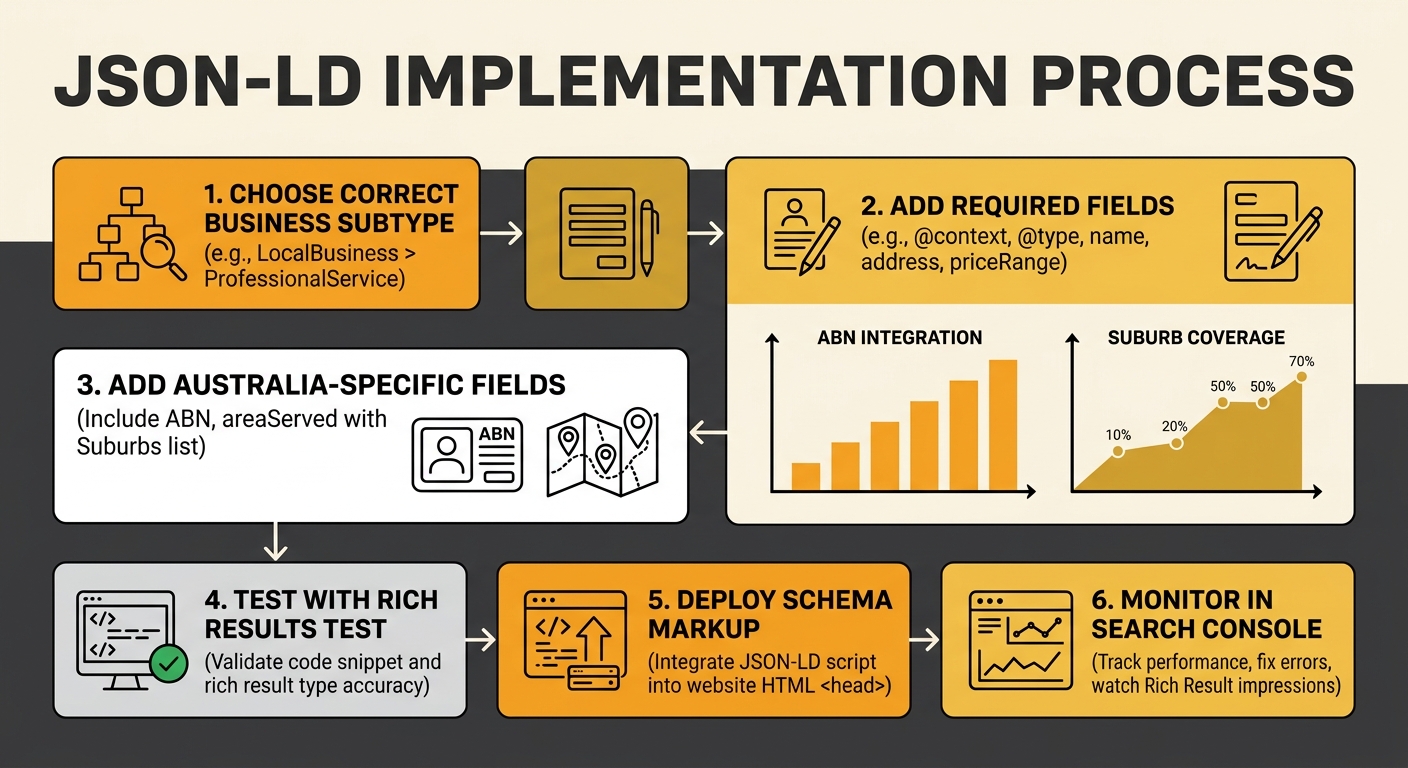
Google recommends JSON-LD as the preferred format over Microdata and RDFa. There are three formats available, but JSON-LD is the only one Google actively recommends for 2026. It sits in your page’s head section as a self-contained script block. It doesn’t interleave with your HTML, which makes it easier to update and less likely to break during site redesigns.
Yellow Pages’ business schema guide advises placing the code “within the head section or just before the closing body tag.” Both placements work, but the head section is more reliable because some page builders strip scripts from the body during rendering. If you’ve had schema that validates but doesn’t produce rich results, incorrect placement is one of the first things to check.
Three JSON-LD best practices that prevent the most common errors:
- One @context declaration per page. Multiple schema blocks should be wrapped in a single @graph array, not scattered as separate script tags with duplicate context declarations
- Test before deploying. Google’s Rich Results Test catches structural errors. Search Console’s Enhancement reports catch implementation issues that only surface after Googlebot processes the page
- Update when business details change. Oceania Marketing’s schema guide is blunt about this: “Regularly monitor your website’s performance and keep schemas up to date,” per their published SEO guidance. Schema showing old opening hours or a disconnected phone number actively works against you
Schema showing old opening hours or a disconnected phone number works against you harder than having no schema at all.
How Schema Feeds AI Search Systems
Structured data is critical for visibility in AI-powered search results. Google’s Gemini-powered AI Mode, along with systems like Perplexity and ChatGPT, reads schema markup to verify business claims and assess source credibility. A business with verified schema data (matching ABN, consistent NAP, current hours) surfaces more reliably in AI search results than one running outdated or missing markup.
The Australian business schema types covered above give AI systems three things they need: identity confirmation (who you are), service specificity (what you do), and geographic precision (where you operate). These are the same signals that drive profile accuracy for Google’s Ask Maps and other conversational search features rolling out across 2026.
What Still Isn’t Settled
Google hasn’t confirmed whether additional schema types will be deprecated this year. The seven types removed in June 2025 had low adoption rates, which suggests widely-used types like LocalBusiness and FAQPage are safe for now. But Google’s track record shows they will cut features that don’t improve search quality, regardless of adoption.
The role of schema in AI-generated answers is also evolving. Early data indicates that pages with structured data get cited more frequently in AI Overviews, but Google hasn’t published official guidance on how schema weight factors into AI citation decisions. For Australian businesses, the safest approach is treating schema as infrastructure you maintain continuously: keep it accurate, keep it current, and make sure it matches every other signal Google sees about your business. When any of those signals conflict, the whole chain of trust that search engines build around your listing starts to fray.