

Subdomain architecture fragments crawl efficiency and weakens indexation priority for enterprises managing hundreds of business locations, according to a Freeform Agency technical guide published June 7. The guide argues subdirectory structures consolidate domain authority and reduce operational overhead for multi-location SEO programs, while subdomain approaches create governance drift and require stronger internal linking discipline to compensate for dispersed crawl signals.
TL;DR: Freeform Agency published a June 7 guide arguing subdirectory architecture delivers superior crawl efficiency and simpler governance for multi-location businesses compared to subdomain structures that fragment authority across separate domain properties.
The 38-page analysis positions multi-location SEO as an infrastructure problem rather than a content optimization exercise, citing distributed ownership and weak governance as the primary failure points when brands scale beyond regional operations. Freeform Agency, which has worked on marketing automation and AI-driven production workflows since 2013, framed the subdirectory-versus-subdomain decision as a technical constraint on search engine discovery rather than a formatting preference.
Scale Economics Drive Infrastructure Decisions
Multi-location brands improved average Google 3-pack presence for competitive keywords from 23.8 percent in 2022 to 33.4 percent in 2024, according to SOCi local SEO statistics cited in the guide. Enterprises with fully optimized Google Business Profiles reached 65.7 percent 3-pack visibility during the same period, indicating infrastructure choices directly affect market-by-market discoverability.
The guide identified manual task execution as a structural bottleneck once location counts exceed regional scale. Each location requires individual page deployment, schema markup, Google Business Profile updates, review responses, local content inputs, and citation monitoring. Generic playbooks underestimate operational burden at multi-hundred-location scale, the report noted.
Freeform’s analysis outlined subdirectory architecture as the default recommendation for most enterprises based on crawl efficiency, indexation priority, and link equity flow. Subdirectory structures (domain.com/locations/city/) keep location pages within one primary site structure, making it simpler to inherit global templates, shared schema components, and centralized analytics patterns. Subdomain structures (city.domain.com) can work when business units operate semi-independently or when regional teams need separate deployment controls, but they create additional overhead for SEO governance and require deliberate internal linking support to prevent weaker subdomains from being neglected by search engine crawlers.
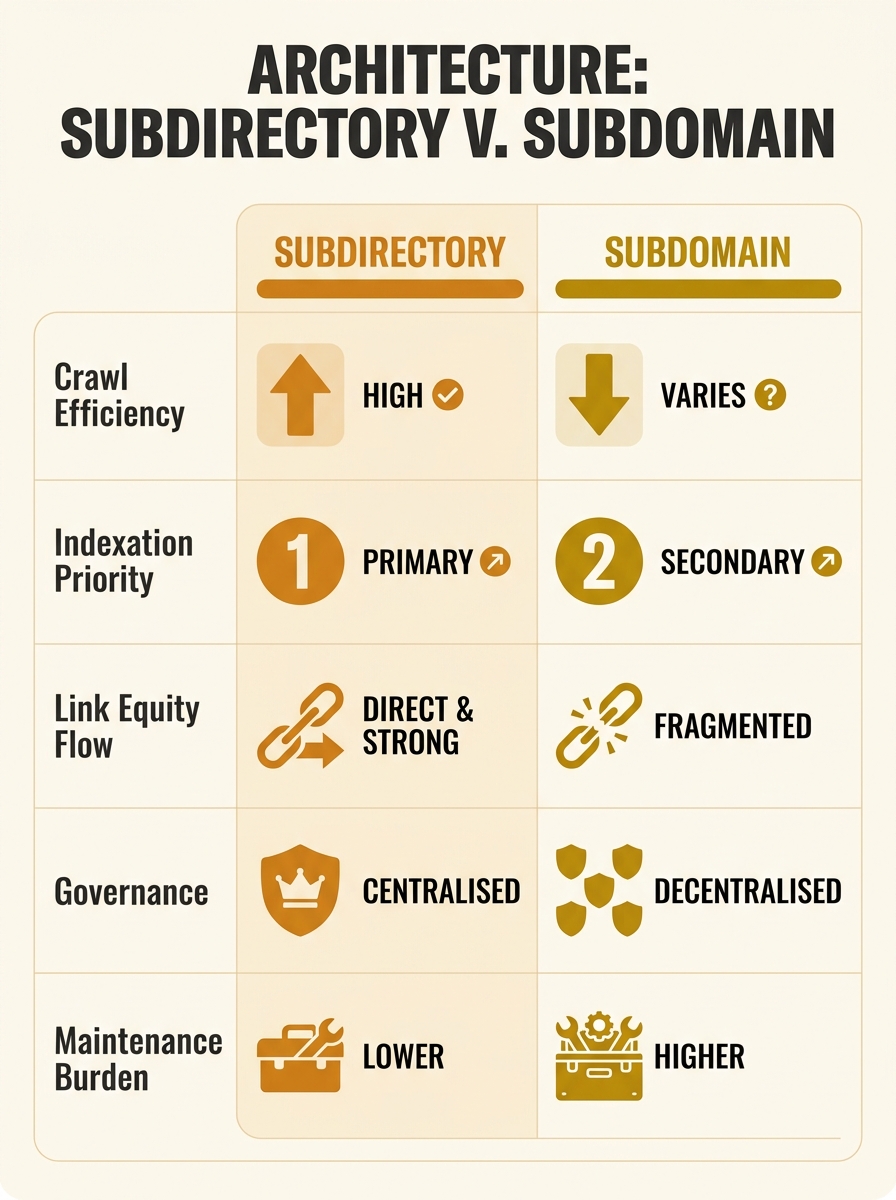
The guide’s comparison framework evaluated six technical considerations: crawl efficiency (subdirectories usually stronger because locations sit within one site structure), indexation priority (easier to reinforce through one domain-level architecture), link equity flow (more direct across corporate and location pages), governance (central teams can standardize templates more easily), compliance operations (simpler when one web stack supports consistent controls), and maintenance burden (lower for shared components and sitewide changes).
Fragmentation Costs Enterprises Visibility Market by Market
The first failure point identified by Freeform occurs when ownership is distributed across teams without centralized standards. One team owns the website, another manages Google Business Profiles, a third controls analytics, and regional staff edit listings directly. The same business can present different hours, categories, phone numbers, and service descriptions across the web when no single team owns the full system.
The guide cited 6S Marketers’ research on local SEO for multiple locations, noting the subdirectory-versus-subdomain choice directly affects crawl efficiency and indexation priority at scale. CTOs typically weigh architecture through internal constraints—CMS flexibility, hosting boundaries, regional governance, release workflows, security policy—but those constraints need balancing against search behavior, the report argued.
Subdomain approaches fragment crawl signals when internal linking and discovery support are weak. Subdirectories inherit domain-level authority more directly, reducing the amount of active linking work required to maintain indexation parity across location pages. For enterprises managing location inventories in the hundreds or thousands, that distinction translates to measurably different crawl budget allocation and index coverage rates.
The analysis positioned content architecture as a technical SEO foundation rather than a post-launch optimization layer. Infrastructure choices determine how search engines discover, prioritize, and understand location inventory—and how much operational overhead teams carry for years after initial deployment.
Governance Determines Consistency Across Location Networks
Freeform’s framework elevated governance to equal standing with technical architecture. Without a centralized system of record, local data drifts as regional teams make uncoordinated edits. Marketing teams want visibility, IT teams want maintainable systems, compliance teams want auditability, local operators want control, and search engines want clear, unique, trustworthy signals.
The guide argued AI-driven production changes the speed of location page rollout, the cost of profile maintenance, and the ability to enforce standards repeatedly across a network. Modern operating models reduce labor intensity, update latency, and per-location costs compared to traditional agency workflows, enabling faster page generation, more efficient profile management, stronger quality assurance, and fewer manual bottlenecks between strategy and deployment.
Automated systems become mandatory rather than optional once manual publishing cycles cannot keep pace with location-level changes. Enterprises that rely exclusively on human task execution face structural disadvantages in crawl budget efficiency and index freshness when competitors deploy automated quality checks and bulk update workflows.
The report noted compliance requirements change how regulated businesses measure and report local SEO performance. Analytics cannot operate as an ungoverned free-for-all when data stewardship obligations apply across the location network.
Why This Matters Now
Australian businesses managing multiple retail, service, or franchise locations face the same infrastructure trade-offs outlined in the Freeform guide. The subdirectory-versus-subdomain decision shapes crawl behavior, indexation outcomes, and operational overhead for years after initial deployment. Enterprises that default to subdomain structures without evaluating crawl efficiency and governance costs often discover fragmentation problems only after visibility gaps appear market by market.
The SOCi statistics—23.8 percent to 33.4 percent 3-pack improvement over two years, 65.7 percent visibility for optimized profiles—demonstrate infrastructure quality directly affects local search performance at scale. For Australian SMBs evaluating expansion into new regions or consolidating fragmented location properties, subdirectory architecture reduces the technical debt associated with distributed authority and simplifies the enforcement of consistent schema, content templates, and profile data across the network.
The shift toward AI-driven location page production and automated profile management creates competitive separation between businesses that can enforce standards repeatedly and those still relying on manual market-by-market execution. Australian enterprises building or rebuilding multi-location footprints should evaluate governance models and content production workflows alongside architectural choices—weak governance costs businesses discoverability even when local demand is strong.