

Aleyda Solis analyzed SISTRIX visibility data for Google’s May core update between May 26 and June 2 and found sites matching a query’s intent, market, and result type gained visibility while sites a step removed from that fit lost ground, according to research published today by Search Engine Journal. The analysis tracked US and UK domains through the final days of the rollout, which Google confirmed complete on June 2.
TL;DR: Google’s May core update favored sites fitting query intent and market over raw authority; local UK domains gained while global .com equivalents fell, and category-level analysis missed the nuance.
Some high-authority domains experienced visibility drops during the update period. The analysis showed nytimes.com and nih.gov both declined despite their established domain authority. Original sources gained while third-party platforms dipped—cambridge.org rose 40.9% in the UK index while pronunciation tool youglish.com fell 69.6%, Solis reported. The education category didn’t win or lose as a whole; what mattered was which source type fit each query.
Authority Alone Didn’t Explain Movements
Sites with established domain authority saw divergent outcomes depending on how closely they matched query intent. The pattern Solis described suggests the update acted as a reset where the destination type matters more than raw authority signals for each query. Authority still plays a role, she noted, but by itself doesn’t fully explain who benefits and who loses.
The data came from one tool measuring two markets at the tail of the rollout. Other datasets and regions may show different patterns, Solis cautioned. Google’s core update documentation recommends waiting at least a week after a core update completes before drawing conclusions from Search Console data, which puts the earliest clean read around June 9.
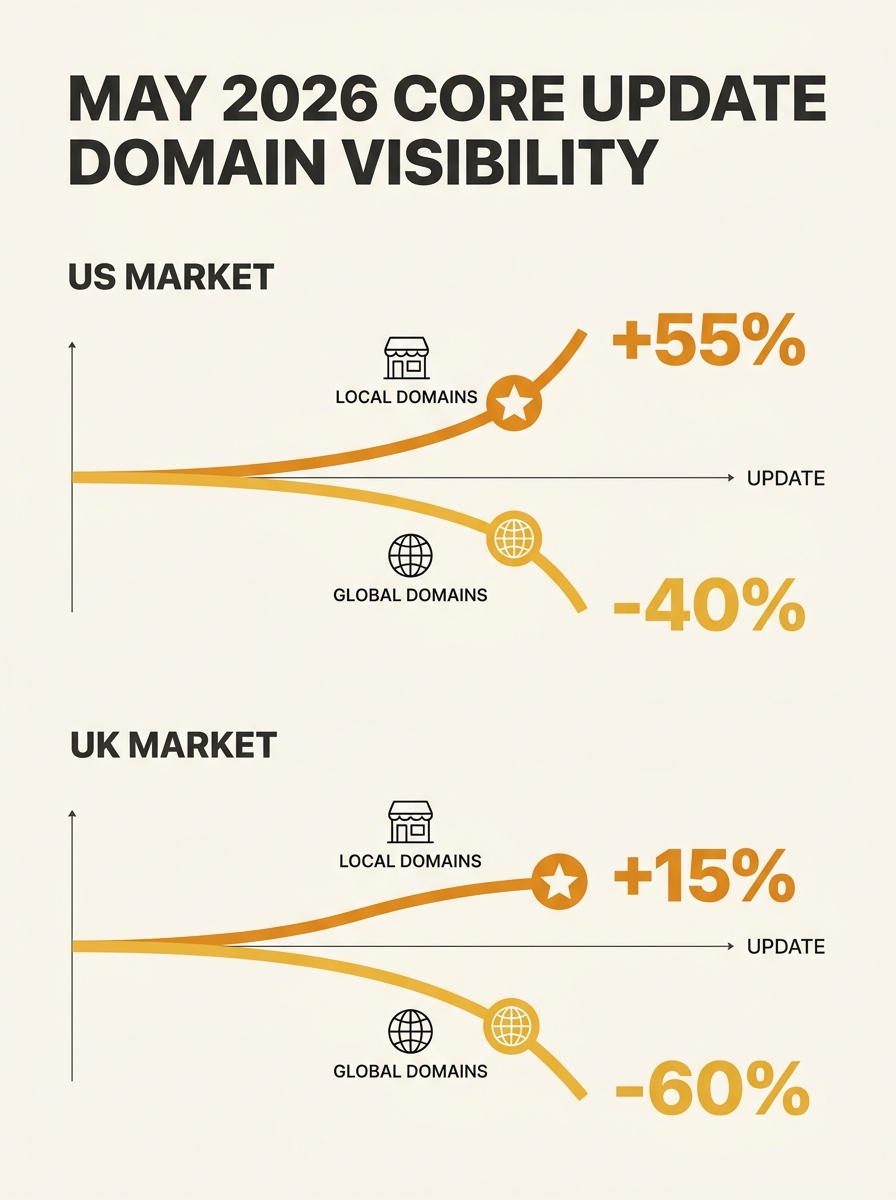
Local Domains Gained Ground in UK Index
UK-specific domains outperformed their global .com equivalents in the UK index while the same .com domains held roughly flat in the US. Amazon.co.uk rose 21.3% for UK users while amazon.com fell 54.6% in the same market. In the US index, .com domains maintained stable visibility, Solis found.
The pattern aligns with earlier work from Solis analyzing AI search clicks across ten markets, which found most clicks going to local domains rather than global defaults. “International sites should check for wrong-market ranking and weak country-specific signals,” she said in her analysis.
Category-Level Analysis Missed the Pattern
The data doesn’t support reading any whole category as a winner or loser. Forums and Q&A sites pulled back—reddit.com dropped 23.8% in the UK—but larger social and video platforms held flat to positive. Big marketplaces including trip.com and indeed.com gained, contradicting any simple “aggregators lost” narrative.
Solis noted the forum pullback could represent a durable correction or end-of-rollout volatility. Different tools measure visibility in different ways and can rank the same domains differently, making this one early signal rather than a settled picture.
For each query that matters, Solis suggests checking which result type gained after the update, then confirming your page is that type and not “a weaker echo of a source that already owns it.” The approach treats intent matching as a query-by-query exercise rather than a site-wide positioning question. Australian businesses reviewing E-E-A-T signals should layer in this result-type analysis when diagnosing visibility shifts.
Context and Outlook
Google’s May core update continues a trend Solis identified in the March 2024 core update, which she described as a move toward stronger default destinations for each query type. Australian SMEs treating authority as a monolithic ranking factor may need to audit whether their pages match the result type Google now prefers for their target queries—not just whether they demonstrate topical expertise.
The earliest reliable Search Console comparison data won’t arrive until June 9, giving Australian businesses a week to map which of their ranking pages fit the preferred result type for each query and which represent a weaker alternative to a primary source. Sites that built content marketing strategies around becoming the “authoritative aggregator” for a topic may need to pivot toward owning a narrower result type if Google’s preference for original sources and market-specific domains holds through the next core update cycle.
The SISTRIX data tracked only US and UK markets. Australian businesses should treat these findings as directional until local visibility data confirms whether the intent-over-authority pattern applies in .au results.